-
 Anthropic Claude Fable 5.1, Claude Mythos 5.1 Models Announced for Advanced Coding, Scientific Research3 September 2026
 -
Anthropic’s Claude Closes 85 Percent of AI Safety Gap in Automated Research Test31 August 2026
-
Anthropic Faces Lawsuit From Sony Music, Warner Chappell Over Alleged Copyrighted Material Use31 August 2026
-
How to Use Claude to Automatically Reply to Emails in Gmail: A Step-by-Step Guide30 August 2026
-
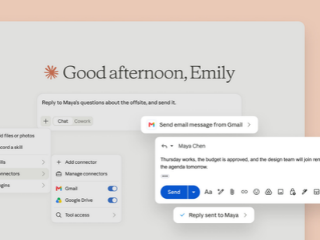
Claude Can Now Take Greater Control Over Gmail, Google Drive With Updated Google Workspace Connectors20 August 2026
Anthropic Adds Hidden Watermarks to Claude AI Text to Help Identify AI-Generated Content
Anthropic says the watermark will not be a definitive AI detector and should not be treated as such.
Written by Shaurya Tomer, Edited by Ketan Pratap | Updated: 12 August 2026 08:58 IST

Photo Credit: Anthropic
The watermarking system is being introduced in markets where supported Claude models are available
Click Here to Add Gadgets360 As A Trusted Source

Advertisement
Anthropic on Tuesday announced that it is adding invisible watermarks to text generated by its artificial intelligence (AI) models. According to the company, the content will have a hidden signal that remains even when it is copied and pasted elsewhere. The move builds upon Anthropic's decision to sign the European Union's AI Act Article 50(2) Code of Practice on Transparency of AI-Generated Content. Anthropic says Claude models launched from August 2, 2026, will support the marking system from day one, and the feature is rolling out globally.
Invisible Watermarks in Claude
Anthropic updated its support page to reveal a list of commitments it is putting into practice, in line with the EU AI Act's Article 50(2) Code of Practice on Transparency of AI-Generated Content, which it has signed as a provider of both generative AI models and generative AI systems.
- Anthropic expanding Claude voice mode with Opus, Sonnet
- Anthropic launched 13 free AI courses along with certification.
- Anthropic Expanding Mythos Access to India Feels Like a Big Deal
- Anthropic’s Claude Mythos Preview is scary!
- Anthropic is offering twice the usage of Claude for the next two weeks. Good time to jump ship from ChatGPT/Gemini for s
As per the company, the watermark will be embedded within text generated by supporting Claude models. It has been designed to travel with the text when copied and pasted elsewhere, and can also survive some level of editing. While how the detection system will work is still being finalised, Anthropic eventually aims to provide users and third parties with tools to detect the embedded watermarks.
Anthropic, however, emphasised that it will be imperceptible to users. Further, the addition of a watermark will not affect the meaning, quality or readability of the response. The process is claimed to be carried out at the model level and is not tied to a particular Claude product or interface.
The company also claims that the watermark will not be a definitive AI detector, and should not be treated as such. “Detecting a Claude mark tells you that the content may have been processed by Claude. It does not, on its own, confirm the full provenance of the content,” the support page reads.
Citing an example, Anthropic said a user could write an article themselves and then use Claude to either proofread, translate, summarise, or change its formatting. Even then, there is a chance that the result could carry a Claude watermark, despite the initial idea and writing originating from the user.
Meanwhile, the opposite is also likely; a missing watermark may not prove that content was not generated or processed by AI. Heavy editing, paraphrasing, translation, combining Claude output with other writing, or using a very short passage could make the mark undetectable, the company said.
The new watermarking system is said to cover supported Claude models across Claude, Claude Platform (API), Claude Code, Claude Cowork and Claude Tag. Such watermarks will also be applied when supported models are accessed through cloud platforms including AWS, Google Cloud and Microsoft Foundry, where supported.
Anthropic will use digitally signed provenance metadata for supported file types like SVG, PNG, and JPG, based on the Coalition for Content Provenance and Authenticity (C2PA) standard. This metadata will indicate if a file has been processed by Claude, and whether the provenance information has been tampered with.
The watermarking system is being introduced in markets where supported Claude models are available.
Comments
Get your daily dose of tech news, reviews, and insights, in under 80 characters on Gadgets 360 Turbo. Connect with fellow tech lovers on our Forum. Follow us on X, Facebook, WhatsApp, Threads and Google News for instant updates. Catch all the action on our YouTube channel.
Related Stories





Advertisement
Follow Us




-
![[Sponsored] Samsung Galaxy Z Fold8, Fold8 Ultra](https://www.gadgets360.com/static/desktop/images/spacer.png)
00:21
[Sponsored] Samsung Galaxy Z Fold8, Fold8 Ultra -
03:41
[Sponsored] Samsung Galaxy Z Fold8: How It Fits Into an Actor’s Busy Day | Camera, Multitasking & More -
09:53
iPhone 18 Goes On Sale In India: Huge Crowds, Long Queues At Apple Stores -
06:32
Google Pixel 11 Pro XL Review: The Most Exciting Pixel Yet? | 120X Zoom + Tensor G6 -
05:20
Samsung Galaxy Watch Ultra 2 Review: Is This the Best Android Smartwatch?
-
Amazon Great Indian Festival: सेल से पहले 6 मोबाइल पर Early Bird Deals
-
Vivo Y600i हुआ लॉन्च; 8000mAh बैटरी और ड्रॉप प्रोटेक्शन के साथ आया फोन
-
लैपटॉप की बैटरी हेल्थ ऐसे करें चेक, नहीं होगा नुकसान
-
Oppo Find X10, Find X10 Pro Max के इंटरनेशनल मार्केट में लॉन्च की तैयारी
-
iQOO Pad Ultra में 9020mAh बैटरी कंफर्म, प्री-ऑर्डर भी शुरू
Advertisement
Popular on Gadgets
- Samsung Galaxy S26 Ultra
- Motorola Razr Fold
- ChatGPT
- OPPO Find N6
- Mobiles Under Rs. 40,000
- Vivo X300 Ultra
- Asus Zenbook S14
- iQOO 15
- Vivo X300 Pro
- Lenovo Yoga Slim 7i Aura Edition
- iQOO 15R
- Vivo X Fold 5
- Sony PlayStation 5
- HP OmniPad 12
- OnePlus Nord CE 6 Lite
- OnePlus Pad 4
- OPPO F33 Pro 5G
- Cryptocurrency
- HP OmniBook Ultra 14 (2026)
- iPhone 17
- Eureka Forbes AP 355 Room Air Purifier
- Latest Mobile Phones
- Compare Phones
Latest Gadgets
- Vivo Y600i
- Mivi One 5G
- Xiaomi 18 Pro Max
- Motorola Signature 27
- OPPO Find X10 E
- OnePlus N6 Lite 4G
- Ai+ Nova 2 Power 5G
- Lava Virat Curve 5G
- Microsoft Surface Laptop, 13-inch (2nd Edition)
- Lenovo LOQ 15AHP11
- Microsoft Surface Pro, 12-inch (2nd Edition)
- Xiaomi Pad 9 Pro
- Amazfit T-Rex Dual Solar
- OPPO Watch S2
- Haier M70 Mini LED 65-inch
- Xiaomi TV FX Mini LED 65
- Acer Predator Atlas 8
- Asus ROG Ally
- Blue Star 1.5 Ton 5 Star Inverter Split AC (IE518ZNURS)
- Blue Star 2 Ton 3 Star Inverter Window AC (WIE324L)

- About Us
- Sitemaps
- Feedback
- Archives
- Contact Us
- RSS
- Advertise
- Career
- Privacy Policy
- Ethics
- Editorial Policy
- Terms & Conditions
- Complaint Redressal
Download Our Apps
Available in Hindi
© Copyright Red Pixels Ventures Limited 2026. All rights reserved.