-
 Google Rolls Out SynthID Detector Globally for AI-Generated Images, Videos and Audio8 October 2026
 -
Google Brings C2PA to Gemini App, OpenAI Adds SynthID to AI Images as Industry Pushes for Transparency20 May 2026
-
Google Brings SynthID-Powered Deepfake AI Video Detection Tool to Gemini App19 December 2025
-
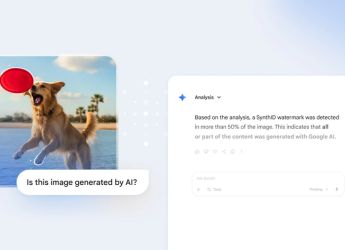
Google Now Lets You Ask Gemini if an Image Was Created Using AI: How to Use21 November 2025
-
Google Announces SynthID Detector That Can Identify Gemini-Generated Content at Google I/O 202521 May 2025
Google’s SynthID AI Watermarking Tech Claimed to Be Reverse-Engineered
The developer, Aloshdenny, has publicly released his work, highlighting how he was able to reverse-engineer SynthID.
Written by Akash Dutta, Edited by Ketan Pratap | Updated: 15 April 2026 17:18 IST

Photo Credit: Google
Google has reportedly denied the claims that SynthID can be removed from content
Click Here to Add Gadgets360 As A Trusted Source

Advertisement
In the world of artificial intelligence (AI) detection, Google's SynthID stands out. First previewed in 2023, it is a watermarking technology that adds an invisible and imperceptible layer of watermark into the content, including text, images, videos, and audio. The Mountain View-based tech giant claims that SynthID cannot be removed, but a developer is now claiming that he was not only able to reverse engineer the watermarking tech, but also distort it to the level that it confuses systems detecting AI content.
Can Google's SynthID Be Removed?
The short answer is no. At least not entirely. But if the claims of developer Aloshdenny are to be believed, the watermarking technology is not the impenetrable wall Google claims it to be. The interesting thing to note here is that the entire process did not involve breaking into Google's watermarking models or manipulating encoders or decoders.
In a Medium post, the developer explained that he was able to detect the pattern of SynthID using 100 plain white and 100 plain black images generated by the tech giant's Nano Banana model. Alongside, he also used 1,23,268 pairs of original and AI-edited images via the same model.
The developer then enhanced the contrast of the black and white images, followed by increasing the saturation and denoising them. The idea behind it was that on a pure black Nano Banana image, every non-zero pixel value should represent the watermark. However, just observing it is not enough since Google's encoders use a randomness factor, meaning every image has a potentially unique positioning of the SynthID.
Once reverse engineering was complete, the developer then attempted to remove the watermark. However, he found that to be incredibly tricky and acknowledged that Google's implementation was solid enough that removing the pattern without distorting the image was not possible. However, he devises a technique to confuse the decoder enough so that it cannot determine with confidence if an image has the watermark or not.
Aloshdenny has made his work publicly available on GitHub so that others can review the process and verify the same. A Google spokesperson told The Verge that the claims that SynthID is removable are not true, and the technology remains an effective way to label and detect content generated using Gemini and other Google AI models.
Comments
Get your daily dose of tech news, reviews, and insights, in under 80 characters on Gadgets 360 Turbo. Connect with fellow tech lovers on our Forum. Follow us on X, Facebook, WhatsApp, Threads and Google News for instant updates. Catch all the action on our YouTube channel.
Related Stories




Advertisement
Follow Us




-
![[Sponsored] LG NANO 4K UHD AI TV NU885: Gemini Search, Dolby Atmos & 5 Years of Updates](https://www.gadgets360.com/static/desktop/images/spacer.png)
04:17
[Sponsored] LG NANO 4K UHD AI TV NU885: Gemini Search, Dolby Atmos & 5 Years of Updates -
00:57
[Sponsored] Samsung Galaxy Z Fold8 My Fan Cam in Action: Find the Moment, Then Share It -
01:41
[Sponsored] What Do You Need To Know Before Your Next Run? | Samsung Galaxy Watch Ultra2 -
01:32
[Sponsored] Big Day Tomorrow? Prep Today | Samsung Galaxy Watch Ultra2 -
04:37
[Sponsored]: CP PLUS CarKam CP-F89B: 4K Dashcam With Rear Camera, GPS & Emergency Recording
-
आ गई हवा में उड़ने वाली Tesla Roadster कार, आखिर सच हुआ फिल्मों वाला कमाल
-
रोबोट ने की लड़की से छेड़छाड़, पीछे से पकड़ा और किए गंदे इशारे, जानें
-
PS5 कहां मिलेगा सस्ता, Flipkart या Amazon, जानें सबकुछ
-
दिवाली पर नया टू-व्हीलर खरीदने का प्लान? 1 लाख से भी कम में मिल रहे ये 5 EV, रेंज 179 किमी तक
-
Oppo के वाइड फोल्डिंग स्मार्टफोन में मिल सकता है 6.35 इंच आउटर डिस्प्ले
Advertisement
Popular on Gadgets
- Samsung Galaxy S26 Ultra
- Motorola Razr Fold
- ChatGPT
- OPPO Find N6
- Mobiles Under Rs. 40,000
- Vivo X300 Ultra
- Asus Zenbook S14
- iQOO 15
- Vivo X300 Pro
- Lenovo Yoga Slim 7i Aura Edition
- iQOO 15R
- Vivo X Fold 5
- Sony PlayStation 5
- HP OmniPad 12
- OnePlus Nord CE 6 Lite
- OnePlus Pad 4
- OPPO F33 Pro 5G
- Cryptocurrency
- HP OmniBook Ultra 14 (2026)
- iPhone 17
- Eureka Forbes AP 355 Room Air Purifier
- Latest Mobile Phones
- Compare Phones
Latest Gadgets
- Tecno Spark 50S 5G
- Vivo Y600s Pro
- Vivo Y32 (2026)
- Infinix Smart 20 HD
- Vivo V80
- Vivo S2 FE
- Vivo Y600K Turbo
- Realme P4s Lite
- HP ZBook Ultra G3a
- Dell Pro Rugged 14
- Amazon Alexa Tablet 8
- Amazon Alexa Tablet 11
- Amazfit T-Rex Dual Solar
- OPPO Watch S2
- Toshiba 65-Inch 4K Ultra HD Smart Mini LED QLED TV (65Z670SP)
- Haier M70 Mini LED 65-inch
- Acer Predator Atlas 8
- Asus ROG Ally
- Blue Star 1.5 Ton 5 Star Inverter Split AC (IE518ZNURS)
- Blue Star 2 Ton 3 Star Inverter Window AC (WIE324L)

- About Us
- Sitemaps
- Feedback
- Archives
- Contact Us
- RSS
- Advertise
- Career
- Privacy Policy
- Ethics
- Editorial Policy
- Terms & Conditions
- Complaint Redressal
Download Our Apps
Available in Hindi
© Copyright Red Pixels Ventures Limited 2026. All rights reserved.