
-
 Nvidia's DLSS 5 Graphics Upscaler Launches in NBA 2K27 This Week Amidst 'AI Slop' Backlash2 September 2026
 -
Nvidia’s New DLSS 4.5 Update Brings AI-Powered 6X Multi-Frame Generation Feature1 April 2026
-
Nvidia Unveils DLSS 5 Graphics Upscaler, Issues Clarification After Backlash Over 'AI Slop Filter'17 March 2026
- Home
- Games
- Games Features
- From Online Trolling to CEO’s Defense, DLSS 5 Unveiling Draws Heat: Five Things to Know
From Online Trolling to CEO’s Defense, DLSS 5 Unveiling Draws Heat: Five Things to Know
Nvidia’s DLSS 5 brings a real-time neural rendering model that is said to add photoreal graphics to game visuals.
Written by Akash Dutta, Edited by Ketan Pratap | Updated: 19 March 2026 11:48 IST
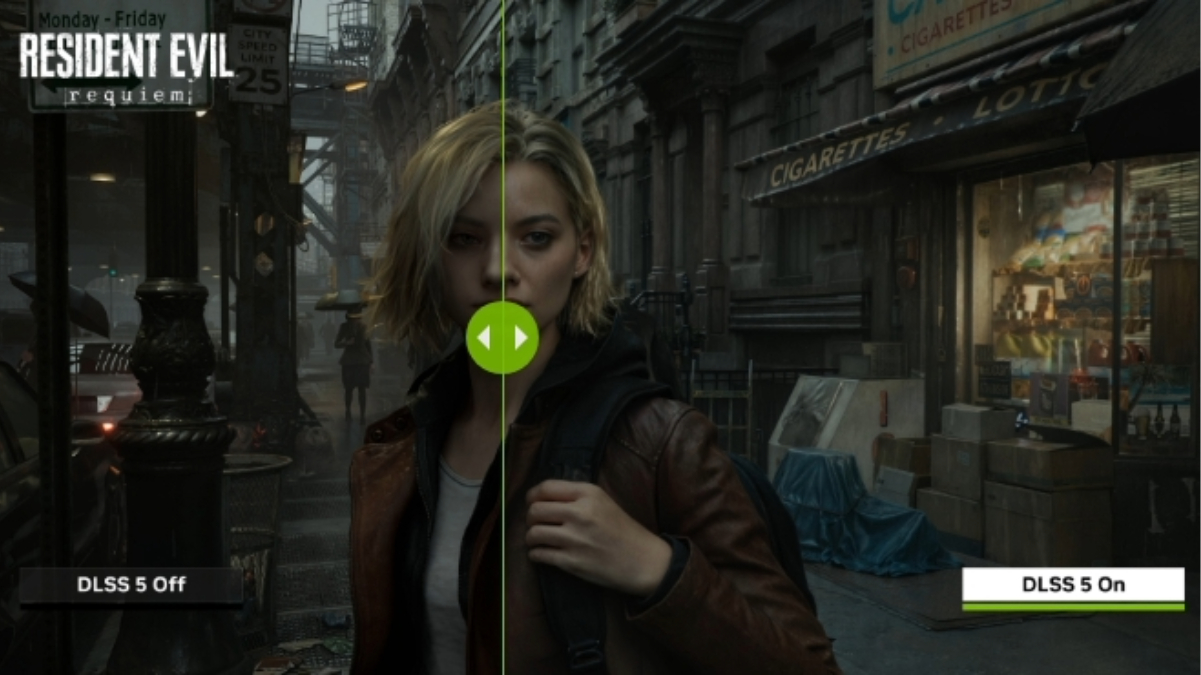
Photo Credit: Nvidia
Nvidia said DLSS 5 will be available later this year
Click Here to Add Gadgets360 As A Trusted Source

Advertisement
Nvidia's Deep Learning Super Sampling or DLSS branding has, for years, stood for one thing in PC gaming: squeezing more performance out of demanding games with the help of artificial intelligence (AI). DLSS 5 changes that conversation. Unveiled this week at Nvidia GTC 2026, the new version is not being pitched simply as an upscaling tool or a frame-generation feature. Instead, Nvidia says DLSS 5 uses real-time neural rendering to change how light, materials, and surfaces appear on screen, pushing game visuals closer to what the company calls “photoreal” graphics.
Ironically, this shift is also the reason why DLSS 5 has become one of the most debated gaming announcements in recent years. Within hours of Nvidia's demos going live, social media users began trolling the feature, arguing that it made characters look uncanny, overly airbrushed, or similar to the kind of AI beauty filters already common in photo apps. Critics also raised a broader concern that if the technology is altering how a game looks beyond resolution and frame rate, where does that leave the original artistic direction set by developers? Here are five things you need to know about the entire saga.
What Is Nvidia DLSS 5?
In a newsroom post, Nvidia described DLSS 5 as a “real-time neural rendering model” that adds photoreal lighting and materials to scenes. Put simply, the company is using AI not just to reconstruct or generate frames, but to infer how surfaces, objects, and characters should look under more realistic lighting conditions while the game is running. Nvidia says the goal is to bridge the gap between conventional game rendering and Hollywood-style cinematic visual effects.
Announcing NVIDIA DLSS 5, an AI-powered breakthrough in visual fidelity for games, coming this fall.
— NVIDIA GeForce (@NVIDIAGeForce) March 16, 2026
DLSS 5 infuses pixels with photorealistic lighting and materials, bridging the gap between rendering and reality.
Learn More → https://t.co/yHON3nGyxE pic.twitter.com/UvF9G7tlZs
This also marks a shift in the strategy for the technology suite. Previous DLSS iterations focused mainly on AI-led graphics upscaling, ray reconstruction, and frame generation. DLSS 5, by contrast, appears to operate more like a neural rendering layer on top of the existing image. Nvidia demonstrated it with titles including Resident Evil Requiem, Starfield, Hogwarts Legacy, and EA Sports FC, to highlight its capabilities. It is set to arrive this fall.
When Was DLSS 5 Launched?
Nvidia unveiled DLSS 5 at the keynote session of its GTC 2026 event on March 16. The company did not launch the tech suite, but showcased a preview and shared more information about how it functions. A major focus was on the real-time neural rendering, which can save developers and publishers time and money.
The timing is also relevant because DLSS 5 was announced while Nvidia is still expanding DLSS 4 support across more games. In other words, DLSS 5 is not replacing Nvidia's existing performance stack overnight. It is being introduced as the next layer in that stack, with a stronger focus on visual fidelity instead of performance uplift.
Why Social Media Users Trolled DLSS 5
The backlash was largely driven by Nvidia's own demo footage. On social media platforms, users argued that the feature made characters look too polished, too symmetrical, or simply not like themselves. Some compared the output to motion smoothing on TVs, while others called it an “AI slop filter” for games. Many also began creating memes highlighting the egregious nature of the visual upscaling showcased in the demo.
DLSS 5 looks like gen AI for video games. Grace looks totally different with DLSS 5 pic.twitter.com/OiLQDfMaoO
— Tom Warren (@tomwarren) March 16, 2026
One particular example highlighted by netizens was the changes added to the face of Grace Ashcroft, the protagonist of Resident Evil Requiem. In the video, after the DLSS 5 effect was applied, the character was seen with full-face makeup, which looked ill-fitted for a horror survival game.
Nvidia showing gamers this and calling it the future:
— NikTek (@NikTek) March 16, 2026
NO DLSS vs DLSS 5 pic.twitter.com/Dq4g4b1EEt
Some of the criticism also centred on the “uncanny valley” effect. Users highlighted that some characters looked strangely beautified or softened in ways that felt synthetic rather than natural, and took them out of the immersion.
I can't believe that Nvidia looked at this "AI on top of games filter" and said to themselves this is the future of gaming.
— NikTek (@NikTek) March 16, 2026
Like it or not, this is where Nvidia is heading and they're calling it neural rendering with DLSS 5.
The examples they've showed reminded me a lot of… pic.twitter.com/jVkkwD01RY
Conversations online also focused on the concerning trend of AI being overly used in game development. Several industry veterans voiced their opinion about AI in gaming after the DLSS 5 demo release. Take-Two Interactive CEO Strauss Zelnick spoke in favour of human creativity over AI tools in a recent interview, adding, "While technology is constantly evolving, the basic building blocks of what makes an entertainment product successful have not changed."
What the Nvidia CEO Said About the Backlash
In the hours following the keynote session, Nvidia CEO Jensen Huang responded publicly to the online criticism. Speaking to Tom's Hardware, he said people criticising DLSS 5 were “completely wrong.” Huang said the technology does not take artistic control away from developers, pushing back against the idea that Nvidia is overriding a game studio's creative intent.
“The reason for that is because, as I have explained very carefully, DLSS 5 fuses the controllability of geometry and textures and everything about the game with generative AI. It's not post-processing, it's not post-processing at the frame level, it's generative control at the geometry level,” he added.
The Bigger Picture
The online debates and the reception of DLSS 5 also highlights the wider perception of generative AI in the gaming industry. The space has become one of the biggest casualties of the disruptive technology. While on one end, the gaming space is dealing with the ongoing RAM shortage, on the other hand, AI-led automation has caused multiple layoffs as well.
In these conditions, Nvidia's AI-powered solution that seemingly adds layers to gaming visuals that goes beyond the vision of developers was bound to be looked at through pessimistic lenses. However, judging the product with a single demo is short-sighted. Since DLSS 5 will not be launched for several months, it makes sense to wait and see the final version of the tool before causing an outage. If Huang's words are to be believed, the technology works in accordance with developers' vision, and not against it.
Comments
Get your daily dose of tech news, reviews, and insights, in under 80 characters on Gadgets 360 Turbo. Connect with fellow tech lovers on our Forum. Follow us on X, Facebook, WhatsApp, Threads and Google News for instant updates. Catch all the action on our YouTube channel.
Related Stories


Advertisement
Follow Us




-

05:20
Samsung Galaxy Watch Ultra 2 Review: Is This the Best Android Smartwatch? -
07:01
Samsung Galaxy Z Fold 8 Review: Is This the Best Foldable Phone? -
06:39
Samsung Galaxy Z Fold8 Ultra Review: Cameras, Battery, Performance Tested -
04:33
[Sponsored] JBL Live 780NC: Great Sound, Perfect Comfort, Smart ANC & 80-Hour Battery -
12:04
[Partner Content] OPPO Reno16 Series Deep Dive: Built for Creators?
Advertisement
Popular on Gadgets
- Samsung Galaxy S26 Ultra
- Motorola Razr Fold
- ChatGPT
- OPPO Find N6
- Mobiles Under Rs. 40,000
- Vivo X300 Ultra
- Asus Zenbook S14
- iQOO 15
- Vivo X300 Pro
- Lenovo Yoga Slim 7i Aura Edition
- iQOO 15R
- Vivo X Fold 5
- Sony PlayStation 5
- HP OmniPad 12
- OnePlus Nord CE 6 Lite
- OnePlus Pad 4
- OPPO F33 Pro 5G
- Cryptocurrency
- HP OmniBook Ultra 14 (2026)
- iPhone 17
- Eureka Forbes AP 355 Room Air Purifier
- Latest Mobile Phones
- Compare Phones
Latest Gadgets
- iPhone Duo
- OPPO A7 Pro
- Huawei Mate XT 2 Ultimate Design
- Realme 16 Pro Harry Potter Edition
- Samsung Galaxy A07s
- Huawei Pura X View
- Tecno Camon Slim 5G
- iQOO Z11xa
- Acer Aspire G 3D 16
- Acer Swift Air 16 (2026)
- Xiaomi Pad 9 Pro
- Xiaomi Pad 9
- Apple Watch Ultra 4
- Apple Watch Series 12
- Haier M70 Mini LED 65-inch
- Xiaomi TV FX Mini LED 65
- Acer Predator Atlas 8
- Asus ROG Ally
- Blue Star 1.5 Ton 5 Star Inverter Split AC (IE518ZNURS)
- Blue Star 2 Ton 3 Star Inverter Window AC (WIE324L)

- About Us
- Sitemaps
- Feedback
- Archives
- Contact Us
- RSS
- Advertise
- Career
- Privacy Policy
- Ethics
- Editorial Policy
- Terms & Conditions
- Complaint Redressal
Download Our Apps
Available in Hindi
© Copyright Red Pixels Ventures Limited 2026. All rights reserved.
-
 Apple Watch Series 12
Starts from ₹56,900
Apple Watch Series 12
Starts from ₹56,900
-
 Samsung Galaxy Watch Ultra 2
Starts from ₹64,999
Samsung Galaxy Watch Ultra 2
Starts from ₹64,999
-
 Samsung Galaxy Watch 9 (44mm, LTE)
Starts from ₹41,999
Samsung Galaxy Watch 9 (44mm, LTE)
Starts from ₹41,999
-
 Samsung Galaxy Watch 9 (40mm, LTE)
Starts from ₹38,999
Samsung Galaxy Watch 9 (40mm, LTE)
Starts from ₹38,999
-
 Samsung Galaxy Watch 9 (40mm)
Starts from ₹37,999
Samsung Galaxy Watch 9 (40mm)
Starts from ₹37,999
-
 Samsung Galaxy Watch 9 (44mm)
Starts from ₹40,999
Samsung Galaxy Watch 9 (44mm)
Starts from ₹40,999
-
 Ethereum Wallet Exploit Drains $7.8 Million in rsETH Tokens, Security Firms Warn
-
 Vivo Buds Clip Launch Date Confirmed for September 21, Colour Options Revealed
-
 Oppo Find X10 Pro Max to Be Among First Phones With MediaTek's 2nm Dimensity 9600 Pro Chip
-
 Delta Exchange Lands Global Sponsor Slot for India-Afghanistan T20I Series