- Home
- Mobiles
- Phone Finder
- Micromax Phones
- Micromax A60
Micromax A60
- Micromax
- 1 User Rating
- Last Updated: 20th October 2026
Key Specs
-
Display 2.80-inch (240x320)
-
Processor 600 MHz one-core
-
Front Camera No
-
Rear Camera 2.15MP
-
Storage 150MB
Market Status Released
Release Date July 2010
Micromax A60 Summary
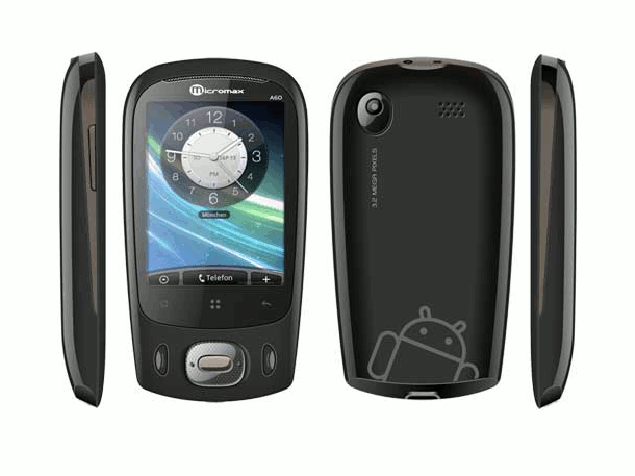
Micromax A60 mobile was launched in July 2010. The phone comes with a 2.80-inch touchscreen display offering a resolution of 240x320 pixels at a pixel density of 143 pixels per inch (ppi). Micromax A60 is powered by a 600 MHz one-core processor.
As far as the cameras are concerned, the Micromax A60 on the rear packs 2.15-megapixel camera.
Micromax A60 packs 150MB of inbuilt storage that can be expanded via microSD card (up to 32GB). The Micromax A60 is a single SIM (GSM) mobile that accepts a Regular-SIM card. The Micromax A60 measures 106.80 x 59.20 x 14.00mm (height x width x thickness) and weighs 105.00 grams. It was launched in Black colour.
Connectivity options on the Micromax A60 include Wi-Fi, GPS, Bluetooth v2.00, and 3G.
As of 20th October 2026, Micromax A60 price in India starts at Rs. 6,600.
Micromax A60 Full Specifications
General
| Brand | Micromax |
| Model | A60 |
| Price in India | ₹6,600 |
| Release date | July 2010 |
| Form factor | Slate |
| Dimensions (mm) | 106.80 x 59.20 x 14.00 |
| Weight (g) | 105.00 |
| Removable battery | No |
| Colours | Black |
Display
| Screen size (inches) | 2.80 |
| Touchscreen | Yes |
| Resolution | 240x320 pixels |
| Pixels per inch (PPI) | 143 |
Hardware
| Processor | 600 MHz one-core |
| Processor make | |
| Internal storage | 150MB |
| Expandable storage | Yes |
| Expandable storage type | microSD |
| Expandable storage up to (GB) | 32 |
Camera
| Rear camera | 2.15-megapixel |
| Rear flash | No |
| Front camera | No |
Connectivity
| Wi-Fi | Yes |
| GPS | Yes |
| Bluetooth | Yes, v 2.00 |
| NFC | No |
| Infrared | No |
| USB OTG | No |
| Headphones | 3.5mm |
| FM | No |
| Number of SIMs | 1 |
| Wi-Fi Direct | No |
| Mobile High-Definition Link (MHL) | No |
| SIM Type | Regular |
| GSM/CDMA | GSM |
| 3G | Yes |
| 4G/ LTE | No |
| Supports 4G in India (Band 40) | No |
Sensors
| Compass/ Magnetometer | No |
| Proximity sensor | No |
| Accelerometer | No |
| Ambient light sensor | No |
| Gyroscope | No |
| Barometer | No |
| Temperature sensor | No |
! Error or missing information?
Please let us know
Micromax A60 Competitors





OR
-
 Micromax A60
Micromax A60 User Review and Ratings
3.0★
1 rating &
1 review
1 review
Displaying 1 of 1 review
Sort By:
-
A old time classicSaurabh Manchanda (Jun 17, 2014) on Gadgets 360I bought Micromax A60 due to lack of budget for a high and model of some big brand and my experience with the phone was quite average. Touch quality: The touch was quite fine, It had a resistive touch which was quite impressive. Built quality: phone was made out of plastic but the over all design was quite impressive. It has a curvy look which made the phone look quite premium. Camera: This was one corner of the phone which is not upto the benchmark. On paper A60 had 3.2 MP shooter but the quality of the camera is pathetic. Memory: It had a 150Mb storage capacity which now seems pretty less but for those times it was quite sufficient. UI: The interface by micromax is just about fine nothing impressive. Micromax need to work on the UI of their devices. Processor: It had a 600 MHz processor which is laggy at times, especially while playing games. Battery: It had a 1280 mAh which was good lasting battery for the utilization of the phone. On one single charge it ran for around 8-9 hours. overall: Micromax a60 was a good phone but don't expect anything huge from the device, especially the camera.Is this review helpful?Reply
Other Micromax Phones
-
CompareMicromax In 2c₹ 7,999
-
CompareMicromax In 2
-
CompareMicromax In Note 2₹ 17,999
-
CompareMicromax In 2b₹ 6,450
-
CompareMicromax In 1₹ 14,999
-
CompareMicromax In Note 1₹ 15,499
-
CompareMicromax In 1b₹ 8,999
-
CompareMicromax iOne Note₹ 7,999
-
CompareMicromax iOne₹ 4,990
-
CompareMicromax Infinity N11₹ 6,185







Related Mobile Phones
-
CompareItel Zeno 20 Max₹ 6,829
-
CompareLava Shark 2 4G₹ 6,999
-
CompareLava Bold N1 Lite₹ 6,999
-
ComparePulse₹ 6,999
-
CompareSamsung Galaxy M05₹ 6,748
-
CompareInfinix Smart 9 HD₹ 6,699
-
CompareItel A80₹ 7,040
-
CompareLava Yuva 4₹ 6,999
-
CompareTecno Spark Go 1₹ 6,299
-
CompareLava Yuva Star 4G₹ 6,349



Need some help?
Micromax service center near you
Price List
-
Samsung Mobiles Price
-
Oppo Mobiles Price
-
Mi Mobiles Price
-
Vivo Mobiles Price
-
Nokia Mobiles Price
-
Motorola Mobiles Price
-
Asus Mobiles Price
-
OnePlus Mobiles Price
-
Apple Mobiles Price
-
Huawei Mobiles Price
-
Google Mobiles Price
-
Realme Mobiles Price
-
Sony Mobiles Price
-
Honor Mobiles Price
-
Lenovo Mobiles Price















Advertisement
Best Mobile Phones
- Best Mobile Phones
- Best Camera Mobile Phones
- Best Mobile Phones Under 10000
- Best Mobile Phones Under 15000
- Best Mobile Phones Under 20000
- Best Mobile Phones Under 25000
- Best Mobile Phones Under 30000
- Best Mobile Phones Under 35000
- Best Mobile Phones Under 40000
- Mobile Phones between 10000 to 15000
- Best Camera Mobile Phones Under 15000
- Best Camera Mobile Phones Under 20000
- Best Camera Mobile Phones Under 25000
- Best Camera Mobile Phones Under 30000
- Best 5G Mobile Phones Under 15000
- Best 5G Mobile Phones Under 20000
- Best 5G Mobile Phones Under 25000
- Best 5G Mobile Phones Under 30000
- Best 5G Mobile Phones Under 40000
- Best 5G Mobile Phones Under 50000

Advertisement
Popular on Gadgets
- Samsung Galaxy S26 Ultra
- Motorola Razr Fold
- ChatGPT
- OPPO Find N6
- Mobiles Under Rs. 40,000
- Vivo X300 Ultra
- Asus Zenbook S14
- iQOO 15
- Vivo X300 Pro
- Lenovo Yoga Slim 7i Aura Edition
- iQOO 15R
- Vivo X Fold 5
- Sony PlayStation 5
- HP OmniPad 12
- OnePlus Nord CE 6 Lite
- OnePlus Pad 4
- OPPO F33 Pro 5G
- Cryptocurrency
- HP OmniBook Ultra 14 (2026)
- iPhone 17
- Eureka Forbes AP 355 Room Air Purifier
- Latest Mobile Phones
- Compare Phones
Latest Gadgets
- Samsung Galaxy F70 5G
- Tecno Spark 50S 5G
- Vivo Y600s Pro
- Vivo Y32 (2026)
- Infinix Smart 20 HD
- Vivo V80
- Vivo S2 FE
- Vivo Y600K Turbo
- HP ZBook Ultra G3a
- Dell Pro Rugged 14
- Amazon Alexa Tablet 8
- Amazon Alexa Tablet 11
- Amazfit T-Rex Dual Solar
- OPPO Watch S2
- Toshiba 65-Inch 4K Ultra HD Smart Mini LED QLED TV (65Z670SP)
- Haier M70 Mini LED 65-inch
- Acer Predator Atlas 8
- Asus ROG Ally
- Blue Star 1.5 Ton 5 Star Inverter Split AC (IE518ZNURS)
- Blue Star 2 Ton 3 Star Inverter Window AC (WIE324L)
- About Us
- Sitemaps
- Feedback
- Archives
- Contact Us
- RSS
- Advertise
- Career
- Privacy Policy
- Ethics
- Editorial Policy
- Terms & Conditions
- Complaint Redressal
Download Our Apps
Available in Hindi
© Copyright Red Pixels Ventures Limited 2026. All rights reserved.