-
 Scientists Identify 45 Earth-Like Planets Beyond Our Solar System4 April 2026
 -
Artemis 2: Astronauts Aboard Orion Spacecraft Begin Journey Towards the Moon on Day 23 April 2026
-
iPhones in Deep Space: NASA Breaks Rules for Artemis 2 Crew; 5 Key Facts2 April 2026
-
Artemis II Launched: NASA’s First Crewed Mission in 50 Years Aims for the Moon2 April 2026
-
Artemis 2: NASA's Astronaut Moon Mission Explained in Five Points1 April 2026
- Home
- Science
- Science News
- Scientists Discover High Density Rocky Planet in LHS 1903 System That Defies Conventional Formation Models
Scientists Discover High-Density Rocky Planet in LHS 1903 System That Defies Conventional Formation Models
The discovery overturns traditional models that predicted gas giants in outer orbits and suggests planets can form in gas-poor environments.
Written by Gadgets 360 Staff | Updated: 18 February 2026 15:33 IST
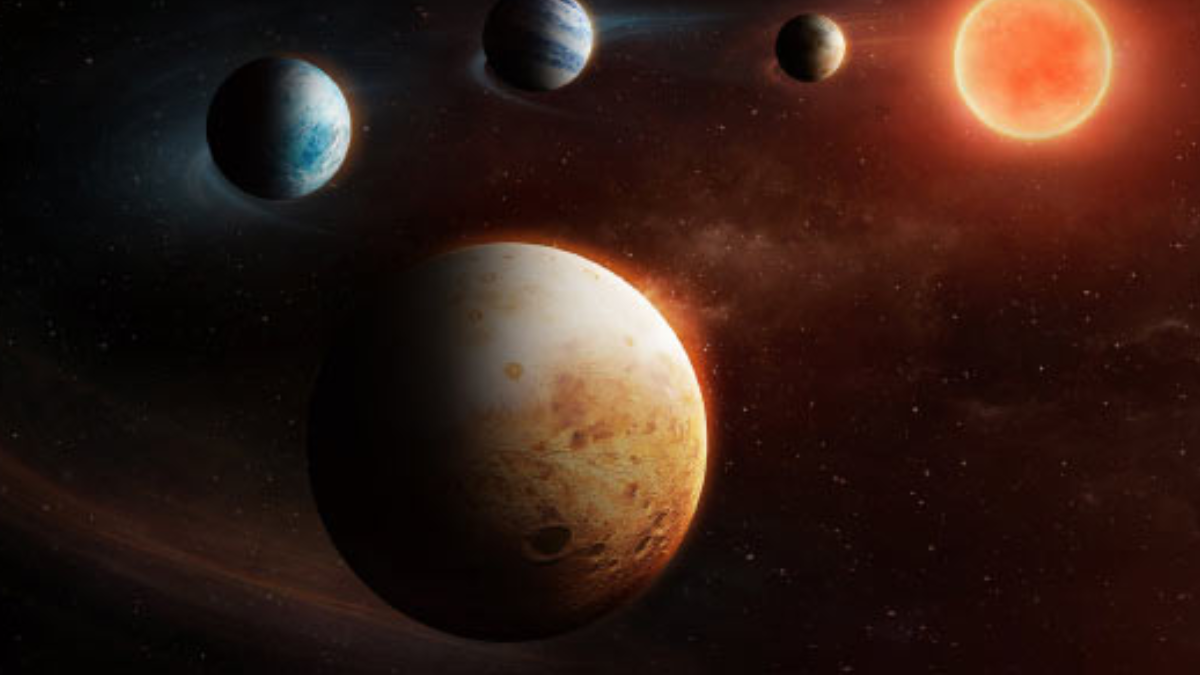
Photo Credit: ESA / ATG Europe
An artist’s impression of the four-planet system around LHS 1903
Click Here to Add Gadgets360 As A Trusted Source


Advertisement
In a discovery made in the early part of 2026, the ESA space telescope CHEOPS (CHaracterising ExOPlanet Satellite) made an unexpected find in the system orbiting the red dwarf star LHS 1903. While three planets match the expected model (a rocky inner planet and two gas giants), the CHEOPS satellite discovered a fourth, outer planet that is also rocky, rather than gaseous. This upends the expected model (rocky inner, gas outer) and indicates that planets can form in ways that challenge our current understanding.
An inside-out planetary system
According to the paper, LHS 1903 is a small, faint red dwarf (cooler and fainter than our Sun) at a distance of 116 light-years. Three planets had been found --- a rocky planet close to the star (LHS 1903 b), and two gas giants similar in size to Neptune (c and d), which orbited farther out.
However, CHEOPS was able to detect a fourth planet, LHS 1903 e, which is located at the edge of the system, and it is also a rocky planet. “This is an inside-out system,” explains Thomas Wilson, because “only the inner planets are rocky.”
Planets forming one by one
Simulations ruled out other explanations (a giant impact or orbital swap). Instead, the planets likely grew one after another as the protoplanetary disc evolved. By the time the fourth planet (LHS 1903 e) formed, the gas was almost gone. Wilson notes this is “first evidence for a planet in a gas-depleted environment”.
These findings, published in Science, offer strong evidence that planets can form in gas-poor conditions. As Ryan Cloutier says, this “challenges the assumptions built into our current models”. Astronomers note that LHS 1903 e thus stands as a reminder that exoplanetary systems can defy our Solar System–based expectations, possibly offering the first clue to a completely new planet-formation pattern.
Comments
Get your daily dose of tech news, reviews, and insights, in under 80 characters on Gadgets 360 Turbo. Connect with fellow tech lovers on our Forum. Follow us on X, Facebook, WhatsApp, Threads and Google News for instant updates. Catch all the action on our YouTube channel.
Related Stories


Scientists Discover High-Density Rocky Planet in LHS 1903 System That Defies Conventional Formation Models


Advertisement
Follow Us




-
05:05
Goboult Mustang Racer Smartwatch Review: Should You Get This Mustang Smartwatch? -
04:58
OnePlus Nord Buds 4 Pro Review: Specs, Sound Quality, ANC, and Battery Backup Tested -
02:29
[Sponsored] Samsung Galaxy S26 Ultra First Look: AI Smartphone for Creators, Gaming & Productivity -
04:25
Vivo X200T Review - Full Camera, Gaming & Battery Test | Worth Buying? -
28:31
The Future of Productivity: Logitech's Anatoliy Polyanker On AI, Hybrid Work, And India's Tech Boom
-
Redmi 15A 5G की सेल शुरू, जानें कितने में मिल रहा 6300mAh बैटरी वाला फोन
-
7300mAh बैटरी, 50MP कैमरा वाले OnePlus फोन पर बंपर डिस्काउंट, जानें
-
Zepto बेच रहा 24 हजार रुपये सस्ता iPhone 17 Pro Max, सबसे तगड़ा डिस्काउंट
-
Xiaomi ने सस्ता वैक्यूम क्लीनर किया लॉन्च, 10000Pa सक्शन, 180 मिनट का बैटरी बैकअप, जानें कीमत
-
Honor 600 सीरीज के जल्द लॉन्च की तैयारी, iPhone 17 Pro Max जैसा हो सकता है कैमरा मॉड्यूल
Advertisement
Popular on Gadgets
- Samsung Galaxy Unpacked 2026
- iPhone 17 Pro Max
- ChatGPT
- iOS 26
- Laptop Under 50000
- Smartwatch Under 10000
- Apple Vision Pro
- Oneplus 12
- OnePlus Nord CE 3 Lite 5G
- iPhone 13
- Xiaomi 14 Pro
- Oppo Find N3
- Tecno Spark Go (2023)
- Realme V30
- Best Phones Under 25000
- Samsung Galaxy S24 Series
- Cryptocurrency
- iQoo 12
- Samsung Galaxy S24 Ultra
- Giottus
- Samsung Galaxy Z Flip 5
- Apple 'Scary Fast'
- Housefull 5
- GoPro Hero 12 Black Review
- Invincible Season 2
- JioGlass
- HD Ready TV
- Latest Mobile Phones
- Compare Phones
Latest Gadgets
- Honor Play 80
- Nord 6
- Honor X80i
- Honor Play 80 Pro
- Redmi Note 15 SE 5G
- Redmi A7 Pro
- OPPO K15 Pro
- OPPO K15 Pro+
- Xiaomi Book Pro 14
- MacBook Neo
- Vivo Pad 6 Pro
- Lenovo Legion Y700 Gen 5
- boAt Valour Watch 1R
- Xiaomi Watch S5
- Xiaomi QLED TV X Pro 75
- Haier H5E Series
- Asus ROG Ally
- Nintendo Switch Lite
- Haier 1.6 Ton 5 Star Inverter Split AC (HSU19G-MZAID5BN-INV)
- Haier 1.6 Ton 5 Star Inverter Split AC (HSU19G-MZAIM5BN-INV)

- About Us
- Sitemaps
- Feedback
- Archives
- Contact Us
- RSS
- Advertise
- Career
- Privacy Policy
- Ethics
- Editorial Policy
- Terms & Conditions
- Complaint Redressal
Download Our Apps
Available in Hindi
© Copyright Red Pixels Ventures Limited 2026. All rights reserved.