-
 NASA Images Show New Island Formed by Retreat of Alaska’s Alsek Glacier20 September 2025
 -
ESA’s Mars Express Discovers Deep Valleys and Frozen Features Hinting at Mars’ Icy Past14 August 2025
-
Greenland's Melting Glaciers Feed Ocean Life, Study Finds7 August 2025
-
China Loses 26 Percent of Its Glaciers Due to Global Warming, Claims New Study1 April 2025
-
Greenland’s Melting Glaciers Expose 1,620 km of New Coastline Since 20001 April 2025
- Home
- Science
- Science News
- Glaciers Speed Up in Summer and Slow in Winter, New Global Map Reveals
Glaciers Speed Up in Summer and Slow in Winter, New Global Map Reveals
A decade-long global glacier-speed map reveals that meltwater makes glaciers flow faster in summer and slower in winter.
Written by Gadgets 360 Staff | Updated: 7 December 2025 18:08 IST
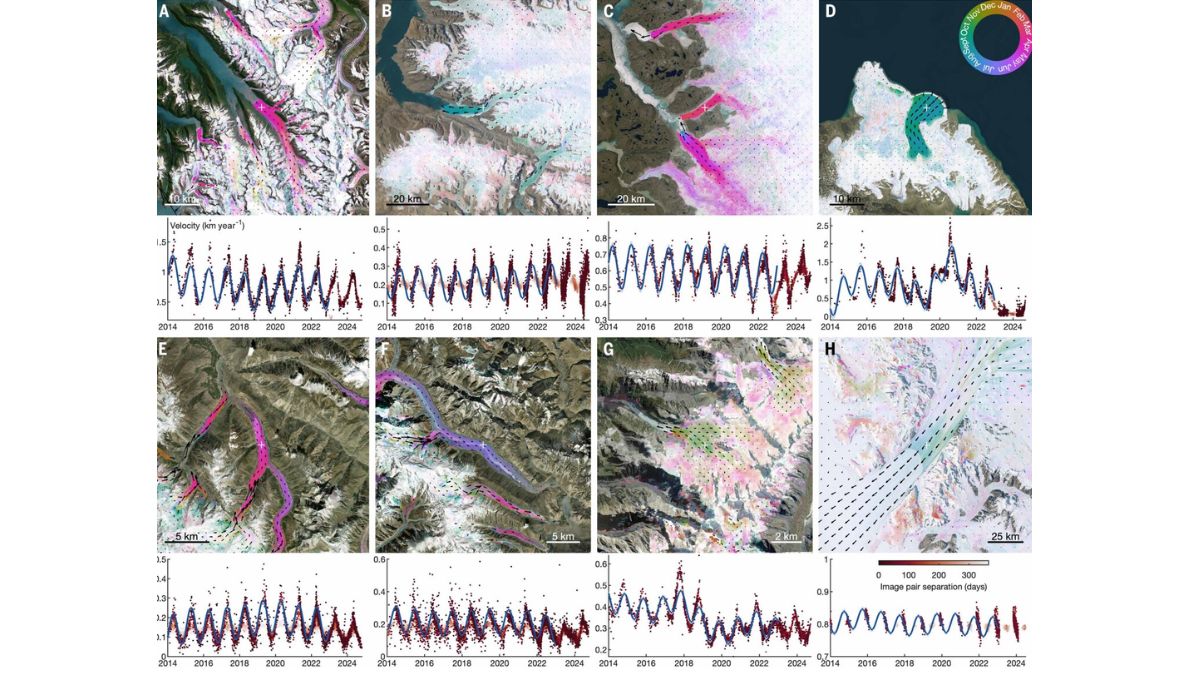
Photo Credit: Science (2025). DOI: 10.1126/science.adx6654
Global glacier-speed map shows meltwater hastening ice flow and signaling rising seas worldwide by 2100
Click Here to Add Gadgets360 As A Trusted Source


Advertisement
Global glaciers cover roughly 700,000 km² and hold about 70% of Earth's freshwater.int. In recent years, they have lost ice at record rates (five of the last six years were record losses). A new study has created the first global map of glacier speeds, revealing that glaciers run faster in summer and slower in winter. Seasonal cycles driven by meltwater hint at how a warming climate will accelerate ice flow.
Seasonal glacier dynamics
According to the study, scientists at NASA's Jet Propulsion Laboratory compiled nearly a decade of satellite data (over 36 million images) to map glacier speeds worldwide. They compared repeated photos of glaciers larger than roughly 5 km² to chart seasonal motion.
The results confirm a simple pattern: summer warmth boosts flow, winter cold slows it. In summer, meltwater penetrates to the glacier base and “acts like a lubricant,” reducing friction so the ice surges faster. Cooler temperatures then bring slower movement.
Future ice loss and sea-level rise
Researchers further indicate that significant seasonal variations are in many cases a signal of eventual long-term increase of speed: glaciers that have larger differences between summer and winter speeds are those which will accelerate more each year. According to the latest data, the cumulative ice loss of glaciers is estimated to be around 6,500 billion tons (≈273 billion tons per year) since 2000, which has led the global sea levels to rise by approximately 18 mm.
At present, glacier melting is the major cause of sea-level rise after ocean warming. Also, seasonal movement monitoring is a means of determining the glaciers that will become the largest sources of melting in the future.
Comments
Get your daily dose of tech news, reviews, and insights, in under 80 characters on Gadgets 360 Turbo. Connect with fellow tech lovers on our Forum. Follow us on X, Facebook, WhatsApp, Threads and Google News for instant updates. Catch all the action on our YouTube channel.
Related Stories




Advertisement
Follow Us




-
04:17
[Sponsored] LG NANO 4K UHD AI TV NU885: Gemini Search, Dolby Atmos & 5 Years of Updates -
00:57
[Sponsored] Samsung Galaxy Z Fold8 My Fan Cam in Action: Find the Moment, Then Share It -
01:41
[Sponsored] What Do You Need To Know Before Your Next Run? | Samsung Galaxy Watch Ultra2 -
01:32
[Sponsored] Big Day Tomorrow? Prep Today | Samsung Galaxy Watch Ultra2 -
04:37
[Sponsored]: CP PLUS CarKam CP-F89B: 4K Dashcam With Rear Camera, GPS & Emergency Recording
-
iPhone 16 आज भी Amazon सेल में मिल रहा ₹15 हजार से ज्यादा सस्ता
-
OnePlus 15 को Amazon Great Indian Festival Sale में खरीदें सस्ता
-
₹2250 सस्ता मिल रहा Motorola का 7000mAh बैटरी वाला फोन! Flipkart पर ऑफर
-
Coolpad लाई पहला वाइड फोन Cool X Wide, 50MP कैमरा, 4600mAh बैटरी, प्री-ऑर्डर शुरू!
-
Realme लाई बजट फोन Realme C01, 6500mAh बैटरी के साथ!
Advertisement
Popular on Gadgets
- Samsung Galaxy S26 Ultra
- Motorola Razr Fold
- ChatGPT
- OPPO Find N6
- Mobiles Under Rs. 40,000
- Vivo X300 Ultra
- Asus Zenbook S14
- iQOO 15
- Vivo X300 Pro
- Lenovo Yoga Slim 7i Aura Edition
- iQOO 15R
- Vivo X Fold 5
- Sony PlayStation 5
- HP OmniPad 12
- OnePlus Nord CE 6 Lite
- OnePlus Pad 4
- OPPO F33 Pro 5G
- Cryptocurrency
- HP OmniBook Ultra 14 (2026)
- iPhone 17
- Eureka Forbes AP 355 Room Air Purifier
- Latest Mobile Phones
- Compare Phones
Latest Gadgets
- Samsung Galaxy F70 5G
- Tecno Spark 50S 5G
- Vivo Y600s Pro
- Vivo Y32 (2026)
- Infinix Smart 20 HD
- Vivo V80
- Vivo S2 FE
- Vivo Y600K Turbo
- HP ZBook Ultra G3a
- Dell Pro Rugged 14
- Amazon Alexa Tablet 8
- Amazon Alexa Tablet 11
- Amazfit T-Rex Dual Solar
- OPPO Watch S2
- Toshiba 65-Inch 4K Ultra HD Smart Mini LED QLED TV (65Z670SP)
- Haier M70 Mini LED 65-inch
- Acer Predator Atlas 8
- Asus ROG Ally
- Blue Star 1.5 Ton 5 Star Inverter Split AC (IE518ZNURS)
- Blue Star 2 Ton 3 Star Inverter Window AC (WIE324L)

- About Us
- Sitemaps
- Feedback
- Archives
- Contact Us
- RSS
- Advertise
- Career
- Privacy Policy
- Ethics
- Editorial Policy
- Terms & Conditions
- Complaint Redressal
Download Our Apps
Available in Hindi
© Copyright Red Pixels Ventures Limited 2026. All rights reserved.