

-
 Astronomers Detect Star-Forming Fuel in a Galaxy 13 Billion Light-Years Away14 June 2026
 -
Astronomers Discover Why Massive Galaxies Died Early in the Universe13 June 2026
-
JWST Reveals the True Identity of Mysterious Little Red Dots11 June 2026
-
James Webb Space Telescope Weighs Most Distant Dormant Black Hole Ever Detected9 June 2026
-
James Webb Space Telescope Detects Most Distant Dormant Black Hole Ever Found6 June 2026
- Home
- Science
- Science News
- Astronomers Create the Largest 3D Map of the Early Universe’s Hydrogen Glow
Astronomers Create the Largest 3D Map of the Early Universe’s Hydrogen Glow
Astronomers created the largest 3D map of hydrogen emission from 9–11 billion years ago using HETDEX data.
Written by Gadgets 360 Staff | Updated: 7 March 2026 18:22 IST
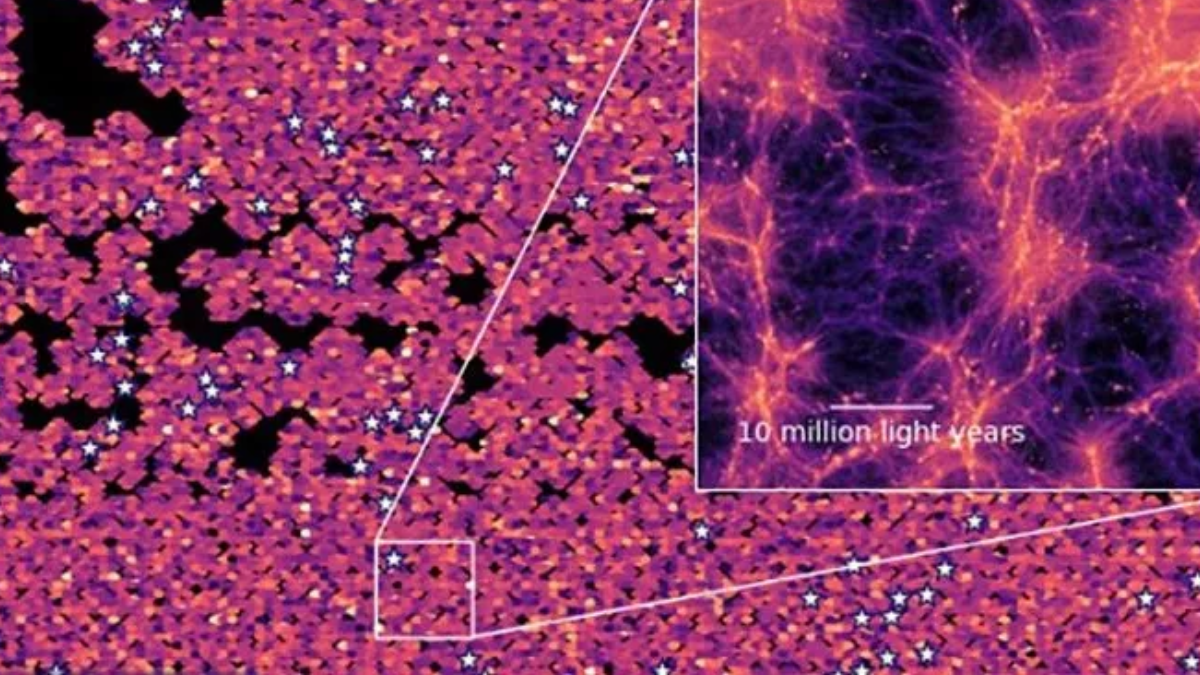
Photo Credit: Maja Lujan Niemeyer/Max Planck Institute for Astrophysics/HETDEX, Chris Byrohl/Stanford University/HETDEX
New HETDEX 3D map shows Lyman-alpha hydrogen glowing in space between galaxies.
Click Here to Add Gadgets360 As A Trusted Source


Advertisement
The astronomers have unveiled the largest ever three-dimensional map of hydrogen emission from the early universe. The map extends over the period of 9 to 11 billion years ago, during the universe's ‘cosmic noon' when star formation was at its peak, and is assembled from the data collected in the Hobby-Eberly Telescope Dark Energy Experiment (HETDEX) that maps the faint Lyman-alpha ultraviolet glow of hydrogen between galaxies. The “sea of light” is invisible until this map is drawn.
Mapping the early universe
According to the new paper, the team applied a technique called line intensity mapping, combining over 600 million HETDEX spectra into a 3D “heat map” of cosmic hydrogen. HETDEX runs on the Hobby-Eberly Telescope in Texas, using spectrographs to capture this vast dataset. Instead of cataloguing galaxies one by one, this approach measures the combined Lyman-alpha emission across wide swaths of sky. By correlating bright galaxy positions with the faint hydrogen glow, it uncovered vast structures in the early universe that earlier surveys focused on bright objects could not detect.
Implications for cosmology
By mapping the location of hydrogen at the peak star-forming epoch of the universe, astronomers have learned new things about how galaxies accumulated gas, made new stars, and merged into vast structures. It is also an important tool for studying the evolution of galaxies.
The project also marks the beginning of an era of surveys that use an approach called intensity mapping, which promises to show the entire, glowing structure of the cosmos, rather than just its brightest parts. Caryl Gronwall, co-author of the study, said in a statement, "This study is an exciting first step in using intensity mapping to understand the processes involved in how galaxies form and evolve."
Comments
Get your daily dose of tech news, reviews, and insights, in under 80 characters on Gadgets 360 Turbo. Connect with fellow tech lovers on our Forum. Follow us on X, Facebook, WhatsApp, Threads and Google News for instant updates. Catch all the action on our YouTube channel.
Related Stories


Advertisement
Follow Us




-
04:17
[Sponsored] LG NANO 4K UHD AI TV NU885: Gemini Search, Dolby Atmos & 5 Years of Updates -
00:57
[Sponsored] Samsung Galaxy Z Fold8 My Fan Cam in Action: Find the Moment, Then Share It -
01:41
[Sponsored] What Do You Need To Know Before Your Next Run? | Samsung Galaxy Watch Ultra2 -
01:32
[Sponsored] Big Day Tomorrow? Prep Today | Samsung Galaxy Watch Ultra2 -
04:37
[Sponsored]: CP PLUS CarKam CP-F89B: 4K Dashcam With Rear Camera, GPS & Emergency Recording
-
iPhone 16 आज भी Amazon सेल में मिल रहा ₹15 हजार से ज्यादा सस्ता
-
OnePlus 15 को Amazon Great Indian Festival Sale में खरीदें सस्ता
-
₹2250 सस्ता मिल रहा Motorola का 7000mAh बैटरी वाला फोन! Flipkart पर ऑफर
-
Realme लाई बजट फोन Realme C01, 6500mAh बैटरी के साथ!
-
Samsung Galaxy F70 5G की भारत में शुरू हुई बिक्री, जानें प्राइस, ऑफर्स
Advertisement
Popular on Gadgets
- Samsung Galaxy S26 Ultra
- Motorola Razr Fold
- ChatGPT
- OPPO Find N6
- Mobiles Under Rs. 40,000
- Vivo X300 Ultra
- Asus Zenbook S14
- iQOO 15
- Vivo X300 Pro
- Lenovo Yoga Slim 7i Aura Edition
- iQOO 15R
- Vivo X Fold 5
- Sony PlayStation 5
- HP OmniPad 12
- OnePlus Nord CE 6 Lite
- OnePlus Pad 4
- OPPO F33 Pro 5G
- Cryptocurrency
- HP OmniBook Ultra 14 (2026)
- iPhone 17
- Eureka Forbes AP 355 Room Air Purifier
- Latest Mobile Phones
- Compare Phones
Latest Gadgets
- Samsung Galaxy F70 5G
- Tecno Spark 50S 5G
- Vivo Y600s Pro
- Vivo Y32 (2026)
- Infinix Smart 20 HD
- Vivo V80
- Vivo S2 FE
- Vivo Y600K Turbo
- HP ZBook Ultra G3a
- Dell Pro Rugged 14
- Amazon Alexa Tablet 8
- Amazon Alexa Tablet 11
- Amazfit T-Rex Dual Solar
- OPPO Watch S2
- Toshiba 65-Inch 4K Ultra HD Smart Mini LED QLED TV (65Z670SP)
- Haier M70 Mini LED 65-inch
- Acer Predator Atlas 8
- Asus ROG Ally
- Blue Star 1.5 Ton 5 Star Inverter Split AC (IE518ZNURS)
- Blue Star 2 Ton 3 Star Inverter Window AC (WIE324L)

- About Us
- Sitemaps
- Feedback
- Archives
- Contact Us
- RSS
- Advertise
- Career
- Privacy Policy
- Ethics
- Editorial Policy
- Terms & Conditions
- Complaint Redressal
Download Our Apps
Available in Hindi
© Copyright Red Pixels Ventures Limited 2026. All rights reserved.