-
 Extreme Star Factory: ALMA Detects Galaxy Y1 Forming Stars 180 Times Faster Than the Milky Way19 November 2025
 -
Webb Finds Phosphorus-Bearing Gas in an Ancient Brown Dwarf10 November 2025
-
James Webb Space Telescope Detects Phosphine on Brown Dwarf Wolf 1130C9 October 2025
-
James Webb Telescope Spots Evidence of a Black Hole Carving a Massive Scar Through a Galaxy9 October 2025
-
JWST Reveals Stunning New Details About M87’s Supermassive Black Hole Jet4 October 2025
- Home
- Science
- Science News
- James Webb Space Telescope Finds Unexpected Ultraviolet Radiation Around Young Protostars
James Webb Space Telescope Finds Unexpected Ultraviolet Radiation Around Young Protostars
JWST has detected surprising ultraviolet radiation around five young protostars in the Ophiuchus cloud.
Written by Gadgets 360 Staff | Updated: 1 December 2025 23:02 IST
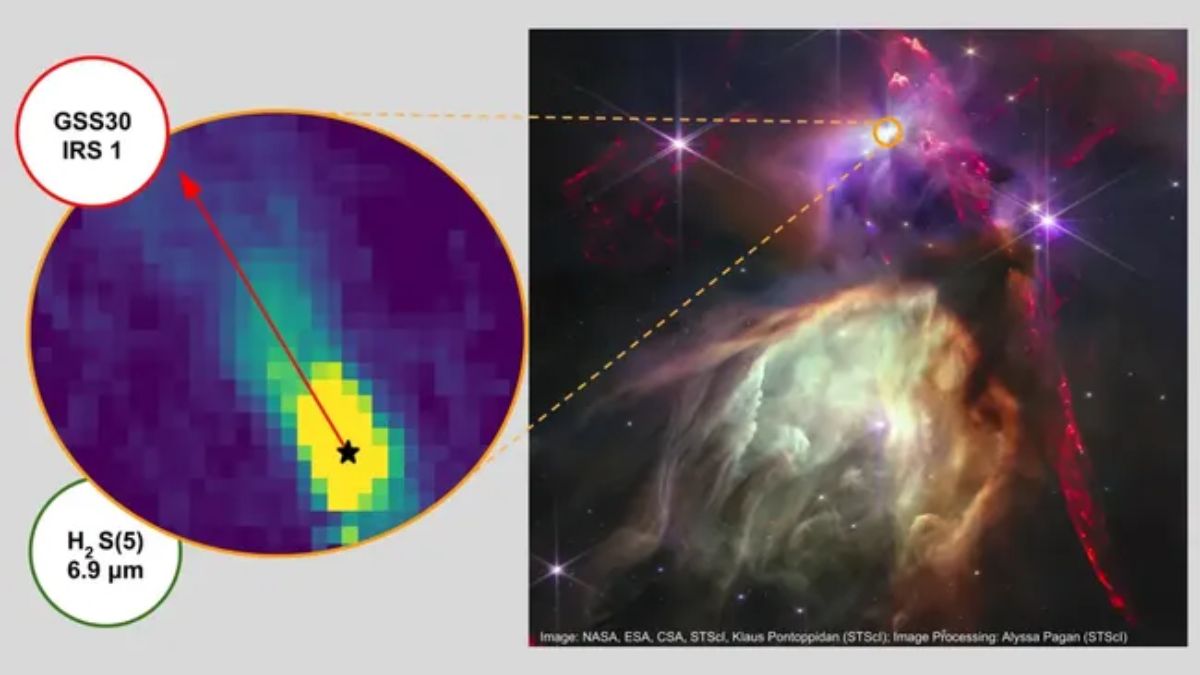
Photo Credit: NASA, ESA, CSA, STScI, Klaus Pontoppidan (STScI), Processing: Alyssa Paghan (STScI)
Star formation within the Ophiuchus Molecular clouds.
Click Here to Add Gadgets360 As A Trusted Source


Advertisement
Astronomers using NASA's James Webb Space Telescope have spotted puzzling high-energy ultraviolet radiation around five forming stars in a nearby stellar nursery. These young objects, called protostars, are still gathering mass from clouds of gas and dust. The unexpected UV light challenges existing star-formation models. A team led by Iason Skretas (Max Planck Institute for Radio Astronomy) and Agata Karska (Nicolaus Copernicus University, Poland) reported the discovery.
Unexpected ultraviolet in a star nursery
According to the study, astronomers turned the James Webb Telescope toward the Ophiuchus molecular cloud, a stellar nursery about 450 light-years away. They detected strong ultraviolet (UV) radiation around five young protostars there. This was surprising because infant stars normally cannot emit UV. “Young stars are not capable of being a source of radiation; they cannot 'produce' radiation.
So we should not expect it. And yet we have shown that UV occurs near protostars,” research team member Agata Karska said in a statement. The team, including researchers at the Max Planck Institute for Radio Astronomy, said this unexpected UV could force revisions to star-formation models.
Probing the source of the UV radiation
Scientists considered whether nearby massive stars could be bathing the protostars in UV light. They estimated external UV from surrounding stars and dust to predict how molecular hydrogen emission would vary. No such variation was seen, allowing the team to rule out external illumination.
“We can say with certainty that UV radiation is present in the vicinity of the protostar,” said Karska, “Therefore, its origin has to be internal”. Future JWST studies of gas, dust and ice may help reveal how these infant stars generate the unexpected UV.
Comments
Get your daily dose of tech news, reviews, and insights, in under 80 characters on Gadgets 360 Turbo. Connect with fellow tech lovers on our Forum. Follow us on X, Facebook, WhatsApp, Threads and Google News for instant updates. Catch all the action on our YouTube channel.
Related Stories


Advertisement
Follow Us




-
05:23
Motorola G67 Power Review: The Real Battery Beast of 2025? -
06:14
[Partner Content] OPPO F31 Series: The Durable Champion That Stays Smooth & Powerful -
04:40
Google Pixel Buds 2a Review | Best Budget Earbuds 2025 -
00:43
[Sponsored] Galaxy Tab S10 Lite: Built for Learning and Work -
00:48
[Sponsored] Samsung Galaxy Tab S11 Series: Creativity Meets AI
Advertisement
Popular on Gadgets
- Samsung Galaxy Unpacked 2025
- ChatGPT
- Redmi Note 14 Pro+
- iPhone 16
- Apple Vision Pro
- Oneplus 12
- OnePlus Nord CE 3 Lite 5G
- iPhone 13
- Xiaomi 14 Pro
- Oppo Find N3
- Tecno Spark Go (2023)
- Realme V30
- Best Phones Under 25000
- Samsung Galaxy S24 Series
- Cryptocurrency
- iQoo 12
- Samsung Galaxy S24 Ultra
- Giottus
- Samsung Galaxy Z Flip 5
- Apple 'Scary Fast'
- Housefull 5
- GoPro Hero 12 Black Review
- Invincible Season 2
- JioGlass
- HD Ready TV
- Laptop Under 50000
- Smartwatch Under 10000
- Latest Mobile Phones
- Compare Phones
Latest Gadgets
- Poco F8 Ultra
- Poco F8 Pro
- Huawei Mate 80 RS Master Edition
- Huawei Mate 80 Pro Max
- Huawei Mate 80 Pro
- Huawei Mate 80
- Huawei Mate X7
- Honor 500
- Asus ProArt P16
- MacBook Pro 14-inch (M5, 2025)
- Poco Pad M1
- Poco Pad X1
- Honor Watch X5
- Huawei Watch Ultimate 2
- Acerpure Nitro Z Series 100-inch QLED TV
- Samsung 43 Inch LED Ultra HD (4K) Smart TV (UA43UE81AFULXL)
- Asus ROG Ally
- Nintendo Switch Lite
- Haier 1.6 Ton 5 Star Inverter Split AC (HSU19G-MZAID5BN-INV)
- Haier 1.6 Ton 5 Star Inverter Split AC (HSU19G-MZAIM5BN-INV)

- About Us
- Sitemaps
- Feedback
- Archives
- Contact Us
- RSS
- Advertise
- Career
- Privacy Policy
- Ethics
- Editorial Policy
- Terms & Conditions
- Complaint Redressal
Download Our Apps
Available in Hindi
© Copyright Red Pixels Ventures Limited 2025. All rights reserved.