-
 Largest Black Holes May Form Through Repeated Collisions, Study Suggests9 May 2026
 -
Physicists Develop New Method to Detect Tiny Fluctuations in Spacetime23 January 2026
-
Scientists Solve the Mystery Behind LIGO’s “Forbidden” Black Hole Pair23 November 2025
-
LIGO Detect Possible Second-Generation Black Holes with Extreme Spins2 November 2025
-
New Black Hole Merger Gives Clearest Test of Einstein’s Relativity11 September 2025
- Home
- Science
- Science News
- New Gravitational Wave Signal May Reveal Primordial Black Holes Born After the Big Bang
New Gravitational-Wave Signal May Reveal Primordial Black Holes Born After the Big Bang
A November 2025 LIGO–Virgo–KAGRA signal hints at ultra-light primordial black holes—hypothetical relics of the early universe. If confirmed, it would mark the first evidence of these exotic objects, though scientists caution the signal may be noise.
Written by Gadgets 360 Staff | Updated: 1 December 2025 23:10 IST
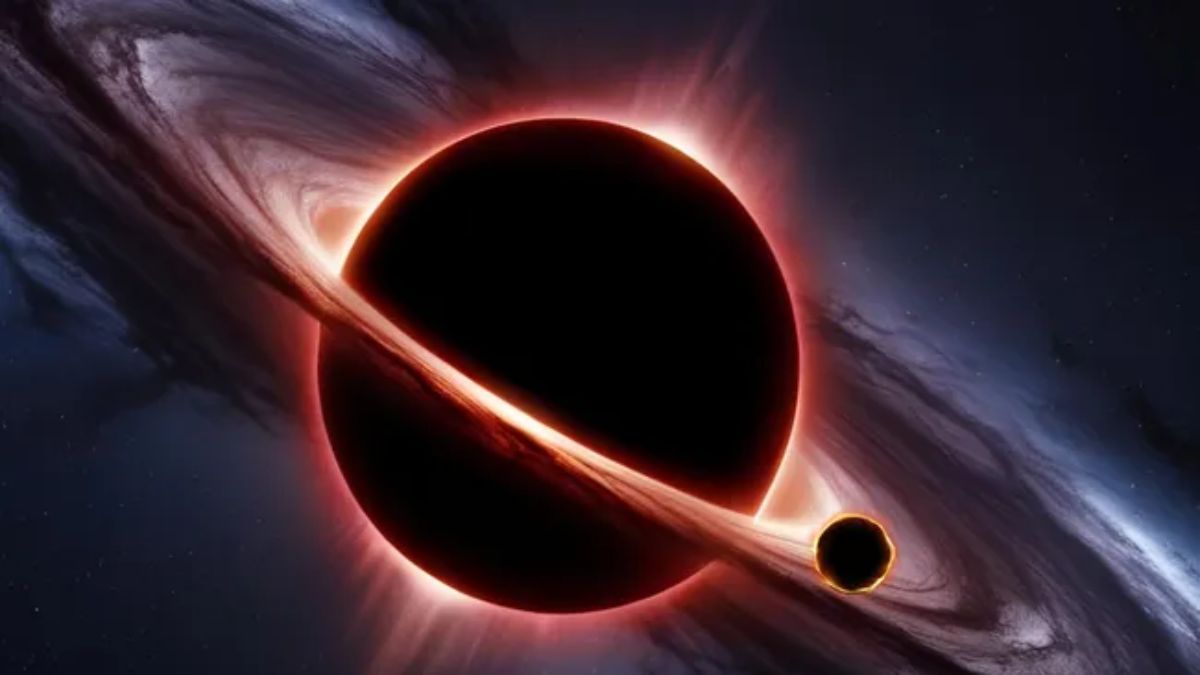
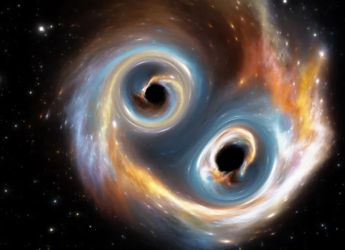
An illustration shows a standard black hole about to merge with a much smaller primordial black hole.
Click Here to Add Gadgets360 As A Trusted Source


Advertisement
The Big Bang may have been the first to give scientists a clue of the existence of primordial black holes. The hint was a strange gravitational-wave signal which was recorded in November 2025 by the LIGO–Virgo–KAGRA observatories. This signal can be caused by the collision of two small black holes (which may not be bigger than a coin). In case it is real, astronomers explain that it would be a discovery of the first in terms of exotic remnants of the early universe.
Unusual gravitational-wave signal
According to reports, LIGO–Virgo–KAGRA detectors flagged an unusual gravitational-wave signal in November 2025 (event S251112cm). The data showed one merging object had a mass far below any known stellar remnant. Durham University physicist Djuna Croon said the finding would be “enormous” if confirmed, since standard astrophysics cannot explain it. The LIGO team cautions this could still be a rare noise glitch (false-alarm odds roughly 1 in 4 years). But even a small chance of a true signal is thrilling, because primordial black holes have long been theorised but never confirmed.
Primordial black holes: cosmic relics
The primordial black holes are theoretical entities which were formed during the very early epochs of the Big Bang, as opposed to the black holes of collapsing stars. They might have masses which are wildly different - less than a paper-clip to 100,000 Suns. In case they do, they could constitute dark matter, an invisible matter that constitutes the 85 percent of cosmic mass. These black holes would not require any exotic particle (they would fit in the known physics). None of them has so far been discovered; very light ones would have evaporated long ago.
Comments
Get your daily dose of tech news, reviews, and insights, in under 80 characters on Gadgets 360 Turbo. Connect with fellow tech lovers on our Forum. Follow us on X, Facebook, WhatsApp, Threads and Google News for instant updates. Catch all the action on our YouTube channel.
Related Stories



Advertisement
Follow Us




-
04:17
[Sponsored] LG NANO 4K UHD AI TV NU885: Gemini Search, Dolby Atmos & 5 Years of Updates -
00:57
[Sponsored] Samsung Galaxy Z Fold8 My Fan Cam in Action: Find the Moment, Then Share It -
01:41
[Sponsored] What Do You Need To Know Before Your Next Run? | Samsung Galaxy Watch Ultra2 -
01:32
[Sponsored] Big Day Tomorrow? Prep Today | Samsung Galaxy Watch Ultra2 -
04:37
[Sponsored]: CP PLUS CarKam CP-F89B: 4K Dashcam With Rear Camera, GPS & Emergency Recording
-
Dell Pro Essential 14, Essential 15 लॉन्च, सिक्योरिटी के लिए गजब फीचर्स
-
Flipkart Big Billion Days Sale: ₹15 हजार में स्टूडेंट के लिए बेस्ट लैपटॉप
-
Amazon Great Indian Festival Sale: 10 हजार से सस्ते मिल रहे ये स्मार्टफोन
-
Amazon Great Indian Festival Sale 2026: ₹35 हजार में OnePlus का 8000mAh बैटरी, Snapdragon चिप वाला फोन
-
₹13 हजार सस्ती कीमत में मिल रहा iPhone 17 Pro, जानें पूरा ऑफर
Advertisement
Popular on Gadgets
- Samsung Galaxy S26 Ultra
- Motorola Razr Fold
- ChatGPT
- OPPO Find N6
- Mobiles Under Rs. 40,000
- Vivo X300 Ultra
- Asus Zenbook S14
- iQOO 15
- Vivo X300 Pro
- Lenovo Yoga Slim 7i Aura Edition
- iQOO 15R
- Vivo X Fold 5
- Sony PlayStation 5
- HP OmniPad 12
- OnePlus Nord CE 6 Lite
- OnePlus Pad 4
- OPPO F33 Pro 5G
- Cryptocurrency
- HP OmniBook Ultra 14 (2026)
- iPhone 17
- Eureka Forbes AP 355 Room Air Purifier
- Latest Mobile Phones
- Compare Phones
Latest Gadgets
- Vivo Y600s Pro
- Vivo Y32 (2026)
- Infinix Smart 20 HD
- Vivo V80
- Vivo S2 FE
- Vivo Y600K Turbo
- Realme P4s Lite
- Vivo S60t
- HP ZBook Ultra G3a
- Dell Pro Rugged 14
- Amazon Alexa Tablet 8
- Amazon Alexa Tablet 11
- Amazfit T-Rex Dual Solar
- OPPO Watch S2
- Toshiba 65-Inch 4K Ultra HD Smart Mini LED QLED TV (65Z670SP)
- Haier M70 Mini LED 65-inch
- Acer Predator Atlas 8
- Asus ROG Ally
- Blue Star 1.5 Ton 5 Star Inverter Split AC (IE518ZNURS)
- Blue Star 2 Ton 3 Star Inverter Window AC (WIE324L)

- About Us
- Sitemaps
- Feedback
- Archives
- Contact Us
- RSS
- Advertise
- Career
- Privacy Policy
- Ethics
- Editorial Policy
- Terms & Conditions
- Complaint Redressal
Download Our Apps
Available in Hindi
© Copyright Red Pixels Ventures Limited 2026. All rights reserved.