
- Home
- Science
- Science News
- Japan’s H3 Rocket Suffers Setback as Michibiki 5 Navigation Satellite Launch Fails
Japan’s H3 Rocket Suffers Setback as Michibiki 5 Navigation Satellite Launch Fails
Japan’s H3 rocket fails during launch; the Michibiki 5 navigation satellite misses orbit.
Written by Gadgets 360 Staff | Updated: 31 December 2025 09:00 IST
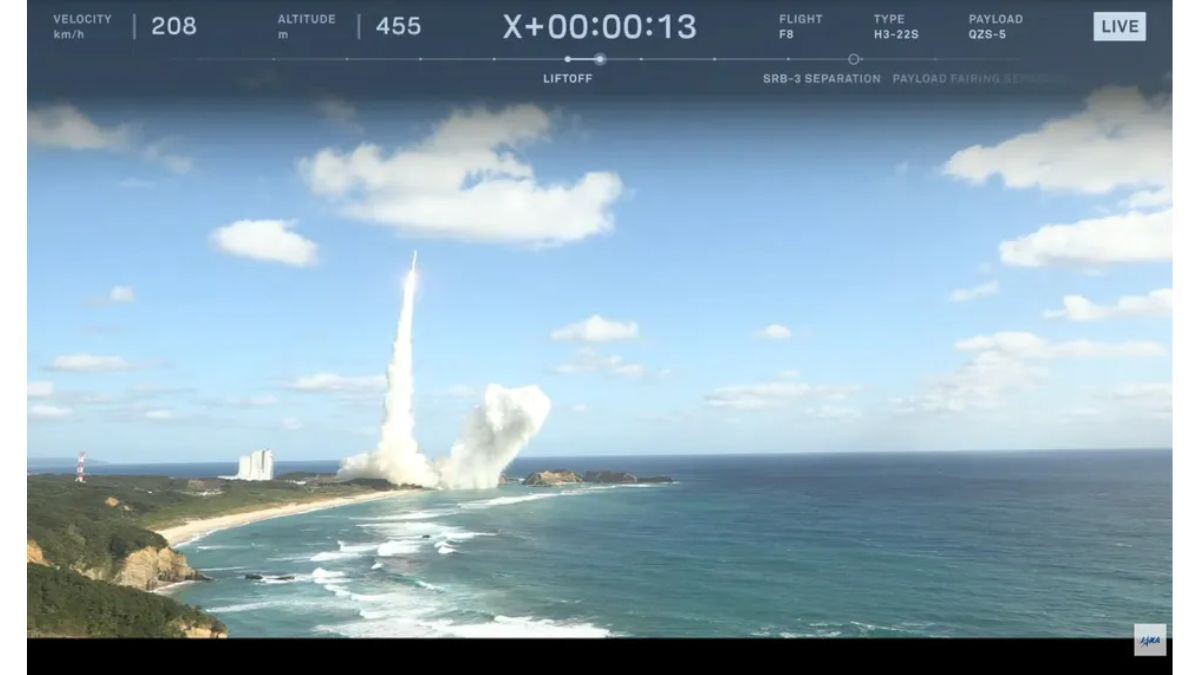
Photo Credit: JAXA
The H3 rocket launch fails; the Michibiki 5 satellite is unable to reach its planned orbit.
Click Here to Add Gadgets360 As A Trusted Source


Advertisement
Japan's H3 rocket, flying in just its seventh mission ever, stumbled to deliver the Michibiki 5 navigation satellite to its intended orbit after launching from Tanegashima Space Center at 10:51 a.m. local Japan time (Dec. 21). The 4,800-kilogram satellite is one in a series that Japan has been developing to complement its GPS system for use over the Asia-Oceania region. “However, the second-stage engine's second ignition failed to start normally and shut down prematurely,” JAXA officials said, causing the mission to end in failure despite the rocket's initial smooth ascent.
JAXA's H3 Rocket Failure Delays Michibiki 5 Satellite Deployment, Prompting Investigation
According to a Japan Aerospace Exploration Agency (JAXA) report, the H3 lost its satellite payload, Michibiki 5, which would have expanded the existing four-satellite QZSS constellation also in orbit. The system is intended to be extended with an additional 11 satellites, providing Navigation in the Japan area and test service elsewhere. The Japan Aerospace Exploration Agency, or JAXA, and Mitsubishi Heavy Industries developed H3 as a successor to H-2A, which has been phased out after a 25-year life.
After a March 2023 debut failure and five successes, H3's second failure in seven missions prompted a JAXA-led investigation and apology.
Michibiki 5 Launch Failure Highlights Challenges in Expanding Japan's QZSS Navigation Network
The Michibiki 5 satellite, another name for which is QZS-5, was intended to improve Japan's domestic navigation network and work with GPS services. Instituted in 2010 with the Pathfinder satellite, QZSS provides accurate positioning and time information in urban locations where GPS signals are blocked, and offers broader regional navigation coverage.
Despite failure, JAXA stays committed to H3 and QZSS expansion, analysing second-stage malfunction to avoid setbacks and advance domestic launches.
Comments
Get your daily dose of tech news, reviews, and insights, in under 80 characters on Gadgets 360 Turbo. Connect with fellow tech lovers on our Forum. Follow us on X, Facebook, WhatsApp, Threads and Google News for instant updates. Catch all the action on our YouTube channel.
Further reading:
H3 rocket, JAXA, Michibiki 5, QZSS, Japan satellite launch, rocket failure, space news, navigation satellite, Aerospace, Mitsubishi Heavy Industries
Related Stories


Advertisement
Follow Us




-
00:21
[Sponsored] Samsung Galaxy Z Fold8, Fold8 Ultra -
03:41
[Sponsored] Samsung Galaxy Z Fold8: How It Fits Into an Actor’s Busy Day | Camera, Multitasking & More -
09:53
iPhone 18 Goes On Sale In India: Huge Crowds, Long Queues At Apple Stores -
06:32
Google Pixel 11 Pro XL Review: The Most Exciting Pixel Yet? | 120X Zoom + Tensor G6 -
05:20
Samsung Galaxy Watch Ultra 2 Review: Is This the Best Android Smartwatch?
-
Lava Virat Curve की भारत में सेल आज से, ₹19,999 में 2 डिस्प्ले वाला फोन
-
1 अक्टूबर से महंगे हो जाएंगे AC, TV, फ्रिज समेत कई सामान
-
Amazon Great Indian Festival Sale 2026: ₹4 हजार सस्ता मिल रहा है Oppo F33
-
Oppo Reno 16T हुआ लॉन्च, 200MP कैमरा और 6700mAh बैटरी के साथ मिलेगा 120Hz AMOLED डिस्प्ले
-
OnePlus Pad 2 Amazon सेल में सबसे सस्ता! ₹11000 का डिस्काउंट, 9510mAh बैटरी
Advertisement
Popular on Gadgets
- Samsung Galaxy S26 Ultra
- Motorola Razr Fold
- ChatGPT
- OPPO Find N6
- Mobiles Under Rs. 40,000
- Vivo X300 Ultra
- Asus Zenbook S14
- iQOO 15
- Vivo X300 Pro
- Lenovo Yoga Slim 7i Aura Edition
- iQOO 15R
- Vivo X Fold 5
- Sony PlayStation 5
- HP OmniPad 12
- OnePlus Nord CE 6 Lite
- OnePlus Pad 4
- OPPO F33 Pro 5G
- Cryptocurrency
- HP OmniBook Ultra 14 (2026)
- iPhone 17
- Eureka Forbes AP 355 Room Air Purifier
- Latest Mobile Phones
- Compare Phones
Latest Gadgets
- Ai+ Pulse 2 FE
- OPPO Reno 16t
- Itel Zeno 300
- Vivo Y600i
- Mivi One 5G
- Xiaomi 18 Pro Max
- Motorola Signature 27
- OPPO Find X10 E
- Microsoft Surface Laptop, 13-inch (2nd Edition)
- Lenovo LOQ 15AHP11
- Ai+ NovaTab
- Microsoft Surface Pro, 12-inch (2nd Edition)
- Amazfit T-Rex Dual Solar
- OPPO Watch S2
- Toshiba 65-Inch 4K Ultra HD Smart Mini LED QLED TV (65Z670SP)
- Haier M70 Mini LED 65-inch
- Acer Predator Atlas 8
- Asus ROG Ally
- Blue Star 1.5 Ton 5 Star Inverter Split AC (IE518ZNURS)
- Blue Star 2 Ton 3 Star Inverter Window AC (WIE324L)

- About Us
- Sitemaps
- Feedback
- Archives
- Contact Us
- RSS
- Advertise
- Career
- Privacy Policy
- Ethics
- Editorial Policy
- Terms & Conditions
- Complaint Redressal
Download Our Apps
Available in Hindi
© Copyright Red Pixels Ventures Limited 2026. All rights reserved.
-
 Apple Watch Series 12
Starts from ₹56,900
Apple Watch Series 12
Starts from ₹56,900
-
 Samsung Galaxy Watch Ultra 2
Starts from ₹59,909
Samsung Galaxy Watch Ultra 2
Starts from ₹59,909
-
 Samsung Galaxy Watch 9 (44mm, LTE)
Starts from ₹41,999
Samsung Galaxy Watch 9 (44mm, LTE)
Starts from ₹41,999
-
 Samsung Galaxy Watch 9 (40mm, LTE)
Starts from ₹38,999
Samsung Galaxy Watch 9 (40mm, LTE)
Starts from ₹38,999
-
 Samsung Galaxy Watch 9 (40mm)
Starts from ₹37,999
Samsung Galaxy Watch 9 (40mm)
Starts from ₹37,999
-
 Samsung Galaxy Watch 9 (44mm)
Starts from ₹40,999
Samsung Galaxy Watch 9 (44mm)
Starts from ₹40,999
-
 God of War Laufey Pre-Orders Begin September 29; Digital Deluxe Edition, New Combat Details Revealed
-
 Ai+ Pulse 2 FE Launched in India Alongside Ai+ NovaTab, Nova LapTab 5G Tablets: Price, Specifications
-
 OpenAI Agents Used Multiple Workarounds to Access UN Data: Researcher
-
 Bitget Restores Bitcoin Withdrawal Services Following $388 Million Hack