-
 JWST Watches HD 80606 bExoplanet Heat Up by 1,100 Degrees in Hours19 June 2026
 -
Scientists May Have Solved the Missing Sulfur Mystery in Star-Forming Clouds16 June 2026
-
Astronomers Discover Two Galaxies That Appear to Lack Dark Matter10 June 2026
-
James Webb Space Telescope Weighs Most Distant Dormant Black Hole Ever Detected9 June 2026
-
Astrophotographer Captures Giant Human-Shaped Solar Prominence8 June 2026
- Home
- Science
- Science News
- JWST Detects Oldest Supernova Ever Seen, Linked to GRB 250314A
JWST Detects Oldest Supernova Ever Seen, Linked to GRB 250314A
The James Webb Space Telescope has confirmed the oldest supernova ever observed, linked to GRB 250314A just 730 million years after the Big Bang, offering rare insights into the universe’s earliest stars and galaxies.
Written by Gadgets 360 Staff | Updated: 12 December 2025 23:17 IST
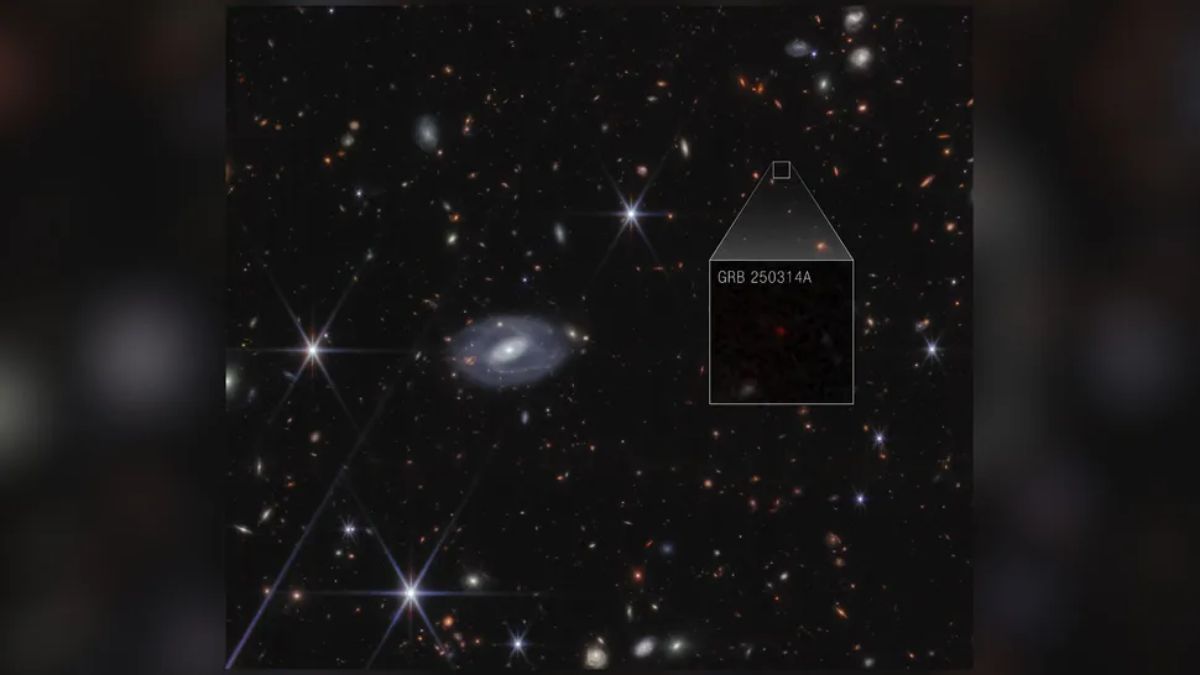
Photo Credit: Space
Webb spots record-breaking supernova, illuminating the universe’s dawn
Click Here to Add Gadgets360 As A Trusted Source


Advertisement
Astronomers with the James Webb Space Telescope (JWST) reported the discovery of the oldest supernova ever seen — a blast linked to a time when the cosmos was just around 730 million years old. As a result of its association with gamma-ray burst GRB 250314A, this finding exemplifies the power of the Webb to trace the most remote stellar explosions in the universe and to provide insight into the formation of the first galaxies and stars.
Unveiling GRB 250314A: A Stellar Explosion from the Early Universe
According to the paper, this violent event, labelled GRB 250314A, was initially identified by the French–Chinese SVOM satellite on March 14, 2025, as a bright gamma-ray flash – the extreme-energy signature of the most powerful events in the universe. Subsequent observations by ground-based telescopes and JWST enabled scientists to determine its redshift of about 7.3, thus locating the explosion only 730 million years after the Big Bang.
After that, the Near-Infrared Camera (NIRCam) of Webb captured the dim, reddened light of the supernova and the galaxy that hosted it, thereby verifying the earliest supernova as the one observed so far, and Webb's own record at 1.8 billion years after the Big Bang was broken.
Why This Discovery Matters
Such discoveries offer a unique chance to study the host environments that give rise to the first star generations in the universe. Understanding star formation, metal production, and galaxy growth well below these extremely early times is possible because JWST resolves the host galaxy. This outcome validates Webb's potent ability to examine individual stellar explosions from the first billion years of the universe, providing fresh perspectives on cosmic origins.
Comments
Get your daily dose of tech news, reviews, and insights, in under 80 characters on Gadgets 360 Turbo. Connect with fellow tech lovers on our Forum. Follow us on X, Facebook, WhatsApp, Threads and Google News for instant updates. Catch all the action on our YouTube channel.
Related Stories


Advertisement
Follow Us




-
01:42
[Sponsored] Galaxy Watch9 for Everyday Health Insights | Smarter Wellness Choices -
01:15
[Sponsored] Galaxy Tab S10 Lite for Students: Notes, Solve Math and More -
04:17
[Sponsored] LG NANO 4K UHD AI TV NU885: Gemini Search, Dolby Atmos & 5 Years of Updates -
00:57
[Sponsored] Samsung Galaxy Z Fold8 My Fan Cam in Action: Find the Moment, Then Share It -
01:41
[Sponsored] What Do You Need To Know Before Your Next Run? | Samsung Galaxy Watch Ultra2
-
NVIDIA के सीईओ ने पेश किए माइक्रोडक रोबोट, AI से चलते हैं, क्या काम आएंगे
-
iPhone Duo को बीच से खोला, फोल्डेबल डिस्प्ले से हटाया कवर, फिर क्या दिखा?
-
1 जनवरी से फोन में बिना सिम नहीं चलेगा WhatsApp, सिम बाइडिंग हुआ अनिवार्य
-
Amazon Sale में ₹23 हजार से सस्ता मिल रहा ₹50 हजार एमआरपी वाला 43 इंच Xiaomi स्मार्ट TV
-
₹200 में Airtel लाई YouTube Premium, JioHotstar, Prime Video जैसे ऐप्स का सब्सक्रिप्शन, Jio, Vi की छुट्टी!
Advertisement
Popular on Gadgets
- Samsung Galaxy S26 Ultra
- Motorola Razr Fold
- ChatGPT
- OPPO Find N6
- Mobiles Under Rs. 40,000
- Vivo X300 Ultra
- Asus Zenbook S14
- iQOO 15
- Vivo X300 Pro
- Lenovo Yoga Slim 7i Aura Edition
- iQOO 15R
- Vivo X Fold 5
- Sony PlayStation 5
- HP OmniPad 12
- OnePlus Nord CE 6 Lite
- OnePlus Pad 4
- OPPO F33 Pro 5G
- Cryptocurrency
- HP OmniBook Ultra 14 (2026)
- iPhone 17
- Eureka Forbes AP 355 Room Air Purifier
- Latest Mobile Phones
- Compare Phones
Latest Gadgets
- HMD 2660 Flip Senior Edition
- Lava Aura Curve
- Poco X8s
- Samsung Galaxy F70 5G
- Tecno Spark 50S 5G
- Vivo Y600s Pro
- Vivo Y32 (2026)
- Infinix Smart 20 HD
- Lenovo Yoga 9n 2-in-1
- Lenovo Yoga Pro 9n
- Amazon Alexa Tablet 8
- Amazon Alexa Tablet 11
- Pebble Qore 2
- Amazfit T-Rex Dual Solar
- Toshiba 65-Inch 4K Ultra HD Smart Mini LED QLED TV (65Z670SP)
- Haier M70 Mini LED 65-inch
- Acer Predator Atlas 8
- Asus ROG Ally
- Blue Star 1.5 Ton 5 Star Inverter Split AC (IE518ZNURS)
- Blue Star 2 Ton 3 Star Inverter Window AC (WIE324L)

- About Us
- Sitemaps
- Feedback
- Archives
- Contact Us
- RSS
- Advertise
- Career
- Privacy Policy
- Ethics
- Editorial Policy
- Terms & Conditions
- Complaint Redressal
Download Our Apps
Available in Hindi
© Copyright Red Pixels Ventures Limited 2026. All rights reserved.