-
 JWST Watches HD 80606 bExoplanet Heat Up by 1,100 Degrees in Hours19 June 2026
 -
Scientists May Have Solved the Missing Sulfur Mystery in Star-Forming Clouds16 June 2026
-
Astronomers Discover Two Galaxies That Appear to Lack Dark Matter10 June 2026
-
James Webb Space Telescope Weighs Most Distant Dormant Black Hole Ever Detected9 June 2026
-
Astrophotographer Captures Giant Human-Shaped Solar Prominence8 June 2026
- Home
- Science
- Science News
- ESA Telescopes Capture Ultra Fast Winds Blasting From Distant Supermassive Black Hole
ESA Telescopes Capture Ultra-Fast Winds Blasting From Distant Supermassive Black Hole
Astronomers observed the supermassive black hole in galaxy NGC 3783 ejecting ultra-fast winds after a powerful X-ray flare. The outflow reached nearly 20% the speed of light, offering rare insights into how black holes shape their host galaxies.
Written by Gadgets 360 Staff | Updated: 11 December 2025 18:53 IST
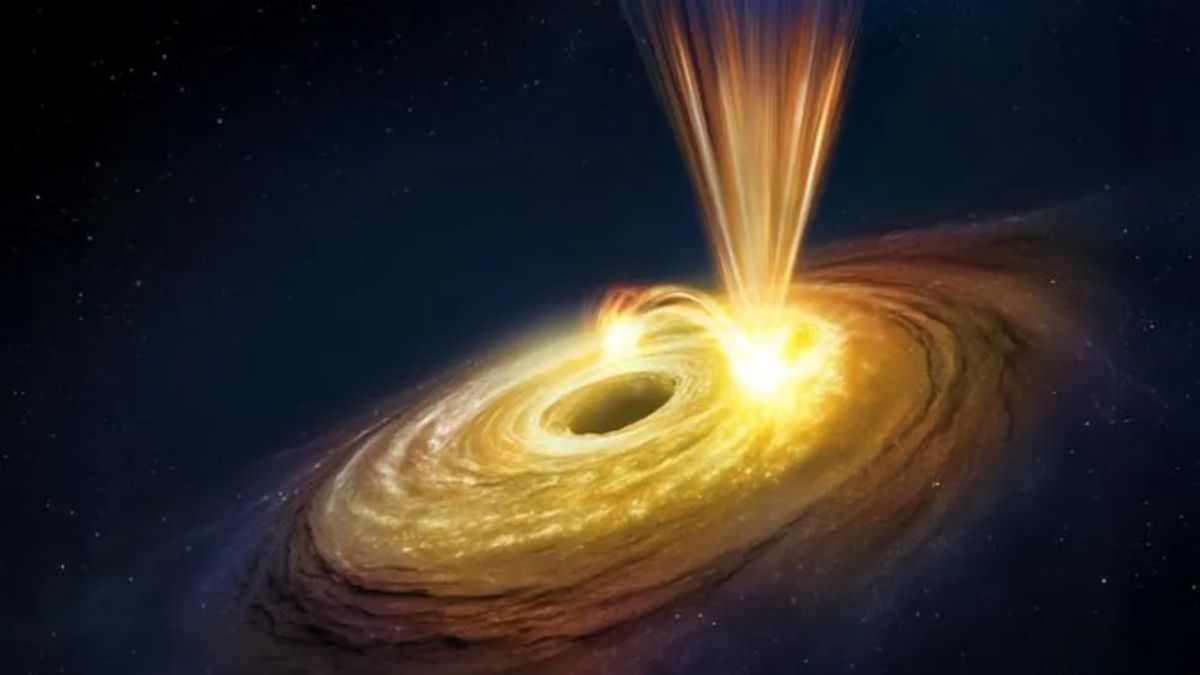
Photo Credit: Space
lack hole in NGC 3783 blasts matter at 20% light speed
Click Here to Add Gadgets360 As A Trusted Source


Advertisement
This time, astronomers have observed the black hole in galaxy NGC 3783 with a mass of approximately 30 million solar masses expelling matter at approximately 20 per cent the speed of light. Based on ESA XRISM and XMM-Newton X-ray telescopes, they observed a burst of X-ray an hour later and then some hours later, ultra-fast winds moving debris at approximately 134 million miles per hour. The outflow, which was caused by this flare, is unprecedented, and it changes the dynamics of black holes.
Unleashing a Cosmic Storm
According to the paper, the team first saw a brief, intense X-ray blast erupt from the galaxy's nucleus, then detected a gale of charged gas whipping outward at ~60,000 km/s (≈134 million mph). Researchers compare the burst to a titanic version of the Sun's coronal mass ejection: tangled magnetic fields around the black hole suddenly snapped and "untwisted," launching the plasmasciencedaily.com. By comparison, even the Sun's largest flares eject plasma at only a few million miles per hour, underlining how gargantuan this black hole storm is.
Cosmic Feedback and Galaxy Evolution
Blasts like this help explain how supermassive black holes influence their host galaxies. Lightweight jets and winds are capable of blowing out gas, and thus they might be used to stop star formation, or they can compress clouds, leading to the creation of new stars. Scientists observe that the studies of such active galactic nucleus (AGN) events, which look a little windy, are crucial in learning how black holes control the growth of galaxies with time. This live view of a black hole in its temper tantrum is a glimpse of the complicated process of self-feedback that forms galaxies in the universe.
Comments
Get your daily dose of tech news, reviews, and insights, in under 80 characters on Gadgets 360 Turbo. Connect with fellow tech lovers on our Forum. Follow us on X, Facebook, WhatsApp, Threads and Google News for instant updates. Catch all the action on our YouTube channel.
Related Stories


Advertisement
Follow Us




-
04:37
[Sponsored]: CP PLUS CarKam CP-F89B: 4K Dashcam With Rear Camera, GPS & Emergency Recording -
04:23
[Partner Content] Your Phone Can Do WAY More Than You Think | OPPO ColorOS 16 -
01:59
Samsung Galaxy Z Fold8 Ultra: Unfold the Ultra Night -
03:24
Apple Pay Launches In India: Supported Devices, Cards And Payments Explained -
00:21
[Sponsored] Samsung Galaxy Z Fold8, Fold8 Ultra
-
Amazon Great Indian Festival Sale: iPhone 17 Pro पर बंपर डील
-
Flipkart Big Billion Days Sale: ₹8K से सस्ता मिल रहा Google Pixel 10a
-
भारत में दुनिया का सबसे सस्ता इंटरनेट, 1GB की कीमत सिर्फ 8 रुपये
-
iQOO Pad Pro पेश हुआ 8.8 इंच डिस्प्ले, Q3 गेमिंग चिप के साथ, प्री-ऑर्डर शुरू
-
Amazon की ग्रेट इंडियन फेस्टिवल सेल में Apple, Lenovo और कई ब्रांड्स के टैबलेट्स पर भारी डिस्काउंट
Advertisement
Popular on Gadgets
- Samsung Galaxy S26 Ultra
- Motorola Razr Fold
- ChatGPT
- OPPO Find N6
- Mobiles Under Rs. 40,000
- Vivo X300 Ultra
- Asus Zenbook S14
- iQOO 15
- Vivo X300 Pro
- Lenovo Yoga Slim 7i Aura Edition
- iQOO 15R
- Vivo X Fold 5
- Sony PlayStation 5
- HP OmniPad 12
- OnePlus Nord CE 6 Lite
- OnePlus Pad 4
- OPPO F33 Pro 5G
- Cryptocurrency
- HP OmniBook Ultra 14 (2026)
- iPhone 17
- Eureka Forbes AP 355 Room Air Purifier
- Latest Mobile Phones
- Compare Phones
Latest Gadgets
- Vivo Y600s Pro
- Vivo Y32 (2026)
- Infinix Smart 20 HD
- Vivo V80
- Vivo S2 FE
- Vivo Y600K Turbo
- Realme P4s Lite
- Vivo S60t
- Dell Pro Rugged 14
- Dell Pro Rugged 13 Extreme
- Amazon Alexa Tablet 8
- Amazon Alexa Tablet 11
- Amazfit T-Rex Dual Solar
- OPPO Watch S2
- Toshiba 65-Inch 4K Ultra HD Smart Mini LED QLED TV (65Z670SP)
- Haier M70 Mini LED 65-inch
- Acer Predator Atlas 8
- Asus ROG Ally
- Blue Star 1.5 Ton 5 Star Inverter Split AC (IE518ZNURS)
- Blue Star 2 Ton 3 Star Inverter Window AC (WIE324L)

- About Us
- Sitemaps
- Feedback
- Archives
- Contact Us
- RSS
- Advertise
- Career
- Privacy Policy
- Ethics
- Editorial Policy
- Terms & Conditions
- Complaint Redressal
Download Our Apps
Available in Hindi
© Copyright Red Pixels Ventures Limited 2026. All rights reserved.