-
 Supermassive Black Hole May Be Hiding in Large Magellanic Cloud, Scientists Suggest10 March 2025
 -
A Neptune-Like Exoplanet Is Racing Through Space at Record Speed17 February 2025
-
Astronomers Spot a High-Speed Star That May Carry a Planet With It14 February 2025
-
A Star With a Planet May Be Racing Through the Galaxy at Record Speed12 February 2025
-
Fastest-Moving Stars in the Galaxy May be Piloted by Aliens, New Study Suggests22 November 2024
- Home
- Science
- Science News
- Runaway Stars Help Astronomers Trace Dark Matter Distribution Across the Milky Way Galaxy
Runaway Stars Help Astronomers Trace Dark Matter Distribution Across the Milky Way Galaxy
Hypervelocity stars are helping astronomers trace the Milky Way’s gravity and dark matter halo.
Written by Gadgets 360 Staff | Updated: 2 January 2026 16:21 IST
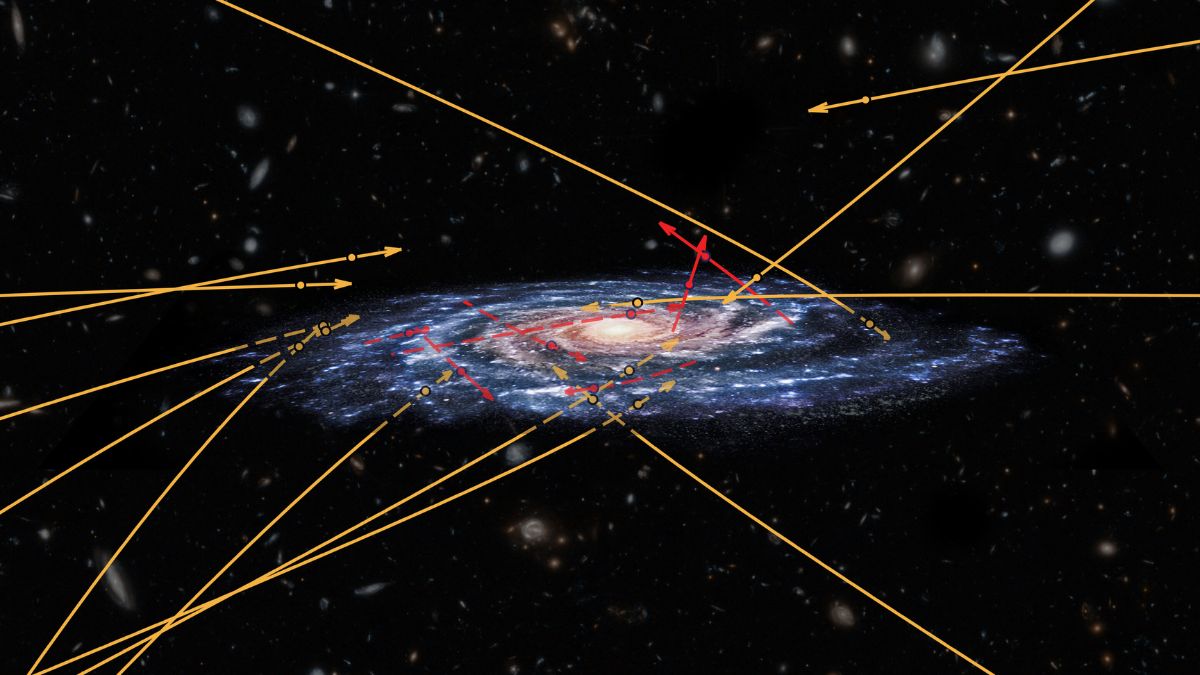
Photo Credit: NASA/ESA/Hubble
Hypervelocity stars race through space, helping scientists map the Milky Way’s dark matter halo.
Click Here to Add Gadgets360 As A Trusted Source


Advertisement
Astronomers have had their sights set on fast-moving runaway stars as a potent new means to probe the hidden structure of the Milky Way. These rare objects, called hypervelocity stars, travel so rapidly that they can escape the galaxy's gravity. Tracking the motion of those stars, scientists can then learn more about how mass is distributed through the Milky Way and around its invisible dark matter. A new large-scale search has now identified dozens of such stars, offering fresh insight into the galaxy's gravitational pull and its vast outer halo.
RR Lyrae Stars Help Trace Origins of Hypervelocity Stars Ejected from the Milky Way's Core
According to a report published in The Astrophysical Journal, the study was performed by astronomers from scientific institutes in Beijing, led by Haozhu Fu of Peking University, on the RR Lyrae stars. Those stars pulse in an orderly manner, so their distances can be measured simply with the help of data from the Sloan Digital Sky Survey and the Gaia space telescope.
Hypervelocity stars travel faster than 1,000 km/s and are ejected by encounters involving Sagittarius A* in the galactic centre – one star is stripped while its companion is captured.
87 Hypervelocity RR Lyrae Stars Offer New Clues to the Milky Way's Gravity and Dark Matter Halo
The researchers started with over a lakh of RR Lyrae stars and scrutinised the data closely. This dropped the sample to 87 strong runaway star candidates, including some clustered around the galactic centre and others by the Magellanic Clouds.
By tracking these stars back to where they came from, scientists can map the gravitational field of the Milky Way. This helps to explain how dark matter spreads through the galaxy's halo and gets researchers a step closer to unravelling one of physics' greatest mysteries.
Comments
Catch the latest from the Consumer Electronics Show on Gadgets 360, at our CES 2026 hub.
Related Stories





Advertisement
Follow Us




-
08:02
Top OxygenOS 16 Features You Must Know: Don't Miss These OnePlus Features On Your Phone! -
10:42
[Partner Content] OPPO Find X9 Two Week Experience: Here's Why It Stands Out -
04:38
Realme Watch 5 Review: Watch This Before You Buy The Latest Realme Smartwatch -
07:03
Vivo X300 Pro Review | Best Camera Phone You Can Buy For 2026 -
04:56
Vivo X300 Review | Best Flagship of 2025? | Unbelievable Camera & Performance Test
Advertisement
Popular on Gadgets
- Samsung Galaxy Unpacked 2025
- ChatGPT
- Redmi Note 14 Pro+
- iPhone 16
- Apple Vision Pro
- Oneplus 12
- OnePlus Nord CE 3 Lite 5G
- iPhone 13
- Xiaomi 14 Pro
- Oppo Find N3
- Tecno Spark Go (2023)
- Realme V30
- Best Phones Under 25000
- Samsung Galaxy S24 Series
- Cryptocurrency
- iQoo 12
- Samsung Galaxy S24 Ultra
- Giottus
- Samsung Galaxy Z Flip 5
- Apple 'Scary Fast'
- Housefull 5
- GoPro Hero 12 Black Review
- Invincible Season 2
- JioGlass
- HD Ready TV
- Laptop Under 50000
- Smartwatch Under 10000
- Latest Mobile Phones
- Compare Phones
Latest Gadgets
- OPPO Reno 15 Pro Max
- Honor Win RT
- Honor Win
- Xiaomi 17 Ultra Leica Edition
- Xiaomi 17 Ultra
- Huawei Nova 15
- Huawei Nova 15 Pro
- Huawei Nova 15 Ultra
- Asus ProArt P16
- MacBook Pro 14-inch (M5, 2025)
- OPPO Pad Air 5
- Huawei MatePad 11.5 (2026)
- Xiaomi Watch 5
- Huawei Watch 10th Anniversary Edition
- Acerpure Nitro Z Series 100-inch QLED TV
- Samsung 43 Inch LED Ultra HD (4K) Smart TV (UA43UE81AFULXL)
- Asus ROG Ally
- Nintendo Switch Lite
- Haier 1.6 Ton 5 Star Inverter Split AC (HSU19G-MZAID5BN-INV)
- Haier 1.6 Ton 5 Star Inverter Split AC (HSU19G-MZAIM5BN-INV)

- About Us
- Sitemaps
- Feedback
- Archives
- Contact Us
- RSS
- Advertise
- Career
- Privacy Policy
- Ethics
- Editorial Policy
- Terms & Conditions
- Complaint Redressal
Download Our Apps
Available in Hindi
© Copyright Red Pixels Ventures Limited 2026. All rights reserved.