- Home
- Science
- Science News
- Astronomers Decode the Strange Behaviour of a Young Star 1,950 Light Years Away
Astronomers Decode the Strange Behaviour of a Young Star 1,950 Light-Years Away
Long-term data reveal V1180 Cassiopeiae as a rare hybrid young star shaped by accretion and dust.
Written by Gadgets 360 Staff | Updated: 2 January 2026 16:28 IST
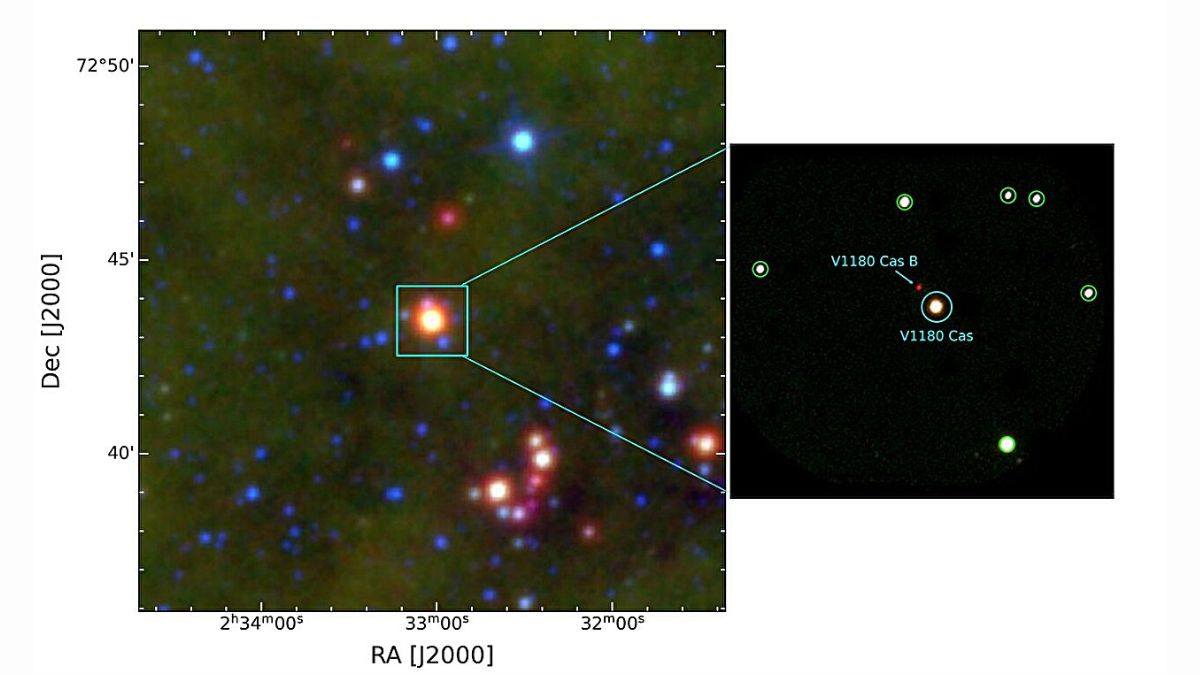
Photo Credit: arXiv (2025)
Long-term observations reveal the hybrid nature of young star V1180 Cassiopeiae.
Click Here to Add Gadgets360 As A Trusted Source


Advertisement
The early life of stars has begun to unveil for researchers after new data shed light on the behaviour of V1180 Cassiopeiae, a young star that lies just over 1,950 light-years away. Astronomers have discovered that the star does not act like a single, simple star. Instead, it becomes brighter during episodes of material falling on its surface and dims when thick clouds of dust transit the line of sight. This rare mix explains years of confusing observations and highlights how messy and active star formation can be inside dusty regions of space.
Study Reveals V1180 Cassiopeiae's Unusual Dual Behavior Across Young Stellar Object Classes
According to an arXiv preprint report published on December 23, the research has been conducted by the astronomers from Aryabhatta Research Institute of Observational Sciences (ARIES) as well as international collaborators. The researchers analysed long-term brightness measurements taken between 1999 and 2025, which were complemented by more than 30 detailed observations in visible and near-infrared light to trace how features evolved over time.
Young stellar objects are stars that are in the process of forming from the gas and dust around them. Some flare as they accrete more; others dim when dust swoops in to eclipse them. Scientists usually group these behaviours into EXors, FUors and UXors, but growing evidence suggests some stars show mixed traits.
Brightness Dips and Spectral Clues Point to V1180 Cassiopeiae as a Rare Hybrid Young Star
V1180 Cassiopeiae was first labelled as an EXor. Later data showed dimming patterns linked to dust, raising doubts about that classification. The new analysis confirms that both processes are active.
Researchers noted strong emission lines linked to accretion and outflows, which changed with brightness. It was concluded that extinction and accretion are closely connected, making V1180 Cassiopeiae a rare hybrid young star.
Comments
Get your daily dose of tech news, reviews, and insights, in under 80 characters on Gadgets 360 Turbo. Connect with fellow tech lovers on our Forum. Follow us on X, Facebook, WhatsApp, Threads and Google News for instant updates. Catch all the action on our YouTube channel.


Advertisement
Follow Us




-
04:23
[Partner Content] Your Phone Can Do WAY More Than You Think | OPPO ColorOS 16 -
01:59
Samsung Galaxy Z Fold8 Ultra: Unfold the Ultra Night -
03:24
Apple Pay Launches In India: Supported Devices, Cards And Payments Explained -
00:21
[Sponsored] Samsung Galaxy Z Fold8, Fold8 Ultra -
03:41
[Sponsored] Samsung Galaxy Z Fold8: How It Fits Into an Actor’s Busy Day | Camera, Multitasking & More
-
iQOO Pad Ultra 165Hz AMOLED डिस्प्ले के साथ हुआ लॉन्च
-
Apple Pay की भारत में एंट्री, सीधा iPhone और स्मार्टवॉच से होगी पेमेंट
-
भारत में बच्चों के सोशल मीडिया पर लगेगा बैन? सरकार उठा सकती है बड़ा कदम
-
Samsung Galaxy Tab S12 Ultra, Galaxy Tab S12+ लॉन्च, 11600mAh की बड़ी बैटरी और 16GB तक RAM
-
Oppo F35 सीरीज में मिलेगा 50 मेगापिक्सल का प्राइमरी कैमरा, अगले सप्ताह भारत में लॉन्च
Advertisement
Popular on Gadgets
- Samsung Galaxy S26 Ultra
- Motorola Razr Fold
- ChatGPT
- OPPO Find N6
- Mobiles Under Rs. 40,000
- Vivo X300 Ultra
- Asus Zenbook S14
- iQOO 15
- Vivo X300 Pro
- Lenovo Yoga Slim 7i Aura Edition
- iQOO 15R
- Vivo X Fold 5
- Sony PlayStation 5
- HP OmniPad 12
- OnePlus Nord CE 6 Lite
- OnePlus Pad 4
- OPPO F33 Pro 5G
- Cryptocurrency
- HP OmniBook Ultra 14 (2026)
- iPhone 17
- Eureka Forbes AP 355 Room Air Purifier
- Latest Mobile Phones
- Compare Phones
Latest Gadgets
- OPPO K15x
- OPPO K15s
- HMD Vibe 2 Pro 5G
- OPPO K14 Plus 5G
- Lava Shark 2 Pro 5G
- Ai+ Pulse 2 FE
- OPPO Reno 16t
- Itel Zeno 300
- Dell 14 Plus 2-in-1 (AMD Ryzen AI 7 350, 2025)
- Microsoft Surface Laptop, 13-inch (2nd Edition)
- Samsung Galaxy Tab S12+
- Samsung Galaxy Tab S12 Ultra
- Amazfit T-Rex Dual Solar
- OPPO Watch S2
- Toshiba 65-Inch 4K Ultra HD Smart Mini LED QLED TV (65Z670SP)
- Haier M70 Mini LED 65-inch
- Acer Predator Atlas 8
- Asus ROG Ally
- Blue Star 1.5 Ton 5 Star Inverter Split AC (IE518ZNURS)
- Blue Star 2 Ton 3 Star Inverter Window AC (WIE324L)

- About Us
- Sitemaps
- Feedback
- Archives
- Contact Us
- RSS
- Advertise
- Career
- Privacy Policy
- Ethics
- Editorial Policy
- Terms & Conditions
- Complaint Redressal
Download Our Apps
Available in Hindi
© Copyright Red Pixels Ventures Limited 2026. All rights reserved.