-
 Total Solar Eclipse Today: How to Watch Live Online, Timings, Safety Tips, and More12 August 2026
 -
JWST Watches HD 80606 bExoplanet Heat Up by 1,100 Degrees in Hours19 June 2026
-
Chandra Captures Sharpest-Ever X-Ray View of M87 Black Hole Jet18 June 2026
-
Astrophotographer Captures Giant Human-Shaped Solar Prominence8 June 2026
-
Blue Origin’s New Glenn Rocket Explodes During Pre-Launch Test in Florida29 May 2026
- Home
- Science
- Science News
- Scientists Discover 77 Rare Red Quasars Hidden Behind Cosmic Dust
Scientists Discover 77 Rare Red Quasars Hidden Behind Cosmic Dust
Astronomers have identified 77 rare “red quasars” hidden behind thick cosmic dust using NASA’s SPHEREx telescope. The discoveries support theories that galaxy collisions trigger rapid black hole growth and intense star formation.
Written by Gadgets 360 Staff | Updated: 25 May 2026 20:18 IST
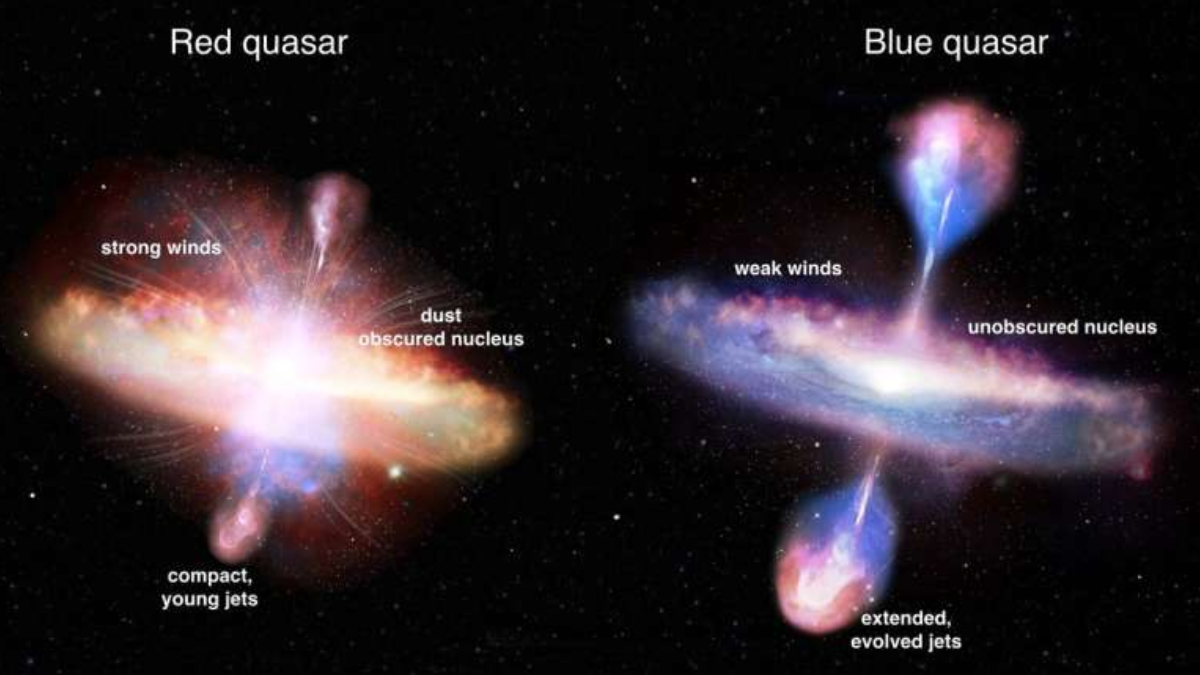
Photo Credit: S. Munro
Artist's impression of red and blue quasars.
Click Here to Add Gadgets360 As A Trusted Source


Advertisement
In the center of many large galaxies lies a supermassive black hole. If such black holes start accreting matter, then they form quasars, some of the most luminous celestial bodies in the cosmos. However, there are some quasars whose light gets obscured by the dust and which appear faint and red. Scientists have discovered 77 such "red quasars" recently, proving that they are in fact an important stage of galaxy development.
When Galaxies Collide
The current galaxy evolution theory states that galaxy mergers trigger a chain reaction process in the universe. The gas clouds run to the center of these galaxies during the collision of galaxies, and in the process, additional stars and even the supermassive black hole at the center of the galaxy are formed. A black hole is formed behind a curtain of gas and dust, which leads to the rapid growth of the black hole and the formation of a reddened quasar in the optical bands. Its occurrence had long been rumoured for many years, but its discovery was extremely difficult.
Cosmic Winds and a Clean Sweep
Observations with the NASA space-based telescope SPHEREX have led to the discovery of another 77 examples of quasars with high redshift, indicating that they originated billions of years ago when the universe was at its peak activity in terms of star formation. Crucially, these objects are those that shine very brightly with light but poorly with hot dust; thus, they must be dispersing the hot dust surrounding them. Scientists had already found compelling evidence of molecular gas flows at 500 km/sec to 1,000 km/sec in reddened quasars.
Comments
Get your daily dose of tech news, reviews, and insights, in under 80 characters on Gadgets 360 Turbo. Connect with fellow tech lovers on our Forum. Follow us on X, Facebook, WhatsApp, Threads and Google News for instant updates. Catch all the action on our YouTube channel.
Further reading:
NASA, SPHEREx, Quasar, supermassive black holes, galaxy evolution, astronomy, cosmic dust, astrophysics, deep space
Related Stories





Advertisement
Follow Us




-
04:37
[Sponsored]: CP PLUS CarKam CP-F89B: 4K Dashcam With Rear Camera, GPS & Emergency Recording -
04:23
[Partner Content] Your Phone Can Do WAY More Than You Think | OPPO ColorOS 16 -
01:59
Samsung Galaxy Z Fold8 Ultra: Unfold the Ultra Night -
03:24
Apple Pay Launches In India: Supported Devices, Cards And Payments Explained -
00:21
[Sponsored] Samsung Galaxy Z Fold8, Fold8 Ultra
-
Amazon Great Indian Festival Sale 2026: ₹15,999 से शुरू स्मार्टफोन डील्स
-
घर की दीवार बनेगी 120 इंच की सिनेमा स्क्रीन! Lumio Arc 7 (2026) हुआ लॉन्च
-
Amazon Great Indian Festival Sale 2026: ₹18 हजार सस्ता मिलेगा iPhone 16!
-
Oppo Find X10 Pro Max जल्द होगा भारत में लॉन्च, MediaTek Dimensity 9600 Pro चिपसेट
-
Lenovo ने लॉन्च किया AI फीचर्स वाला ThinkBook 14x लैपटॉप, आपकी पसंद के मिलेंगे फीचर्स
Advertisement
Popular on Gadgets
- Samsung Galaxy S26 Ultra
- Motorola Razr Fold
- ChatGPT
- OPPO Find N6
- Mobiles Under Rs. 40,000
- Vivo X300 Ultra
- Asus Zenbook S14
- iQOO 15
- Vivo X300 Pro
- Lenovo Yoga Slim 7i Aura Edition
- iQOO 15R
- Vivo X Fold 5
- Sony PlayStation 5
- HP OmniPad 12
- OnePlus Nord CE 6 Lite
- OnePlus Pad 4
- OPPO F33 Pro 5G
- Cryptocurrency
- HP OmniBook Ultra 14 (2026)
- iPhone 17
- Eureka Forbes AP 355 Room Air Purifier
- Latest Mobile Phones
- Compare Phones
Latest Gadgets
- Vivo Y32 (2026)
- Infinix Smart 20 HD
- Vivo V80
- Vivo S2 FE
- Vivo Y600K Turbo
- Realme P4s Lite
- Vivo S60t
- OPPO F35 5G
- Lenovo ThinkBook 14x
- Dell 14 Plus 2-in-1 (AMD Ryzen AI 7 350, 2025)
- Samsung Galaxy Tab S12+
- Samsung Galaxy Tab S12 Ultra
- Amazfit T-Rex Dual Solar
- OPPO Watch S2
- Toshiba 65-Inch 4K Ultra HD Smart Mini LED QLED TV (65Z670SP)
- Haier M70 Mini LED 65-inch
- Acer Predator Atlas 8
- Asus ROG Ally
- Blue Star 1.5 Ton 5 Star Inverter Split AC (IE518ZNURS)
- Blue Star 2 Ton 3 Star Inverter Window AC (WIE324L)

- About Us
- Sitemaps
- Feedback
- Archives
- Contact Us
- RSS
- Advertise
- Career
- Privacy Policy
- Ethics
- Editorial Policy
- Terms & Conditions
- Complaint Redressal
Download Our Apps
Available in Hindi
© Copyright Red Pixels Ventures Limited 2026. All rights reserved.