-
 SETI Scientists Searched Interstellar Comet 3I/ATLAS for Alien Signals7 June 2026
 -
A Visitor from Another Star: Interstellar Comet Reveals Alien Origins26 April 2026
-
Hubble Telescope Captures Comet Reversing Its Rotation for the First Time27 March 2026
-
SPHEREx Captures Dramatic Outburst of Interstellar Comet 3I/ATLAS11 February 2026
-
NASA’s SPHEREx Spots Interstellar Comet Flaring With Gas and Organic Molecules9 February 2026
- Home
- Science
- Science News
- NASA Observes Rare Sungrazer Comet Disintegration Near the Sun
NASA Observes Rare Sungrazer Comet Disintegration Near the Sun
Astronomers observed the sungrazing comet C/2026 A1 (MAPS) disintegrate as it passed extremely close to the Sun. Captured by multiple NASA spacecraft, the comet broke apart before reaching its closest approach, leaving behind a cloud of dust and gas.
Written by Gadgets 360 Staff | Updated: 19 April 2026 18:00 IST
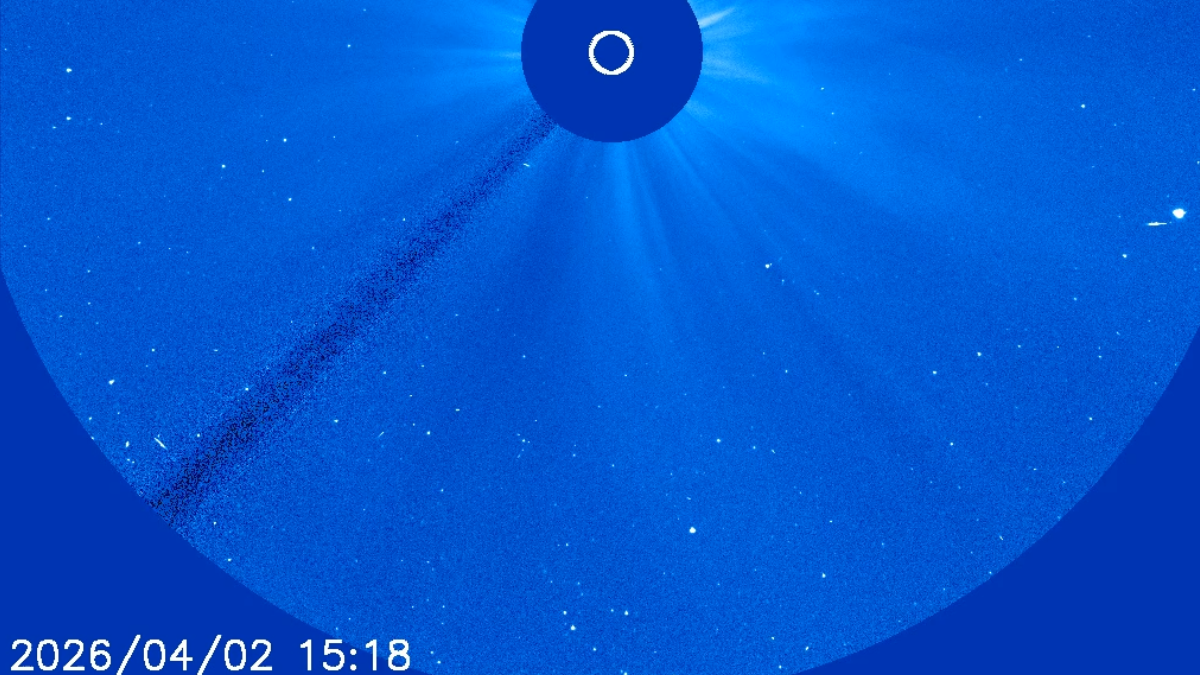
Photo Credit: NASA
SOHO coronagraph captures comet C/2026 A1 approaching Sun, leaving dust after close pass.
Click Here to Add Gadgets360 As A Trusted Source


Advertisement
In April 2026, C/2026 A1 (MAPS), a sungrazer comet, fell into the proximity of the Sun along a steep trajectory. Part of the Kreutz sungrazer family, MAPS was first detected by amateurs several months before its demise. Its approach to perihelion was registered by NASA probes, which observed that the comet did not survive its encounter with the Sun. Data collected on the comet's evaporation in the solar atmosphere helps to have a better understanding of its structure and the formation of the early solar system.
Solar Missions Observe Comet MAPS
According to a NASA news release, multiple NASA spacecraft observed Comet MAPS. SOHO's LASCO coronagraph saw the comet intact approaching the Sun, but only a dust cloud emerged after perihelion. From a different angle, the STEREO probe showed the comet swinging around the Sun and then vanishing. The principal investigator for SOHO's coronagraph notes MAPS "was clearly destroyed — likely several hours before its closest approach to the Sun". NASA's new PUNCH mission also imaged MAPS before the close approach (April 1) and will track its tail under the influence of the solar wind. Similarly, Parker Solar Probe's WISPR instrument captured a different sungrazing comet in 2020, confirming that intense sunlight causes these comets to disintegrate.
Why Comets Break Up Near the Sun
Due to the heating of its ice caused by proximity to the Sun, pressure builds up inside the comet, causing its nucleus to break into pieces. Other forces that act on the comet include tidal force exerted by the Sun and the fast velocity at which it travels (about 1.6 million km per hour). As a consequence, all that remains behind are gases and dust. The study of comets breaking apart is important for several reasons.
Comments
Get your daily dose of tech news, reviews, and insights, in under 80 characters on Gadgets 360 Turbo. Connect with fellow tech lovers on our Forum. Follow us on X, Facebook, WhatsApp, Threads and Google News for instant updates. Catch all the action on our YouTube channel.
Further reading:
comets, sungrazer, C/2026 A1 MAPS, SOHO, NASA, STEREO, Parker Solar Prob, solar system, astrophysics
Related Stories




Advertisement
Follow Us




-
04:17
[Sponsored] LG NANO 4K UHD AI TV NU885: Gemini Search, Dolby Atmos & 5 Years of Updates -
00:57
[Sponsored] Samsung Galaxy Z Fold8 My Fan Cam in Action: Find the Moment, Then Share It -
01:41
[Sponsored] What Do You Need To Know Before Your Next Run? | Samsung Galaxy Watch Ultra2 -
01:32
[Sponsored] Big Day Tomorrow? Prep Today | Samsung Galaxy Watch Ultra2 -
04:37
[Sponsored]: CP PLUS CarKam CP-F89B: 4K Dashcam With Rear Camera, GPS & Emergency Recording
-
आ गई हवा में उड़ने वाली Tesla Roadster कार, आखिर सच हुआ फिल्मों वाला कमाल
-
रोबोट ने की लड़की से छेड़छाड़, पीछे से पकड़ा और किए गंदे इशारे, जानें
-
PS5 कहां मिलेगा सस्ता, Flipkart या Amazon, जानें सबकुछ
-
Flipkart Big Billion Sale 2026: ₹10 हजार से ₹15 हजार में मिल रहे Mivi, Lava, Boltt के AI कैमरा फोन
-
Vi Prepaid Family Plan: Vi लाई फैमिली प्लान, अब फैमिली मेंबर्स को शेयर करें मोबाइल डेटा
Advertisement
Popular on Gadgets
- Samsung Galaxy S26 Ultra
- Motorola Razr Fold
- ChatGPT
- OPPO Find N6
- Mobiles Under Rs. 40,000
- Vivo X300 Ultra
- Asus Zenbook S14
- iQOO 15
- Vivo X300 Pro
- Lenovo Yoga Slim 7i Aura Edition
- iQOO 15R
- Vivo X Fold 5
- Sony PlayStation 5
- HP OmniPad 12
- OnePlus Nord CE 6 Lite
- OnePlus Pad 4
- OPPO F33 Pro 5G
- Cryptocurrency
- HP OmniBook Ultra 14 (2026)
- iPhone 17
- Eureka Forbes AP 355 Room Air Purifier
- Latest Mobile Phones
- Compare Phones
Latest Gadgets
- Tecno Spark 50S 5G
- Vivo Y600s Pro
- Vivo Y32 (2026)
- Infinix Smart 20 HD
- Vivo V80
- Vivo S2 FE
- Vivo Y600K Turbo
- Realme P4s Lite
- HP ZBook Ultra G3a
- Dell Pro Rugged 14
- Amazon Alexa Tablet 8
- Amazon Alexa Tablet 11
- Amazfit T-Rex Dual Solar
- OPPO Watch S2
- Toshiba 65-Inch 4K Ultra HD Smart Mini LED QLED TV (65Z670SP)
- Haier M70 Mini LED 65-inch
- Acer Predator Atlas 8
- Asus ROG Ally
- Blue Star 1.5 Ton 5 Star Inverter Split AC (IE518ZNURS)
- Blue Star 2 Ton 3 Star Inverter Window AC (WIE324L)

- About Us
- Sitemaps
- Feedback
- Archives
- Contact Us
- RSS
- Advertise
- Career
- Privacy Policy
- Ethics
- Editorial Policy
- Terms & Conditions
- Complaint Redressal
Download Our Apps
Available in Hindi
© Copyright Red Pixels Ventures Limited 2026. All rights reserved.