-
 NASA’s MAVEN Detects Rare Solar Wind Effect in Mars Atmosphere28 May 2026
 -
Scientists Develop Swarm Robots to Explore Hidden Lava Tubes on Mars27 May 2026
-
Mysterious Stacked Rocks Spotted by NASA Perseverance Rover on Mars22 May 2026
-
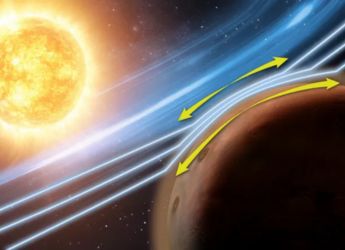
Massive Solar Storm Reveals How Mars Is Losing Its Atmosphere19 May 2026
-
New Biosignature Method Could Transform Search for Alien Life16 May 2026
- Home
- Science
- Science News
- Mars Dust Storms May Be Predictable Based on Surface Heating Patterns
Mars Dust Storms May Be Predictable Based on Surface Heating Patterns
Research shows 78% of Mars dust storms are linked to surface heating, enabling possible predictions.
Written by Gadgets 360 Staff | Updated: 12 December 2024 22:00 IST

Photo Credit: NASA/ESA/STScI
A dust storm shrouds the surface of Mars, as seen by the Hubble Space Telescope in 2018.
Click Here to Add Gadgets360 As A Trusted Source


Advertisement
New research has indicated a strong connection between warm, sunny days on Mars and the occurrence of dust storms, with nearly 78 percent of storms preceded by increased solar heating, according to a study presented at the annual meeting of the American Geophysical Union in Washington, D.C. The study, led by Heshani Pieris and Paul Hayne of the University of Colorado, Boulder, analysed data from NASA's Mars Reconnaissance Orbiter, revealing patterns that could help predict these atmospheric phenomena.
Insights into Dust Storm Patterns
The researchers investigated data spanning eight Martian years—approximately 15 Earth years—collected by the Mars Climate Sounder instrument. Observations focused on two types of dust storms, categorised as "A" and "C" storms, which primarily originate in the planet's northern hemisphere and travel through Acidalia Planitia and Utopia Planitia. The study found a direct correlation between prolonged surface heating and the emergence of these storms.
In a statement, Pieris highlighted the significant impact dust storms have on Mars missions, noting their tendency to coat solar panels with fine particles, which can disrupt operations. This was exemplified by NASA's Opportunity rover, which was rendered inoperable during a global dust storm.
Potential for Forecasting Dust Storms
Pieris and Hayne's research suggests the possibility of predicting Martian dust storms based on patterns of surface heating. An algorithm developed during the study has shown a 64% confidence level in forecasting "A" and "C" storms, offering a potential tool for managing the risks posed to future crewed missions.
While the study marks progress, as per reports, Hayne pointed out that fundamental questions about dust storm formation remain unanswered, including the factors that allow localised storms to grow into global events. Data from NASA's deactivated Mars Global Surveyor supports the findings, showing that imbalances in solar energy absorption during warmer periods can fuel storm activity.
Comments
Get your daily dose of tech news, reviews, and insights, in under 80 characters on Gadgets 360 Turbo. Connect with fellow tech lovers on our Forum. Follow us on X, Facebook, WhatsApp, Threads and Google News for instant updates. Catch all the action on our YouTube channel.
Related Stories



Advertisement
Follow Us




-
01:15
[Sponsored] Galaxy Tab S10 Lite for Students: Notes, Solve Math and More -
04:17
[Sponsored] LG NANO 4K UHD AI TV NU885: Gemini Search, Dolby Atmos & 5 Years of Updates -
00:57
[Sponsored] Samsung Galaxy Z Fold8 My Fan Cam in Action: Find the Moment, Then Share It -
01:41
[Sponsored] What Do You Need To Know Before Your Next Run? | Samsung Galaxy Watch Ultra2 -
01:32
[Sponsored] Big Day Tomorrow? Prep Today | Samsung Galaxy Watch Ultra2
Advertisement
Popular on Gadgets
- Samsung Galaxy S26 Ultra
- Motorola Razr Fold
- ChatGPT
- OPPO Find N6
- Mobiles Under Rs. 40,000
- Vivo X300 Ultra
- Asus Zenbook S14
- iQOO 15
- Vivo X300 Pro
- Lenovo Yoga Slim 7i Aura Edition
- iQOO 15R
- Vivo X Fold 5
- Sony PlayStation 5
- HP OmniPad 12
- OnePlus Nord CE 6 Lite
- OnePlus Pad 4
- OPPO F33 Pro 5G
- Cryptocurrency
- HP OmniBook Ultra 14 (2026)
- iPhone 17
- Eureka Forbes AP 355 Room Air Purifier
- Latest Mobile Phones
- Compare Phones
Latest Gadgets
- Lava Aura Curve
- Poco X8s
- Samsung Galaxy F70 5G
- Tecno Spark 50S 5G
- Vivo Y600s Pro
- Vivo Y32 (2026)
- Infinix Smart 20 HD
- Vivo V80
- HP ZBook Ultra G3a
- Dell Pro Rugged 14
- Amazon Alexa Tablet 8
- Amazon Alexa Tablet 11
- Pebble Qore 2
- Amazfit T-Rex Dual Solar
- Toshiba 65-Inch 4K Ultra HD Smart Mini LED QLED TV (65Z670SP)
- Haier M70 Mini LED 65-inch
- Acer Predator Atlas 8
- Asus ROG Ally
- Blue Star 1.5 Ton 5 Star Inverter Split AC (IE518ZNURS)
- Blue Star 2 Ton 3 Star Inverter Window AC (WIE324L)

- About Us
- Sitemaps
- Feedback
- Archives
- Contact Us
- RSS
- Advertise
- Career
- Privacy Policy
- Ethics
- Editorial Policy
- Terms & Conditions
- Complaint Redressal
Download Our Apps
Available in Hindi
© Copyright Red Pixels Ventures Limited 2026. All rights reserved.