-
 Flipkart Big Bang Diwali Sale 2026 Date Announced; iPhone 17 and More Smartphones to Be Discounted26 October 2026
 -
JWST Discovers Ancient Black Hole Older Than Its Own Galaxy31 May 2026
-
New Gravity Theory Challenges Big Bang Singularity Problem7 April 2026
-
James Webb Telescope Finds Galaxies Nearly as Old as the Early Universe11 February 2026
-
JWST Uncovers the Origins of the Universe’s First Supermassive Black Holes1 February 2026
- Home
- Science
- Science News
- Universe’s First Stars May Have Been Smaller Than Astronomers Once Believed
Universe’s First Stars May Have Been Smaller Than Astronomers Once Believed
Two new studies show turbulence and molecular cooling allowed the first stars to form at smaller sizes.
Written by Gadgets 360 Staff | Updated: 9 September 2025 17:34 IST
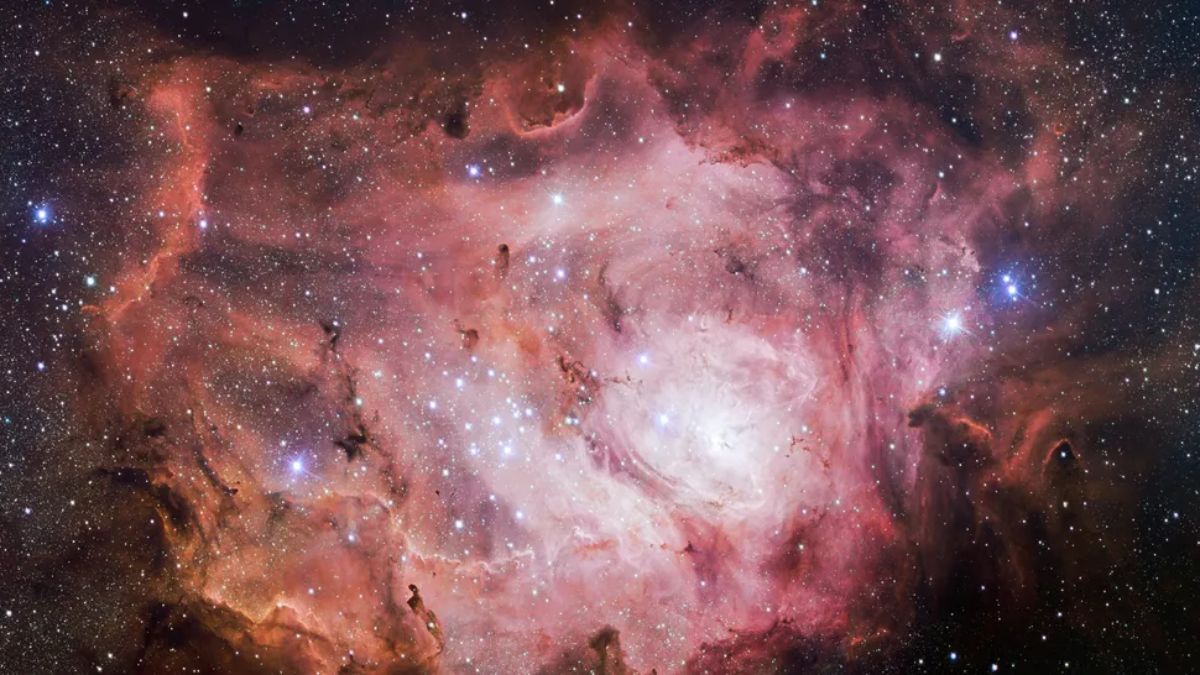
Photo Credit: ESO/VPHAS+
Astronomers once thought the universe's first stars (made of hydrogen and helium) were nearly all giants
Click Here to Add Gadgets360 As A Trusted Source


Advertisement
Astronomers once thought the universe's first stars (made of hydrogen and helium) were nearly all giants, hundreds to thousands of times the Sun's mass. For decades, astronomers assumed only huge clouds could collapse in the early universe. Now two new studies challenge that picture. One team ran simulations of collapsing clouds, and another did lab experiments on early-universe chemistry. Both found ways to cool and fragment the gas more effectively, suggesting some first-generation stars could have been much smaller than previously believed.
Turbulence and Star Formation
In the Astrophysical Journal Letters, astrophysicist Ke-Jung Chen reported that each collapsing cloud in primordial gas clouds can be broken up into numerous smaller clumps by supersonic turbulence. Their simulation demonstrated that fragments as small as about one solar mass can form due to chaotic gas flows.
The group came to the conclusion that stars with turbulence could have masses ranging from about one to forty times that of the Sun. That is, low-mass suns may have coexisted with the giants in the first generation of stars.
Primordial Chemistry and Cooling
Under the direction of Florian Grussie, another research team discovered that helium hydride ions (HeH⁺), the first molecule in the universe, could form and persist in greater quantities than anticipated. Their findings were published in Astronomy & Astrophysics.
These HeH⁺ ions emit infrared photons as they react easily with hydrogen, including deuterium, to form molecular hydrogen (H₂). The gas cools as the photons remove thermal energy. Even comparatively tiny primordial clouds can release heat and collapse into stars as a result of this additional cooling. Essentially, modest clouds could form low-mass first stars if molecular cooling becomes more effective.
Comments
Get your daily dose of tech news, reviews, and insights, in under 80 characters on Gadgets 360 Turbo. Connect with fellow tech lovers on our Forum. Follow us on X, Facebook, WhatsApp, Threads and Google News for instant updates. Catch all the action on our YouTube channel.
Related Stories




Advertisement
Follow Us




-
01:42
[Sponsored] Galaxy Watch9 for Everyday Health Insights | Smarter Wellness Choices -
01:15
[Sponsored] Galaxy Tab S10 Lite for Students: Notes, Solve Math and More -
04:17
[Sponsored] LG NANO 4K UHD AI TV NU885: Gemini Search, Dolby Atmos & 5 Years of Updates -
00:57
[Sponsored] Samsung Galaxy Z Fold8 My Fan Cam in Action: Find the Moment, Then Share It -
01:41
[Sponsored] What Do You Need To Know Before Your Next Run? | Samsung Galaxy Watch Ultra2
Advertisement
Popular on Gadgets
- Samsung Galaxy S26 Ultra
- Motorola Razr Fold
- ChatGPT
- OPPO Find N6
- Mobiles Under Rs. 40,000
- Vivo X300 Ultra
- Asus Zenbook S14
- iQOO 15
- Vivo X300 Pro
- Lenovo Yoga Slim 7i Aura Edition
- iQOO 15R
- Vivo X Fold 5
- Sony PlayStation 5
- HP OmniPad 12
- OnePlus Nord CE 6 Lite
- OnePlus Pad 4
- OPPO F33 Pro 5G
- Cryptocurrency
- HP OmniBook Ultra 14 (2026)
- iPhone 17
- Eureka Forbes AP 355 Room Air Purifier
- Latest Mobile Phones
- Compare Phones
Latest Gadgets
- Vivo Y600
- HMD 2660 Flip Senior Edition
- Lava Aura Curve
- Poco X8s
- Samsung Galaxy F70 5G
- Tecno Spark 50S 5G
- Vivo Y600s Pro
- Vivo Y32 (2026)
- Lenovo Yoga 9n 2-in-1
- Lenovo Yoga Pro 9n
- iPad mini (2026)
- Amazon Alexa Tablet 8
- Pebble Qore 2
- Amazfit T-Rex Dual Solar
- Toshiba 65-Inch 4K Ultra HD Smart Mini LED QLED TV (65Z670SP)
- Haier M70 Mini LED 65-inch
- Acer Predator Atlas 8
- Asus ROG Ally
- Blue Star 1.5 Ton 5 Star Inverter Split AC (IE518ZNURS)
- Blue Star 2 Ton 3 Star Inverter Window AC (WIE324L)

- About Us
- Sitemaps
- Feedback
- Archives
- Contact Us
- RSS
- Advertise
- Career
- Privacy Policy
- Ethics
- Editorial Policy
- Terms & Conditions
- Complaint Redressal
Download Our Apps
Available in Hindi
© Copyright Red Pixels Ventures Limited 2026. All rights reserved.