-
 New Study Suggests Uranus and Neptune May Contain More Rock Than Ice14 May 2026
 -
James Webb Telescope Maps Uranus in 3D for the First Time; Data Reveals Hidden Storms, Methane Clouds25 February 2026
-
Uranus and Neptune May Be Rock-Dominated Planets, Study Suggests13 December 2025
-
Uranus and Neptune May Be Rocky Worlds Not Ice Giants, New Research Shows11 December 2025
-
James Webb Telescope Discovers Tiny New Moon Orbiting Uranus23 August 2025
- Home
- Science
- Science News
- Uranus’ Outer Rings May Reveal Hidden Moons, Scientists Say
Uranus’ Outer Rings May Reveal Hidden Moons, Scientists Say
Scientists studying the rings of Uranus have uncovered evidence that its outer rings contain both water ice and carbon-rich organic material. These findings suggest the presence of unseen moonlets shaping the rings.
Written by Gadgets 360 Staff | Updated: 24 April 2026 20:13 IST
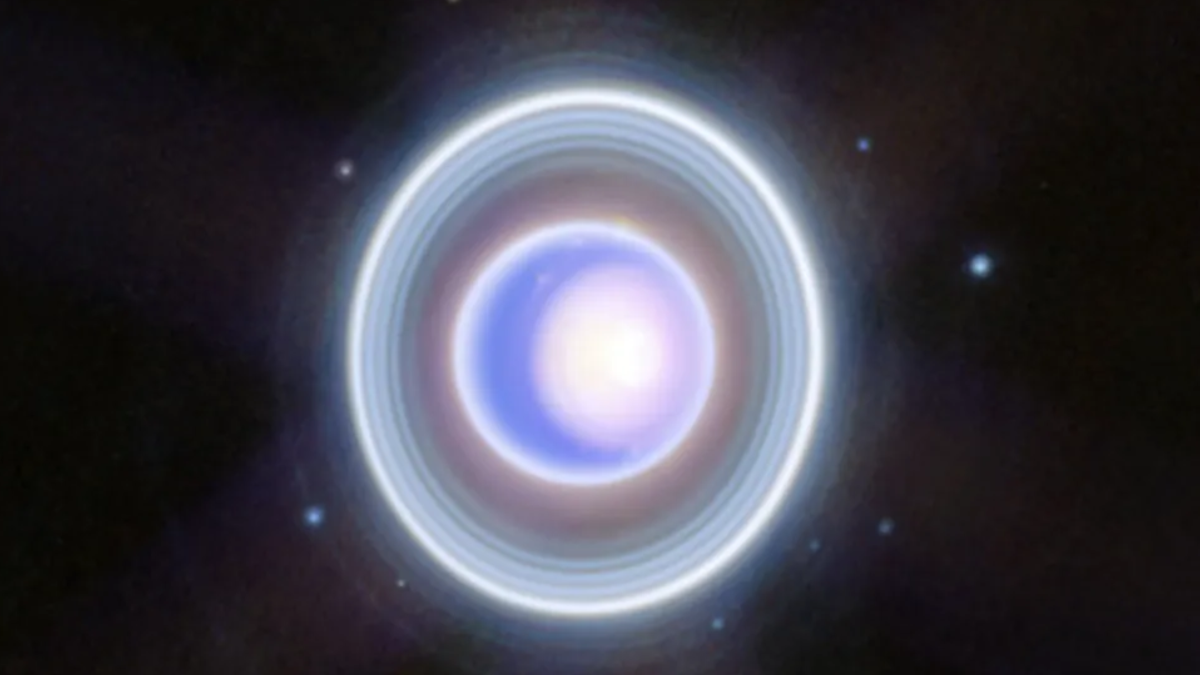
Photo Credit: NASA
An image of Uranus from NIRCam (Near-Infrared Camera) on the NASA/ESA/CSA James Webb Space.
Click Here to Add Gadgets360 As A Trusted Source


Advertisement
Uranus, which stands as the seventh planet from the sun, exists as a frigid planet that rotates on its side and is an ice giant that possesses an exceptional ring system that differs from all other solar system rings. The thirteen rings of Uranus remained unknown until 1977, while Saturn displays its extensive and luminous ring system. The mu (μ) and nu (ν) rings, which represent the most distant outer rings, have provided new information about moons that scientists have yet to discover.
Two Rings, Two Very Different Stories
Published in the Journal of Geophysical Research: Planets, research conducted by Imke de Pater at the University of California, Berkeley, used observations by the JWST, Hubble and the Keck Observatory to develop the first composite reflectance spectrum for both rings. The results are fascinating. The bluish μ ring is composed of water ice particles knocked off a small moon known as Mab through micrometeoroid impacts. The reddish ν ring, on the other hand, is mineral and includes 10–15% carbon-based organics, resulting from the orbits of unseen moonlets within its vicinity.
The Search for What Lies Hidden
The ν ring's dust, containing abundant organic matter, suggests that undiscovered satellite bodies, too faint to be discovered by our present-day telescopes, are orbiting within Uranus's known inner moons. The mystery deepened in 2025 when the James Webb Space Telescope discovered another Uranian moon, S/2025 U1, which was only 10 kilometers wide, according to ScienceDaily, hinting at the existence of even more tiny bodies yet to be discovered. The reasons behind the icy nature of Mab compared to its rocky inner companions have yet to be explained. It has been widely accepted that a mission to Uranus could help solve such perplexing riddles.
Comments
Get your daily dose of tech news, reviews, and insights, in under 80 characters on Gadgets 360 Turbo. Connect with fellow tech lovers on our Forum. Follow us on X, Facebook, WhatsApp, Threads and Google News for instant updates. Catch all the action on our YouTube channel.
Further reading:
Uranus, astronomy, planetary rings, astrophysics, James Webb Space Telescope, Hubble Space Telescope
Related Stories





Advertisement
Follow Us




-
05:06
OnePlus N6 Full Review: Performance, Camera, Battery & Display Tested -
04:57
Samsung Galaxy Unpacked Everything You Need to Know | Galaxy Z Fold8, Z Fold8 Ultra, Z Flip8 -
04:22
Upcoming Foldable Smartphones in India | Upcoming Foldable Launches : Samsung, Apple, Google & more -
04:37
Redmi Turbo 5 Review: Battery, Cameras, Performance Tested -
09:19
Can the OPPO Find X9s Replace Your Camera on a Trip?
-
पीएम नरेंद्र मोदी के Instagram पर सिर्फ 4 दिनों में बढ़े 40 लाख फॉलोअर्स
-
₹47 हजार से ज्यादा सस्ता हुआ Samsung का फ्लैगशिप स्मार्टफोन, जानें
-
Flipkart Freedom sale vs Amazon Great Freedom Sale अगस्त में इस दिन से
-
चुटकी में साफ होंगे लैपटॉप, कीबोर्ड और कार! Portronics भारत में लॉन्च किया बजट एयर डस्टर
-
भारत में Fusion Red कलर में लॉन्च हुआ Vivo T5x 5G, जानें प्राइस, फीचर्स
Advertisement
Popular on Gadgets
- Samsung Galaxy S26 Ultra
- Motorola Razr Fold
- ChatGPT
- OPPO Find N6
- Mobiles Under Rs. 40,000
- Vivo X300 Ultra
- Asus Zenbook S14
- iQOO 15
- Vivo X300 Pro
- Lenovo Yoga Slim 7i Aura Edition
- iQOO 15R
- Vivo X Fold 5
- Sony PlayStation 5
- HP OmniPad 12
- OnePlus Nord CE 6 Lite
- OnePlus Pad 4
- OPPO F33 Pro 5G
- Cryptocurrency
- HP OmniBook Ultra 14 (2026)
- iPhone 17
- Eureka Forbes AP 355 Room Air Purifier
- Latest Mobile Phones
- Compare Phones
Latest Gadgets
- Vivo T5e
- Vivo X300 E
- Itel Zeno 100 Pro
- Itel Zeno 100 Lite
- Lava Virat V1
- Lava Virat V1 5G
- iQOO Z11 Lite
- OPPO K15
- Dell Alienware 18 Area-51 (2026)
- Dell Alienware 16 Area-51 (2026)
- Honor Pad X9 Max
- Red Magic Gaming Tablet 5 Pro
- Samsung Galaxy Watch 9 (44mm)
- Samsung Galaxy Watch 9 (44mm, LTE)
- Sony Bravia 9 II
- Haier HQLED P7 Pro
- Acer Predator Atlas 8
- Asus ROG Ally
- Blue Star 1.5 Ton 5 Star Inverter Split AC (IE518ZNURS)
- Blue Star 2 Ton 3 Star Inverter Window AC (WIE324L)

- About Us
- Sitemaps
- Feedback
- Archives
- Contact Us
- RSS
- Advertise
- Career
- Privacy Policy
- Ethics
- Editorial Policy
- Terms & Conditions
- Complaint Redressal
Download Our Apps
Available in Hindi
© Copyright Red Pixels Ventures Limited 2026. All rights reserved.