-
 Google Fitbit Edge Set to Launch Today: Expected Price, Specifications12 October 2026
 -
Google Rolls Out SynthID Detector Globally for AI-Generated Images, Videos and Audio8 October 2026
-
Google Labs Playground Turns AI Prompts Into Playable Games Without Any Coding8 October 2026
-
Google Reportedly Explains How Intel Googlebooks Run Arm Android Apps7 October 2026
-
Claude for Google Workspace With Docs, Sheets and Slides Support Launched in Beta for Paid Users7 October 2026
Google’s Veo 3.1 AI Model Can Now Generate TikTok, Reels-Style Vertical Videos
Google is improving Veo 3.1’s “Ingredients to Video” capability, which lets users generate videos based on a reference image.
Written by Akash Dutta, Edited by Ketan Pratap | Updated: 14 January 2026 13:14 IST
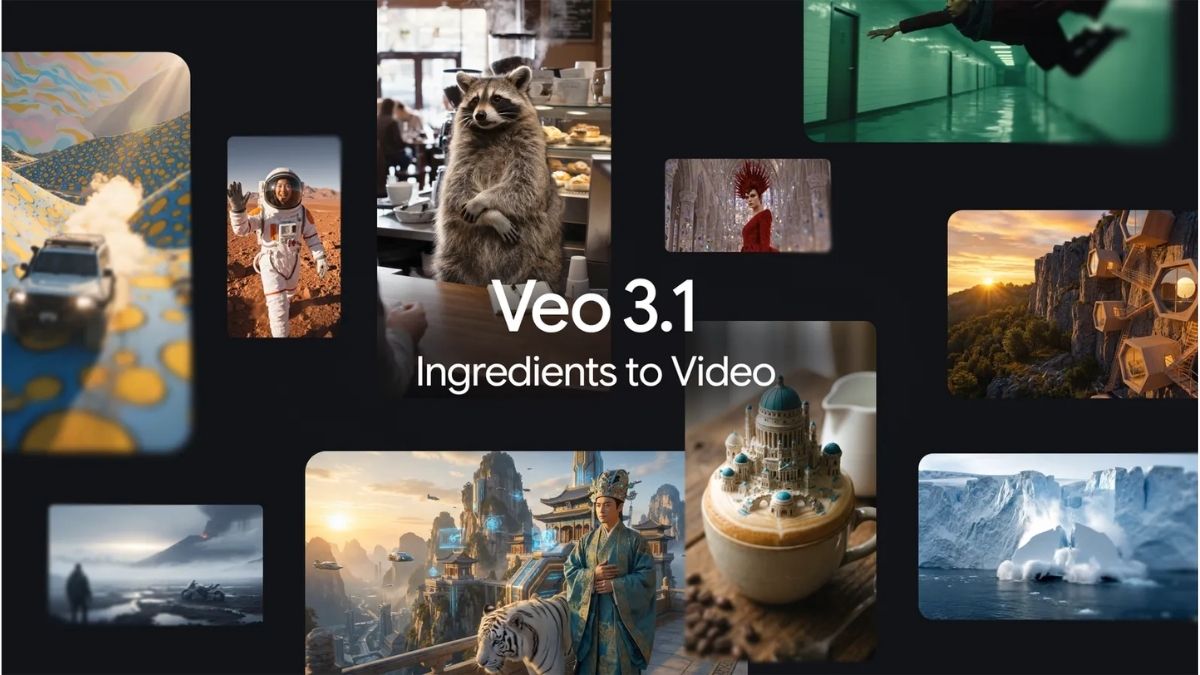
Photo Credit: Google
Google’s Veo 3.1 also lets users upscale videos to 1080p and 4K resolutions
Click Here to Add Gadgets360 As A Trusted Source

Advertisement
Google upgraded its Veo 3.1 artificial intelligence (AI) model with new capabilities and improved instruction following on Tuesday. In particular, the Mountain View-based tech giant is improving the “Ingredients to Video” feature, which lets users add one or more reference images to generate videos based on them. The company says that after the update, users will notice higher character and background consistency, while making it easier to get the desired output without having to type long, detailed prompts. However, the biggest addition is the native support for vertical videos that can be uploaded as YouTube Shorts or Instagram Reels.
Google Upgrades Veo 3.1 AI Model
In a blog post, the tech giant announced and detailed the changes made to its latest video generation model. These improvements now bring the AI model closer to Sora 2, which grew popular after OpenAI released it within the new Sora app. OpenAI's main focus was on character consistency and prompt adherence while using reference images or videos, and that is exactly where Google's update focuses.
Veo 3.1 comes with a feature dubbed “Ingredients to Video.” It is essentially the capability that allows users to generate an image-to-video with an additional text prompt for guidance. Users can upload one or more images and instruct the AI model to use them in the narrative of the generated video. Google says that several aspects of this feature have now been improved.
Google says Veo 3.1 can better understand prompts, eliminating the need to write long and detailed instructions. Now, even with short prompts, the AI model can generate videos with “richer dialogue and storytelling.” In an example, the prompt “Documentary style, a raccoon manages a coffee shop, dialogue” and an image of the said raccoon generated a cinematic video of the animal sitting behind the counter of a coffee shop and interacting with customers.
The update also improves the character consistency, meaning no matter the setting or the prompt, the character's appearance and facial details will not change and remain the same throughout the video. This feature is also helpful when a user wishes to stitch together multiple videos with the same character to create a longer story.
Additionally, the AI model offers a similar level of consistency to the setting and the objects placed in a scene. Google says this will allow users to reuse an object, background, or texture across scenes. Veo 3.1 also allows combining disparate elements into a cohesive clip, offering more creative freedom.
More importantly, with native support for the 9:16 aspect ratio, users can directly upload a generated clip to YouTube Shorts, Instagram Reels, or TikTok without having to worry about cropping or loss of quality. Further, the company is also improving the 1080p resolution quality and adding a new 4K resolution upscaling to let users export the output for larger screens.
Veo 3.1's Ingredient to Videos feature is now rolling out to YouTube Shorts and the YouTube Create app. It is also available in the Gemini app for end users. For enterprises and developers, the AI model is available in the Flow app, the Gemini application programming interface (API), Vertex AI, and Google Vids. However, the latter does not support 1080 or 4K video resolution.
Comments
Get your daily dose of tech news, reviews, and insights, in under 80 characters on Gadgets 360 Turbo. Connect with fellow tech lovers on our Forum. Follow us on X, Facebook, WhatsApp, Threads and Google News for instant updates. Catch all the action on our YouTube channel.
Related Stories






Advertisement
Follow Us




-
![[Sponsored]: CP PLUS CarKam CP-F89B: 4K Dashcam With Rear Camera, GPS & Emergency Recording](https://www.gadgets360.com/static/desktop/images/spacer.png)
04:37
[Sponsored]: CP PLUS CarKam CP-F89B: 4K Dashcam With Rear Camera, GPS & Emergency Recording -
04:23
[Partner Content] Your Phone Can Do WAY More Than You Think | OPPO ColorOS 16 -
01:59
Samsung Galaxy Z Fold8 Ultra: Unfold the Ultra Night -
03:24
Apple Pay Launches In India: Supported Devices, Cards And Payments Explained -
00:21
[Sponsored] Samsung Galaxy Z Fold8, Fold8 Ultra
-
OnePlus 16 लॉन्च: 200 मेगापिक्सल कैमरा, 9000mAh की बैटरी से लैस, जानें
-
Vivo का लेटेस्ट फोन Amazon Great Indian Festival में मिल रहा ₹6,300 सस्ता
-
Amazon Great Indian Festival: ₹51000 सस्ता मिल रहा Samsung फोल्डेबल फोन
-
Flipkart Big Billion Sale 2026: ₹5,500 से ज्यादा सस्ता मिल रहा Motorola Signature, 50MP तीन कैमरा वाला फोन
-
Oppo Find N7 में मिल सकता है 7.6 इंच मेन डिस्प्ले, 200 मेगापिक्सल प्राइमरी कैमरा
Advertisement
Popular on Gadgets
- Samsung Galaxy S26 Ultra
- Motorola Razr Fold
- ChatGPT
- OPPO Find N6
- Mobiles Under Rs. 40,000
- Vivo X300 Ultra
- Asus Zenbook S14
- iQOO 15
- Vivo X300 Pro
- Lenovo Yoga Slim 7i Aura Edition
- iQOO 15R
- Vivo X Fold 5
- Sony PlayStation 5
- HP OmniPad 12
- OnePlus Nord CE 6 Lite
- OnePlus Pad 4
- OPPO F33 Pro 5G
- Cryptocurrency
- HP OmniBook Ultra 14 (2026)
- iPhone 17
- Eureka Forbes AP 355 Room Air Purifier
- Latest Mobile Phones
- Compare Phones
Latest Gadgets
- Vivo Y600s Pro
- Vivo Y32 (2026)
- Infinix Smart 20 HD
- Vivo V80
- Vivo S2 FE
- Vivo Y600K Turbo
- Realme P4s Lite
- Vivo S60t
- Dell Pro Rugged 14
- Dell Pro Rugged 13 Extreme
- Amazon Alexa Tablet 8
- Amazon Alexa Tablet 11
- Amazfit T-Rex Dual Solar
- OPPO Watch S2
- Toshiba 65-Inch 4K Ultra HD Smart Mini LED QLED TV (65Z670SP)
- Haier M70 Mini LED 65-inch
- Acer Predator Atlas 8
- Asus ROG Ally
- Blue Star 1.5 Ton 5 Star Inverter Split AC (IE518ZNURS)
- Blue Star 2 Ton 3 Star Inverter Window AC (WIE324L)

- About Us
- Sitemaps
- Feedback
- Archives
- Contact Us
- RSS
- Advertise
- Career
- Privacy Policy
- Ethics
- Editorial Policy
- Terms & Conditions
- Complaint Redressal
Download Our Apps
Available in Hindi
© Copyright Red Pixels Ventures Limited 2026. All rights reserved.