-
 Google Introduces Gemma 4 Open-Source AI Model, Enables Building Autonomous Agents3 April 2026
 -
Oppo Find X9s Pro, Find X9 Ultra Key Features, Colour Options Leaked Ahead of April 21 Launch3 April 2026
-
Vivo T5 Pro 5G India Launch Teased Along With Availability Details, Key Specifications3 April 2026
-
Oppo Find X9 Ultra Leaked Image Reveals Design; Tipped to Feature 7,050mAh Battery3 April 2026
-
Redmi 15A 5G Goes on Sale in India for the First Time: Price, Specifications3 April 2026
Microsoft’s Copilot Checkout Will Let Users Search, Purchase Products Without Leaving the Chat Window
Copilot Checkout is an in-built capability that activates when users ask for a product recommendation or run an inquiry.
Written by Akash Dutta, Edited by Ketan Pratap | Updated: 9 January 2026 19:18 IST
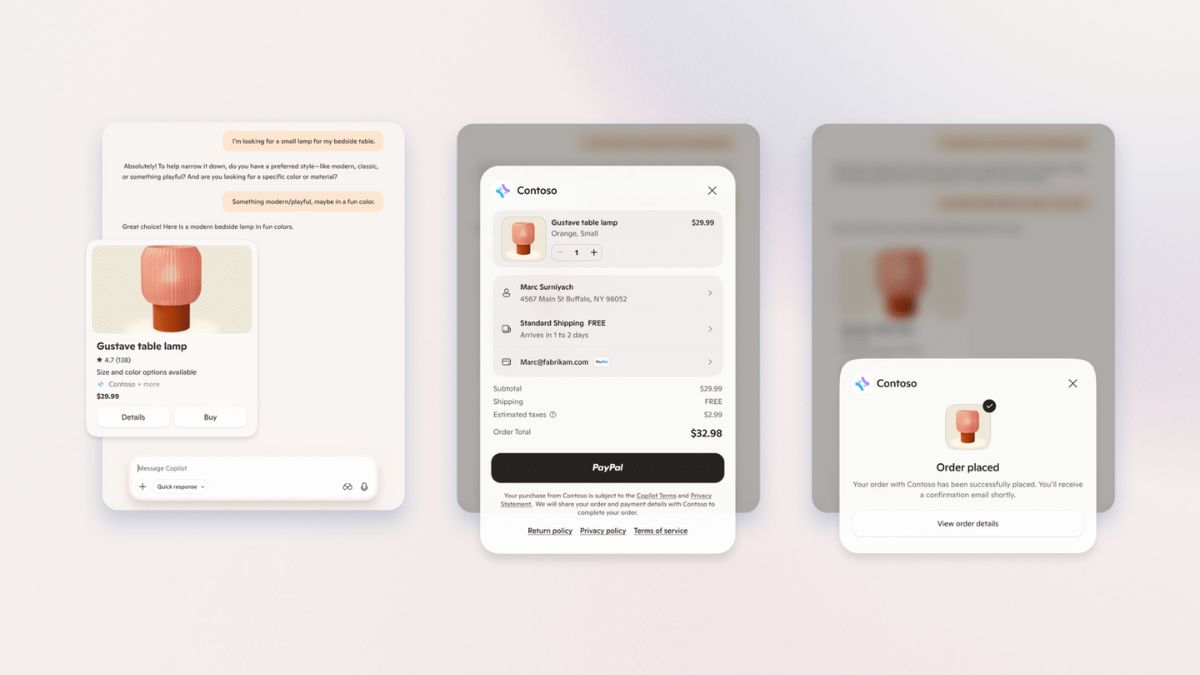
Photo Credit: Microsoft
Microsoft’s Copilot Checkout is currently available on the Copilot website in the US
Click Here to Add Gadgets360 As A Trusted Source


Advertisement
Microsoft, on Thursday, introduced Copilot Checkout, a new artificial intelligence (AI)-powered shopping experience for its chatbot that allows users to make purchases right from the chat window. With this release, the Redmond-based tech giant has joined OpenAI, Google, and Perplexity in the rising trend of AI shopping tools. While the tech giant is a late entrant in this space, it has already forged partnerships with Shopify, PayPal, and Stripe for the capability. Notably, in November, the company released shopping features for Copilot in the Edge browser.
Microsoft Releases Copilot Checkout
In a blog post, the tech giant announced and detailed the new AI shopping experience for Copilot. It is currently available in the US on the chatbot's website, with broader rollout across more regions and interfaces expected soon. Microsoft has also opened an application form for merchants who wish to onboard the experience via PayPal or Stripe. For now, eligible users can look up and purchase products listed on Shopify via Copilot.
The company pitches the new capability as a “conversation to conversion” tool, claiming that “journeys that include Copilot led to 53 percent more purchases within 30 minutes of interaction compared to those without,” and “when shopping intent is present, journeys with Copilot are 194 percent more likely to result in a purchase.”
For the end user, the experience is straightforward. They can go to Copilot's web client and write a prompt about a product they have in mind or want recommendations for. Once the chatbot suggests products (currently only those listed on Shopify), users will see an option to buy. Tapping the option will open a new pop-up window to make the payment and complete the purchase. After that, they will receive the details of the order, delivery details, and a link to track the delivery.
Interestingly, Microsoft claims that despite enabling the shopping experience on its interface, the company will not take charge of the transaction, the customer data, or the post-purchasing relationship of the merchant. It will hand over the relevant data at the time of the transaction. This was likely done to avoid a situation like Perplexity, which was handed a cease-and-desist letter by Amazon for degrading customer experience and eroding trust.
Comments
Get your daily dose of tech news, reviews, and insights, in under 80 characters on Gadgets 360 Turbo. Connect with fellow tech lovers on our Forum. Follow us on X, Facebook, WhatsApp, Threads and Google News for instant updates. Catch all the action on our YouTube channel.
Related Stories





Microsoft’s Copilot Checkout Will Let Users Search, Purchase Products Without Leaving the Chat Window


Advertisement
Follow Us




-
05:05
Goboult Mustang Racer Smartwatch Review: Should You Get This Mustang Smartwatch? -
04:58
OnePlus Nord Buds 4 Pro Review: Specs, Sound Quality, ANC, and Battery Backup Tested -
02:29
[Sponsored] Samsung Galaxy S26 Ultra First Look: AI Smartphone for Creators, Gaming & Productivity -
04:25
Vivo X200T Review - Full Camera, Gaming & Battery Test | Worth Buying? -
28:31
The Future of Productivity: Logitech's Anatoliy Polyanker On AI, Hybrid Work, And India's Tech Boom
-
200 मेगापिक्सल कैमरा, 7000mAh बैटरी के साथ Vivo V70 FE लॉन्च, जानें सबकुछ
-
Redmi Note 15 SE भारत में लेटेस्ट AI फीचर्स, 5800mAh बैटरी के साथ लॉन्च
-
5100mAh बैटरी, 50MP कैमरा वाला Pixel फोन हुआ 4700 रुपये सस्ता
-
Ola की इलेक्ट्रिक मोटरसाइकिल Roadster X+ पर भारी डिस्काउंट, प्राइस में हुई 60,000 रुपये की कमी
-
ईरान और रूस में ड्रोन खरीदने के लिए हो रहा क्रिप्टोकरेंसी का इस्तेमाल
Advertisement
Popular on Gadgets
- Samsung Galaxy Unpacked 2026
- iPhone 17 Pro Max
- ChatGPT
- iOS 26
- Laptop Under 50000
- Smartwatch Under 10000
- Apple Vision Pro
- Oneplus 12
- OnePlus Nord CE 3 Lite 5G
- iPhone 13
- Xiaomi 14 Pro
- Oppo Find N3
- Tecno Spark Go (2023)
- Realme V30
- Best Phones Under 25000
- Samsung Galaxy S24 Series
- Cryptocurrency
- iQoo 12
- Samsung Galaxy S24 Ultra
- Giottus
- Samsung Galaxy Z Flip 5
- Apple 'Scary Fast'
- Housefull 5
- GoPro Hero 12 Black Review
- Invincible Season 2
- JioGlass
- HD Ready TV
- Latest Mobile Phones
- Compare Phones
Latest Gadgets
- Honor Play 80
- Nord 6
- Honor X80i
- Honor Play 80 Pro
- Redmi Note 15 SE 5G
- Redmi A7 Pro
- OPPO K15 Pro
- OPPO K15 Pro+
- Xiaomi Book Pro 14
- MacBook Neo
- Vivo Pad 6 Pro
- Lenovo Legion Y700 Gen 5
- boAt Valour Watch 1R
- Xiaomi Watch S5
- Xiaomi QLED TV X Pro 75
- Haier H5E Series
- Asus ROG Ally
- Nintendo Switch Lite
- Haier 1.6 Ton 5 Star Inverter Split AC (HSU19G-MZAID5BN-INV)
- Haier 1.6 Ton 5 Star Inverter Split AC (HSU19G-MZAIM5BN-INV)

- About Us
- Sitemaps
- Feedback
- Archives
- Contact Us
- RSS
- Advertise
- Career
- Privacy Policy
- Ethics
- Editorial Policy
- Terms & Conditions
- Complaint Redressal
Download Our Apps
Available in Hindi
© Copyright Red Pixels Ventures Limited 2026. All rights reserved.