-
 NASA’s MAVEN Detects Rare Solar Wind Effect in Mars Atmosphere28 May 2026
 -
Mysterious Stacked Rocks Spotted by NASA Perseverance Rover on Mars22 May 2026
-
Massive Solar Storm Reveals How Mars Is Losing Its Atmosphere19 May 2026
-
New Biosignature Method Could Transform Search for Alien Life16 May 2026
-
NASA’s Curiosity Rover Stalled on Mars for Six Days by Stuck Rock10 May 2026
- Home
- Science
- Science News
- Scientists Develop Swarm Robots to Explore Hidden Lava Tubes on Mars
Scientists Develop Swarm Robots to Explore Hidden Lava Tubes on Mars
Researchers are developing nature-inspired robots to investigate giant lava tubes hidden beneath Mars. The system uses rolling robots and tiny flying drones to map underground tunnels that may protect microbial life and future astronauts from radiation.
Written by Gadgets 360 Staff | Updated: 27 May 2026 15:06 IST
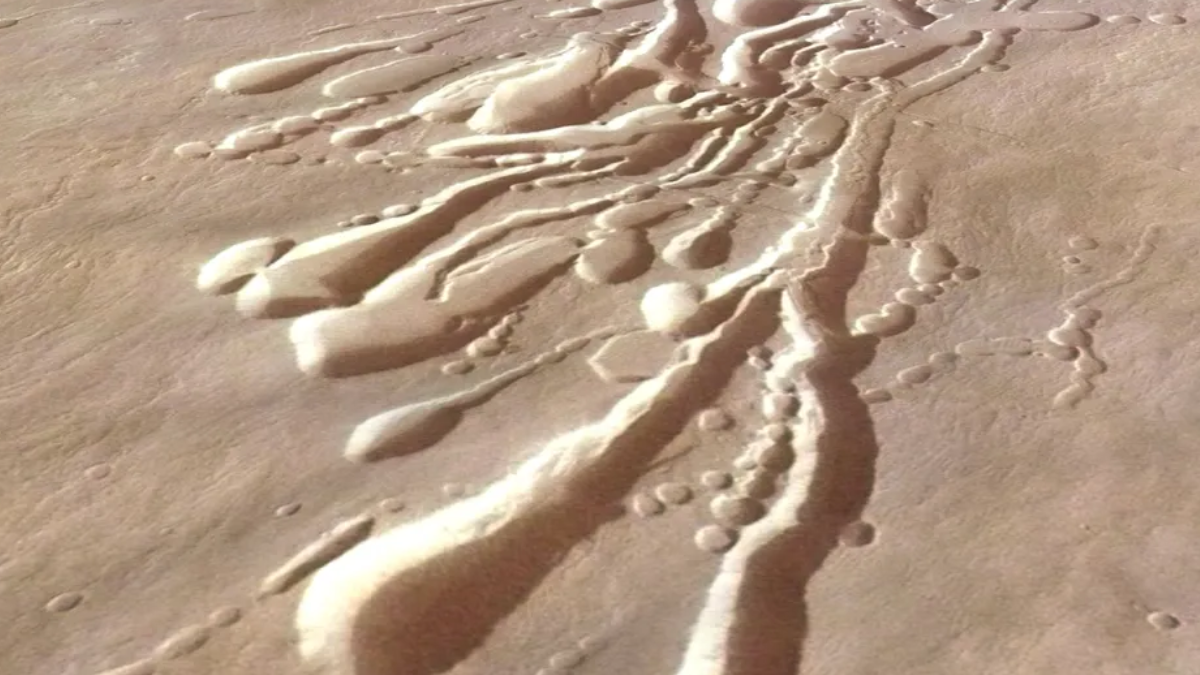
Photo Credit: ESA
Lava tubes on Pavonis Mons, a Martian volcano.
Click Here to Add Gadgets360 As A Trusted Source


Advertisement
Mars harbours one of the most profound mysteries in our solar system under the dusty layers of its surface: an extensive underground complex of lava tubes that spans over 746 miles long. Created by volcanic eruptions that occurred millions of years ago, these caves can protect microbes from the harmful effects of radiation on Mars – perhaps even serving to house future human inhabitants – but investigating them has not been possible until now.
Nature-Inspired Robots for the Red Planet
According to the report, Mostafa Hassanalian, an associate professor at New Mexico Tech, is developing a two-tier robotic system rooted in biomimicry, engineering solutions that mimic nature. The first component is a "roly-poly robot," modelled on the pillbug, which rolls into a ball and parachutes down through a collapsed ceiling opening, or "skylight," in a Martian lava tube. Once inside, it releases thousands of tiny "dandelion drones" — microscale flyers powered by piezoelectricity from flexible polymers. Painted white to reflect heat and reduce weight, they ride Mars' powerful subterranean winds for miles, mapping the tunnels as they go.
Racing to Unlock Mars' Underground
The present-day rovers, such as Curiosity and Perseverance, which weigh about the same as school buses, can't fit into any lava tubes, but there is no doubt that the research of those tunnels is crucial to scientists. Scientists have obtained information about how much the temperature of the interior of such lava tubes differs from the outside environment by analysing data from thermometers on collapsed roofs of volcanoes. Hassanalian is not the only scientist working in this area — researchers from Europe tested out robots in lava tubes in Lanzarote, and NASA plans to explore the Arsia Mons volcano.
Comments
Get your daily dose of tech news, reviews, and insights, in under 80 characters on Gadgets 360 Turbo. Connect with fellow tech lovers on our Forum. Follow us on X, Facebook, WhatsApp, Threads and Google News for instant updates. Catch all the action on our YouTube channel.
Further reading:
Mars, NASA, Mars exploration, lava tubes, space robotics, planetary science, astrobiology, future space missions
Related Stories





Advertisement
Follow Us




-
04:37
[Sponsored]: CP PLUS CarKam CP-F89B: 4K Dashcam With Rear Camera, GPS & Emergency Recording -
04:23
[Partner Content] Your Phone Can Do WAY More Than You Think | OPPO ColorOS 16 -
01:59
Samsung Galaxy Z Fold8 Ultra: Unfold the Ultra Night -
03:24
Apple Pay Launches In India: Supported Devices, Cards And Payments Explained -
00:21
[Sponsored] Samsung Galaxy Z Fold8, Fold8 Ultra
-
Amazon Great Indian Festival Sale: iPhone 17 Pro पर बंपर डील
-
Flipkart Big Billion Days Sale: ₹8K से सस्ता मिल रहा Google Pixel 10a
-
भारत में दुनिया का सबसे सस्ता इंटरनेट, 1GB की कीमत सिर्फ 8 रुपये
-
Flipkart Big Billion Sale 2026: ₹20 हजार से सस्ते खरीदें Samsung, Mivi, Ai+ बजट फोन, 7000mAh तक बैटरी
-
iQOO Pad Pro पेश हुआ 8.8 इंच डिस्प्ले, Q3 गेमिंग चिप के साथ, प्री-ऑर्डर शुरू
Advertisement
Popular on Gadgets
- Samsung Galaxy S26 Ultra
- Motorola Razr Fold
- ChatGPT
- OPPO Find N6
- Mobiles Under Rs. 40,000
- Vivo X300 Ultra
- Asus Zenbook S14
- iQOO 15
- Vivo X300 Pro
- Lenovo Yoga Slim 7i Aura Edition
- iQOO 15R
- Vivo X Fold 5
- Sony PlayStation 5
- HP OmniPad 12
- OnePlus Nord CE 6 Lite
- OnePlus Pad 4
- OPPO F33 Pro 5G
- Cryptocurrency
- HP OmniBook Ultra 14 (2026)
- iPhone 17
- Eureka Forbes AP 355 Room Air Purifier
- Latest Mobile Phones
- Compare Phones
Latest Gadgets
- Vivo Y600s Pro
- Vivo Y32 (2026)
- Infinix Smart 20 HD
- Vivo V80
- Vivo S2 FE
- Vivo Y600K Turbo
- Realme P4s Lite
- Vivo S60t
- Dell Pro Rugged 14
- Dell Pro Rugged 13 Extreme
- Amazon Alexa Tablet 8
- Amazon Alexa Tablet 11
- Amazfit T-Rex Dual Solar
- OPPO Watch S2
- Toshiba 65-Inch 4K Ultra HD Smart Mini LED QLED TV (65Z670SP)
- Haier M70 Mini LED 65-inch
- Acer Predator Atlas 8
- Asus ROG Ally
- Blue Star 1.5 Ton 5 Star Inverter Split AC (IE518ZNURS)
- Blue Star 2 Ton 3 Star Inverter Window AC (WIE324L)

- About Us
- Sitemaps
- Feedback
- Archives
- Contact Us
- RSS
- Advertise
- Career
- Privacy Policy
- Ethics
- Editorial Policy
- Terms & Conditions
- Complaint Redressal
Download Our Apps
Available in Hindi
© Copyright Red Pixels Ventures Limited 2026. All rights reserved.