- Home
- Science
- Science News
- ISS Crew Prepares to Send Japan’s HTV X1 Cargo Spacecraft Back to Earth After Four Months
ISS Crew Prepares to Send Japan’s HTV-X1 Cargo Spacecraft Back to Earth After Four Months
The Expedition 74 crew aboard the International Space Station is preparing to release Japan’s HTV-X1 cargo spacecraft after four months docked. Using Canadarm2, flight controllers will detach the uncrewed vehicle from the Harmony module before releasing it into orbit.
Written by Gadgets 360 Staff | Updated: 5 March 2026 21:20 IST
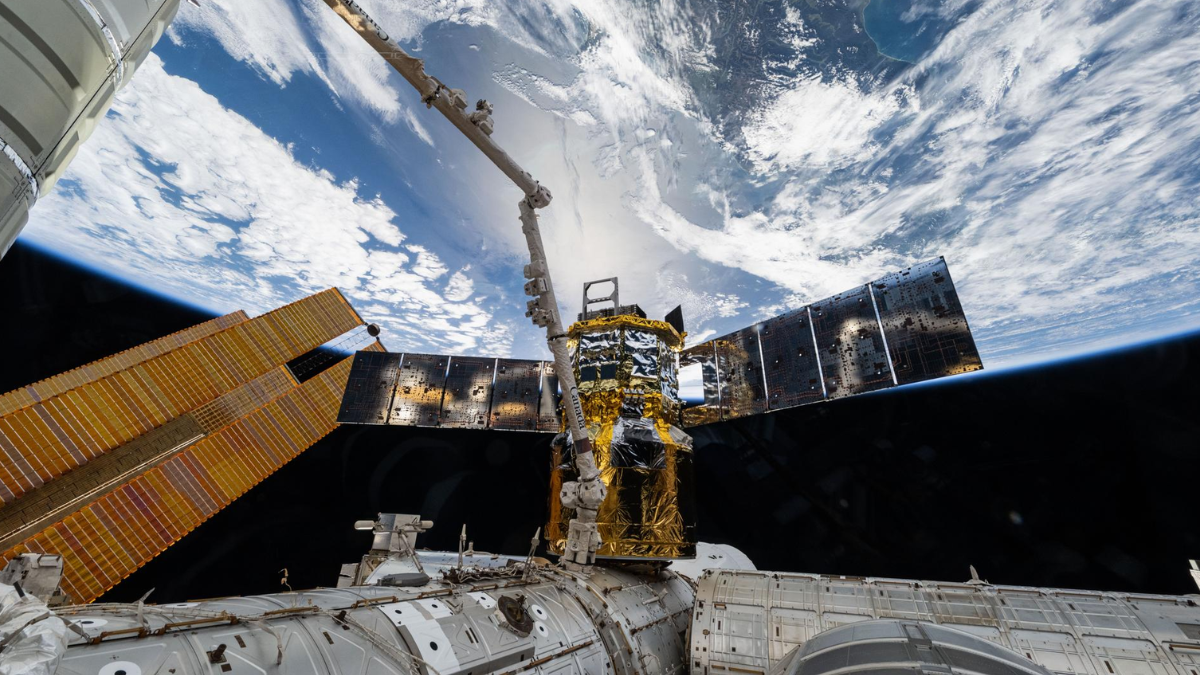
Photo Credit: NASA
HTV-X1 docks at ISS Harmony’s Earth-facing port as Canadarm2 hovers in foreground
Click Here to Add Gadgets360 As A Trusted Source


Advertisement
The International Space Station's Expedition 74 crew is preparing to send the Japanese HTV X1 cargo spacecraft back to Earth this week. The uncrewed vehicle, provided by JAXA, has been attached to the station for four months, delivering supplies and experiments. The spacecraft will leave the Harmony module space station connection point later this week. The crew continues their work on various biology studies and advanced technology tests, which will help improve life for people on Earth and in space.
Spacecraft Set to Return to Earth
As per NASA, at 2:25 p.m. EST on March 5th, the station's Canadarm2 robotic arm will be used by flight controllers to detach the spacecraft from the Harmony module, then briefly park it, followed by its release into orbit by midday Friday. The HTV X1 will then be used for hosting other experiments at a safe distance for about three months, after which it will be commanded to deorbit, burning up in the atmosphere while disposing of tons of waste material accumulated on the station.
Science Aboard the Station
The crew conducted various types of biology and technology research this week. In the Japanese Kibo lab, researchers installed new robotics equipment and conducted a cognition test as part of their CIPHER research package. CIPHER is designed to conduct brain activity research in space. The crew of two flight engineers used a device called EchoFinder-2, which uses artificial intelligence and ultrasound technology in the Columbus lab to remotely scan bodies using augmented reality. Cosmonaut Fedyaev used sensors to conduct research on blood pressure in space and how it affects the circulatory system.
Comments
Get your daily dose of tech news, reviews, and insights, in under 80 characters on Gadgets 360 Turbo. Connect with fellow tech lovers on our Forum. Follow us on X, Facebook, WhatsApp, Threads and Google News for instant updates. Catch all the action on our YouTube channel.
Further reading:
Expedition 74, International Space Station, HTV-X1, JAXA, Canadarm2, Space Cargo, Kibo Laboratory, Space Research


Advertisement
Follow Us




-
04:17
[Sponsored] LG NANO 4K UHD AI TV NU885: Gemini Search, Dolby Atmos & 5 Years of Updates -
00:57
[Sponsored] Samsung Galaxy Z Fold8 My Fan Cam in Action: Find the Moment, Then Share It -
01:41
[Sponsored] What Do You Need To Know Before Your Next Run? | Samsung Galaxy Watch Ultra2 -
01:32
[Sponsored] Big Day Tomorrow? Prep Today | Samsung Galaxy Watch Ultra2 -
04:37
[Sponsored]: CP PLUS CarKam CP-F89B: 4K Dashcam With Rear Camera, GPS & Emergency Recording
-
आ गई हवा में उड़ने वाली Tesla Roadster कार, आखिर सच हुआ फिल्मों वाला कमाल
-
रोबोट ने की लड़की से छेड़छाड़, पीछे से पकड़ा और किए गंदे इशारे, जानें
-
PS5 कहां मिलेगा सस्ता, Flipkart या Amazon, जानें सबकुछ
-
Samsung Galaxy A38 5G में मिल सकती है ट्रिपल रियर कैमरा यूनिट
-
Lenovo ने सस्ता लैपटॉप ग्लोबल मार्केट में किया लॉन्च, Snapdragon X चिप से लैस
Advertisement
Popular on Gadgets
- Samsung Galaxy S26 Ultra
- Motorola Razr Fold
- ChatGPT
- OPPO Find N6
- Mobiles Under Rs. 40,000
- Vivo X300 Ultra
- Asus Zenbook S14
- iQOO 15
- Vivo X300 Pro
- Lenovo Yoga Slim 7i Aura Edition
- iQOO 15R
- Vivo X Fold 5
- Sony PlayStation 5
- HP OmniPad 12
- OnePlus Nord CE 6 Lite
- OnePlus Pad 4
- OPPO F33 Pro 5G
- Cryptocurrency
- HP OmniBook Ultra 14 (2026)
- iPhone 17
- Eureka Forbes AP 355 Room Air Purifier
- Latest Mobile Phones
- Compare Phones
Latest Gadgets
- Tecno Spark 50S 5G
- Vivo Y600s Pro
- Vivo Y32 (2026)
- Infinix Smart 20 HD
- Vivo V80
- Vivo S2 FE
- Vivo Y600K Turbo
- Realme P4s Lite
- HP ZBook Ultra G3a
- Dell Pro Rugged 14
- Amazon Alexa Tablet 8
- Amazon Alexa Tablet 11
- Amazfit T-Rex Dual Solar
- OPPO Watch S2
- Toshiba 65-Inch 4K Ultra HD Smart Mini LED QLED TV (65Z670SP)
- Haier M70 Mini LED 65-inch
- Acer Predator Atlas 8
- Asus ROG Ally
- Blue Star 1.5 Ton 5 Star Inverter Split AC (IE518ZNURS)
- Blue Star 2 Ton 3 Star Inverter Window AC (WIE324L)

- About Us
- Sitemaps
- Feedback
- Archives
- Contact Us
- RSS
- Advertise
- Career
- Privacy Policy
- Ethics
- Editorial Policy
- Terms & Conditions
- Complaint Redressal
Download Our Apps
Available in Hindi
© Copyright Red Pixels Ventures Limited 2026. All rights reserved.