-
 Astronomers Discover Why Massive Galaxies Died Early in the Universe13 June 2026
 -
Astronomers Discover Two Galaxies That Appear to Lack Dark Matter10 June 2026
-
James Webb Space Telescope Weighs Most Distant Dormant Black Hole Ever Detected9 June 2026
-
Scientists Discover 77 Rare Red Quasars Hidden Behind Cosmic Dust25 May 2026
-
New Dark Matter Simulation Could Change How Galaxies Are Thought to Evolve20 January 2026
- Home
- Science
- Science News
- Astronomers Detect Star Forming Fuel in a Galaxy 13 Billion Light Years Away
Astronomers Detect Star-Forming Fuel in a Galaxy 13 Billion Light-Years Away
Astronomers have directly detected a vast supply of molecular gas in REBELS-25, a galaxy observed only 700 million years after the Big Bang.
Written by Gadgets 360 Staff | Updated: 14 June 2026 19:10 IST
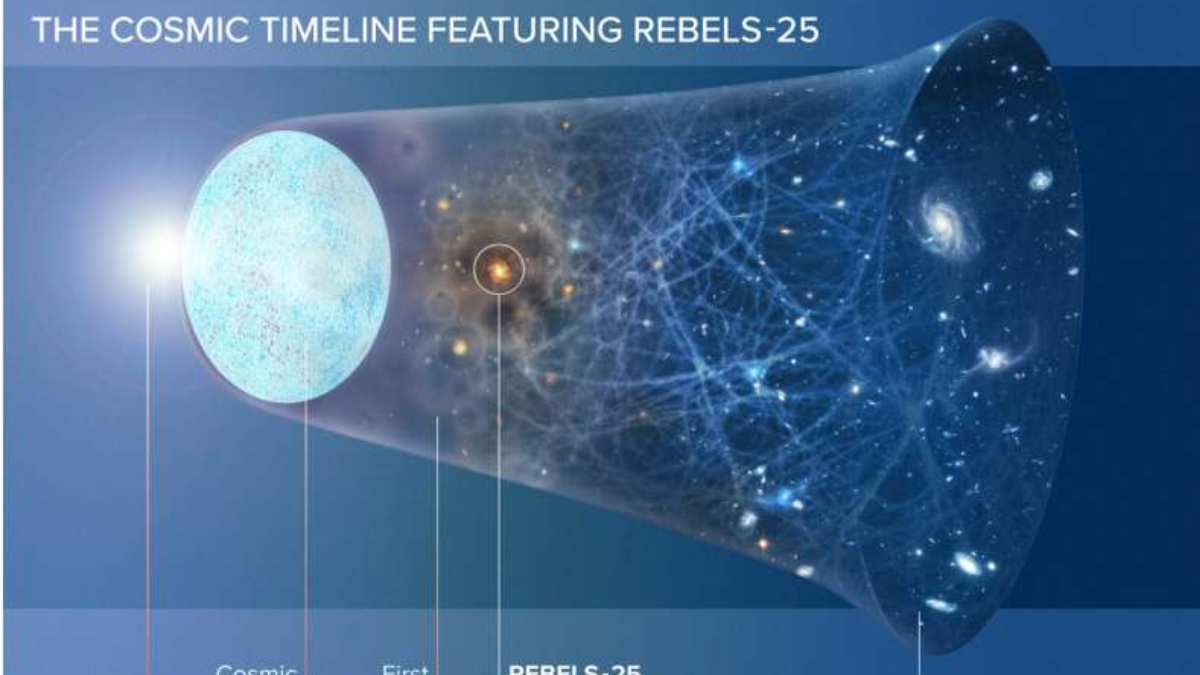
Photo Credit: NSF
This illustration traces the universe's evolution from the Big Bang.
Click Here to Add Gadgets360 As A Trusted Source


Advertisement
When the universe was barely 700 million years old—like 5% of its current age— a distant galaxy called REBELS-25 was already holding this colossal kind of reservoir of cold gas, the basic fuel for making stars, you know? A fresh study straight up detected gas for the first time at those cosmic distances, and it gives a real clue to astronomy's most persistent question: how did early galaxies grow so fast, in the first place?
Carbon Monoxide from 13 Billion Years Ago
Published in Monthly Notices of the Royal Astronomical Society, the study was led by Karin Cescon at Leiden University. Her team used the NSF Very Large Array and ALMA, spending roughly 40 hours hunting faint carbon monoxide signals in REBELS-25, a galaxy at redshift z=7.31 in the Epoch of Reionization. Their CO(3-2) detection is the most distant low-energy CO line ever recorded. Combining VLA and ALMA data, they estimated the galaxy's molecular gas mass at approximately 100 billion solar masses and a gas fraction of ~95%.
Fuel-Loaded Galaxies and the Road Ahead
A gas fraction of ~95% means nearly all of REBELS-25's mass was still unprocessed gas, confirming that some early galaxies entered their star-forming prime already loaded with material. Until now, astronomers could only infer such gas supplies indirectly; this direct detection changes what is measurable at cosmic dawn. At this distance, the cosmic microwave background — relic radiation from the Big Bang — acts as a bright backdrop suppressing CO signals, making detection especially challenging. The planned Next-Generation VLA (ngVLA) will make such measurements ten times faster, letting scientists map how entire populations of early galaxies fueled their rapid growth.
Comments
Get your daily dose of tech news, reviews, and insights, in under 80 characters on Gadgets 360 Turbo. Connect with fellow tech lovers on our Forum. Follow us on X, Facebook, WhatsApp, Threads and Google News for instant updates. Catch all the action on our YouTube channel.
Further reading:
Galaxy Evolution, Early Universe, REBELS-25, Cosmic Dawn, ALMA, Very Large Array, VLA, Molecular Gas, Carbon Monoxide, Astronomy, Astrophysics
Related Stories


Advertisement
Follow Us




-
05:20
Samsung Galaxy Watch Ultra 2 Review: Is This the Best Android Smartwatch? -
07:01
Samsung Galaxy Z Fold 8 Review: Is This the Best Foldable Phone? -
06:39
Samsung Galaxy Z Fold8 Ultra Review: Cameras, Battery, Performance Tested -
04:33
[Sponsored] JBL Live 780NC: Great Sound, Perfect Comfort, Smart ANC & 80-Hour Battery -
12:04
[Partner Content] OPPO Reno16 Series Deep Dive: Built for Creators?
-
iPhone Duo के लिए ₹3 लाख का बजट नहीं है? ये 4 सस्ते फोल्डेबल फोन देखिए
-
सोशल मीडिया में छाया 80s AI Photo Trend, आप भी आजमाएं ये 5 Prompts
-
Motorola के 7000mAh बैटरी वाले फोन पर ₹4,500 तक की बचत
-
₹8 हजार सस्ता मिल रहा 64MP कैमरा वाला Vivo 5G फोन! आई जबरदस्त डील
-
Vivo X Fold 6 के इंटरनेशनल मार्केट में लॉन्च की तैयारी, Geekbench पर हुई लिस्टिंग
Advertisement
Popular on Gadgets
- Samsung Galaxy S26 Ultra
- Motorola Razr Fold
- ChatGPT
- OPPO Find N6
- Mobiles Under Rs. 40,000
- Vivo X300 Ultra
- Asus Zenbook S14
- iQOO 15
- Vivo X300 Pro
- Lenovo Yoga Slim 7i Aura Edition
- iQOO 15R
- Vivo X Fold 5
- Sony PlayStation 5
- HP OmniPad 12
- OnePlus Nord CE 6 Lite
- OnePlus Pad 4
- OPPO F33 Pro 5G
- Cryptocurrency
- HP OmniBook Ultra 14 (2026)
- iPhone 17
- Eureka Forbes AP 355 Room Air Purifier
- Latest Mobile Phones
- Compare Phones
Latest Gadgets
- iPhone Duo
- OPPO A7 Pro
- Huawei Mate XT 2 Ultimate Design
- Realme 16 Pro Harry Potter Edition
- Samsung Galaxy A07s
- Huawei Pura X View
- Tecno Camon Slim 5G
- iQOO Z11xa
- Acer Aspire G 3D 16
- Acer Swift Air 16 (2026)
- Infinix Xpad 30 Pro
- Lenovo Yoga Tab Gen 2
- Apple Watch Ultra 4
- Apple Watch Series 12
- Haier M70 Mini LED 65-inch
- Xiaomi TV FX Mini LED 65
- Acer Predator Atlas 8
- Asus ROG Ally
- Blue Star 1.5 Ton 5 Star Inverter Split AC (IE518ZNURS)
- Blue Star 2 Ton 3 Star Inverter Window AC (WIE324L)

- About Us
- Sitemaps
- Feedback
- Archives
- Contact Us
- RSS
- Advertise
- Career
- Privacy Policy
- Ethics
- Editorial Policy
- Terms & Conditions
- Complaint Redressal
Download Our Apps
Available in Hindi
© Copyright Red Pixels Ventures Limited 2026. All rights reserved.