- Home
- Science
- Science News
- New Carbon Titanium Composite Dramatically Improves Lithium Sulfur Batteries
New Carbon-Titanium Composite Dramatically Improves Lithium-Sulfur Batteries
South Korean researchers developed a carbon-titanium composite that significantly improves lithium-sulfur battery capacity, stability, and lifespan, opening the way for lighter electric vehicles, longer-flying drones, and longer-lasting consumer electronics.
Written by Gadgets 360 Staff | Updated: 11 December 2025 17:51 IST
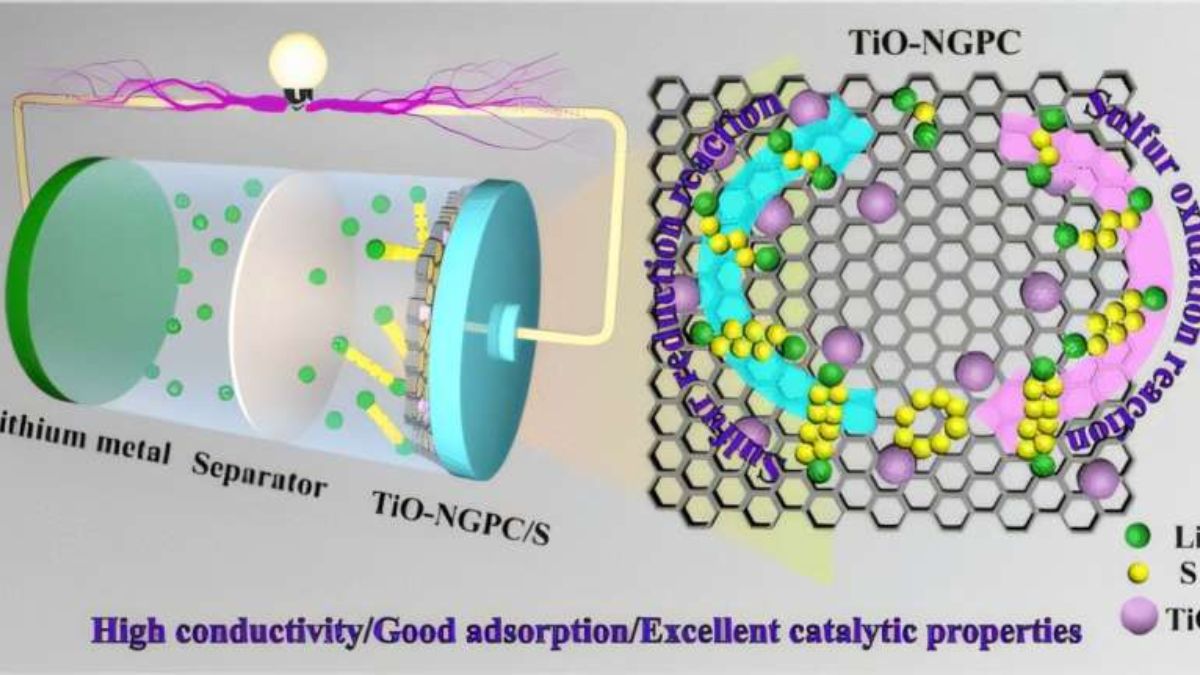
Photo Credit: ACS Nano (2025)
South Korean carbon-titanium composite boosts lithium-sulfur battery life, density, stability, efficiency
Click Here to Add Gadgets360 As A Trusted Source


Advertisement
A new carbon-titanium composite developed by the researchers in South Korea also improves the performance of lithium-sulfur batteries to a considerable extent. To be used in electric cars and portable devices, lithium-sulfur batteries have the potential to store much more energy with a lower weight than the current lithium-ion cells. A group of researchers at DGIST developed a honeycomb structure of titanium monoxide (TiO) nanoparticles into nitrogen-doped porous carbon. This single-step electrode structure has larger amounts of sulfur, and it conducts better and may significantly increase battery life.
Innovative Electrode Design
According to the paper, researchers used a simple magnesium reduction to embed titanium monoxide (TiO) nanoparticles into nitrogen-doped porous carbon. This creates a 3D honeycomb carbon framework that securely holds sulfur and provides high conductivity. The polar TiO and nitrogen strongly bind lithium polysulfides (charged sulfur compounds) and catalyze their reactions, preventing leakage and boosting battery efficiency. In tests, the Li-S cathode delivered 1082 mAh/g initially and retained ~580 mAh/g after 1000 cycles.
Potential Applications
The combination of the high energy density of lithium-sulfur and low mass has the potential to revolutionize devices, allowing electric cars to go much further and drones to remain up in the air much longer. During a single experiment, a Li-S battery had a UAV that was able to fly for more than 3 hours, and in future generation packs, an 8-hour flight expectancy has been achieved. Lightweight batteries could be installed in phones and laptops with significantly extended run times. Sulfur is inexpensive and in large quantities, and thus Li-S batteries can also be cheaper. This new carbon-titanium alloy would assist in taking these enhancements to the regular products by making Li-S cells more efficient and dependable.
Comments
Get your daily dose of tech news, reviews, and insights, in under 80 characters on Gadgets 360 Turbo. Connect with fellow tech lovers on our Forum. Follow us on X, Facebook, WhatsApp, Threads and Google News for instant updates. Catch all the action on our YouTube channel.


Advertisement
Follow Us




-
07:03
Vivo X300 Pro Review | Best Camera Phone You Can Buy For 2026 -
04:56
Vivo X300 Review | Best Flagship of 2025? | Unbelievable Camera & Performance Test -
03:49
Lava Agni 4 Review - Best Indian 5G Phone Under Budget? -
05:23
Motorola G67 Power Review: The Real Battery Beast of 2025? -
06:14
[Partner Content] OPPO F31 Series: The Durable Champion That Stays Smooth & Powerful
Advertisement
Popular on Gadgets
- Samsung Galaxy Unpacked 2025
- ChatGPT
- Redmi Note 14 Pro+
- iPhone 16
- Apple Vision Pro
- Oneplus 12
- OnePlus Nord CE 3 Lite 5G
- iPhone 13
- Xiaomi 14 Pro
- Oppo Find N3
- Tecno Spark Go (2023)
- Realme V30
- Best Phones Under 25000
- Samsung Galaxy S24 Series
- Cryptocurrency
- iQoo 12
- Samsung Galaxy S24 Ultra
- Giottus
- Samsung Galaxy Z Flip 5
- Apple 'Scary Fast'
- Housefull 5
- GoPro Hero 12 Black Review
- Invincible Season 2
- JioGlass
- HD Ready TV
- Laptop Under 50000
- Smartwatch Under 10000
- Latest Mobile Phones
- Compare Phones
Latest Gadgets
- Redmi Note 15 5G
- Redmi Note 15 Pro 5G
- Redmi Note 15 Pro+ 5G
- Lava Play Max
- Poco C85 5G
- Honor Magic 8 Lite
- Jolla Phone
- Realme P4x 5G
- Asus ProArt P16
- MacBook Pro 14-inch (M5, 2025)
- OnePlus Pad Go 2
- Poco Pad M1
- Just Corseca Skywatch Pro
- Honor Watch X5
- Acerpure Nitro Z Series 100-inch QLED TV
- Samsung 43 Inch LED Ultra HD (4K) Smart TV (UA43UE81AFULXL)
- Asus ROG Ally
- Nintendo Switch Lite
- Haier 1.6 Ton 5 Star Inverter Split AC (HSU19G-MZAID5BN-INV)
- Haier 1.6 Ton 5 Star Inverter Split AC (HSU19G-MZAIM5BN-INV)

- About Us
- Sitemaps
- Feedback
- Archives
- Contact Us
- RSS
- Advertise
- Career
- Privacy Policy
- Ethics
- Editorial Policy
- Terms & Conditions
- Complaint Redressal
Download Our Apps
Available in Hindi
© Copyright Red Pixels Ventures Limited 2025. All rights reserved.