
- Home
- Science
- Science News
- New Orbital Clues Reveal How Hot Jupiters Moved Close to Their Stars
New Orbital Clues Reveal How Hot Jupiters Moved Close to Their Stars
Some hot Jupiters moved inward smoothly through disks, not via violent scattering, study finds.
Written by Gadgets 360 Staff | Updated: 16 December 2025 22:50 IST
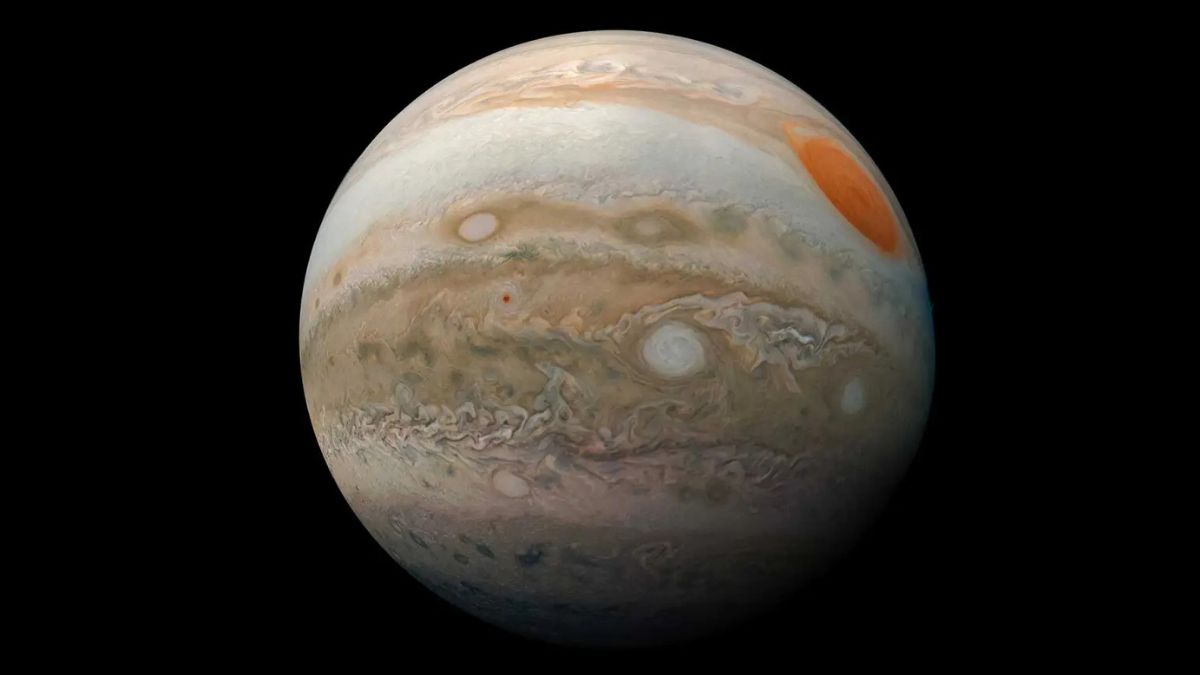
Photo Credit: NASA/JPL-Caltech/SwRI/MSSS
Timing-based orbital analysis shows hot Jupiters’ inward migration paths.
Click Here to Add Gadgets360 As A Trusted Source


Advertisement
Giant exoplanets, called hot Jupiters, that swing close to their stars have long puzzled astronomers as they try to explain how such large planets formed near their stars. Now, a new study purports to have cracked this one: These hot Jupiters were just visiting from other parts instead of having been violently ejected in the early days of protoplanetary disks. Comparing the timescale for orbital circularization, find evidence of planets that are more circular than they could have formed through disruptive mechanisms, providing strong support for smooth disk-driven migration and a new take on how planetary systems form.
Study Reveals Gradual Disk Migration Behind Certain Hot Jupiters, Challenging Previous High-Eccentricity Theories
According to a report published in The Astronomical Journal, PhD student Yugo Kawai and Assistant Professor Akihiko Fukui calculated circularization times for over 500 hot Jupiters. Researchers identified 30 planets with circular, star-aligned orbits in multi-planet systems, suggesting gradual disk-driven migration, not high-eccentricity scattering.
In terms of orbital timescale, the approach taken by the Tokyo team provides an explanation for hot-Jupiter migration and is a potential means to investigate exoplanet formation routes.
Smooth Migration of Hot Jupiters Supports Stable Multi-Planet Systems, Offering New Insights into Planetary Dynamics
The discovery also has implications for the stability and structure of planetary systems. Hot Jupiters that migrate smoothly are less likely to disrupt nearby planets, so multi-planet systems can survive, unlike in violent migration when companions are more frequently ejected or scattered.
Hot Jupiter formation insight is valuable in planetary system dynamics and diversity, and timing-based works may discover migrating exoplanets, thereby clarifying the knowledge of solar system evolution.
Comments
Get your daily dose of tech news, reviews, and insights, in under 80 characters on Gadgets 360 Turbo. Connect with fellow tech lovers on our Forum. Follow us on X, Facebook, WhatsApp, Threads and Google News for instant updates. Catch all the action on our YouTube channel.
Further reading:
Hot Jupiters, Exoplanets, disk migration, Planetary, formation, orbital dynamics, Astrophysics
Related Stories



Advertisement
Follow Us




-
05:20
Samsung Galaxy Watch Ultra 2 Review: Is This the Best Android Smartwatch? -
07:01
Samsung Galaxy Z Fold 8 Review: Is This the Best Foldable Phone? -
06:39
Samsung Galaxy Z Fold8 Ultra Review: Cameras, Battery, Performance Tested -
04:33
[Sponsored] JBL Live 780NC: Great Sound, Perfect Comfort, Smart ANC & 80-Hour Battery -
12:04
[Partner Content] OPPO Reno16 Series Deep Dive: Built for Creators?
-
Ganesh Chaturthi Stickers: ऐसे डाउनलोड करें और भेजे गणपति बप्पा के स्टिकर
-
iQOO 16 में होगा दुनिया का पहला 2K 165Hz डिस्प्ले
-
Xiaomi का ये छोटा सा सॉकेट पुराने पंखे-लैंप को बना देगा सुपर स्मार्ट
-
150 इंच स्क्रीन पर 4K सिनेमा और बिल्ट-इन 2.1 चैनल स्पीकर सिस्टम! लॉन्च हुआ OBE R3 Ultra Max Projector
-
Motorola Edge 70 Neo भारत में लॉन्च होगा Snapdragon चिप, 6GB रैम के साथ, IP68, IP69 रेटिंग!
Advertisement
Popular on Gadgets
- Samsung Galaxy S26 Ultra
- Motorola Razr Fold
- ChatGPT
- OPPO Find N6
- Mobiles Under Rs. 40,000
- Vivo X300 Ultra
- Asus Zenbook S14
- iQOO 15
- Vivo X300 Pro
- Lenovo Yoga Slim 7i Aura Edition
- iQOO 15R
- Vivo X Fold 5
- Sony PlayStation 5
- HP OmniPad 12
- OnePlus Nord CE 6 Lite
- OnePlus Pad 4
- OPPO F33 Pro 5G
- Cryptocurrency
- HP OmniBook Ultra 14 (2026)
- iPhone 17
- Eureka Forbes AP 355 Room Air Purifier
- Latest Mobile Phones
- Compare Phones
Latest Gadgets
- iPhone Duo
- OPPO A7 Pro
- Huawei Mate XT 2 Ultimate Design
- Realme 16 Pro Harry Potter Edition
- Samsung Galaxy A07s
- Huawei Pura X View
- Tecno Camon Slim 5G
- iQOO Z11xa
- Acer Aspire G 3D 16
- Acer Swift Air 16 (2026)
- Infinix Xpad 30 Pro
- Lenovo Yoga Tab Gen 2
- Apple Watch Ultra 4
- Apple Watch Series 12
- Haier M70 Mini LED 65-inch
- Xiaomi TV FX Mini LED 65
- Acer Predator Atlas 8
- Asus ROG Ally
- Blue Star 1.5 Ton 5 Star Inverter Split AC (IE518ZNURS)
- Blue Star 2 Ton 3 Star Inverter Window AC (WIE324L)

- About Us
- Sitemaps
- Feedback
- Archives
- Contact Us
- RSS
- Advertise
- Career
- Privacy Policy
- Ethics
- Editorial Policy
- Terms & Conditions
- Complaint Redressal
Download Our Apps
Available in Hindi
© Copyright Red Pixels Ventures Limited 2026. All rights reserved.
-
 Samsung Galaxy Watch 9 (44mm, LTE)
Starts from ₹44,590
Samsung Galaxy Watch 9 (44mm, LTE)
Starts from ₹44,590
-
 Samsung Galaxy Watch 9 (40mm, LTE)
Starts from ₹41,061
Samsung Galaxy Watch 9 (40mm, LTE)
Starts from ₹41,061
-
 Samsung Galaxy Watch 9 (40mm)
Starts from ₹37,999
Samsung Galaxy Watch 9 (40mm)
Starts from ₹37,999
-
 Haier M70 Mini LED 65-inch
Starts from ₹74,990
Haier M70 Mini LED 65-inch
Starts from ₹74,990
-
 CMF Buds Neo True Wireless Stereo (TWS) Earphones
Starts from ₹2,199
CMF Buds Neo True Wireless Stereo (TWS) Earphones
Starts from ₹2,199
-
 Xiaomi TV FX Mini LED 65
Starts from ₹64,999
Xiaomi TV FX Mini LED 65
Starts from ₹64,999
-
 iPhone 17 Pro, iPhone 17 Pro Max Get Big Discounts in India Ahead of iPhone 18 Pro Sale: Check Offers
-
 Oppo F35 Series is Coming: Rebranded Design, Leaked Prices, and Key Upgrades
-
 OnePlus 16 Might Not Launch in India as OnePlus 16R Will Lead Firm's New Product Strategy, Tipster Claims
-
 Motorola Edge 70 Neo Geekbench Listing Reveals Chipset Ahead of India Launch