-
 Astronomers Spot the Longest Gamma-Ray Burst Ever Seen: What You Need to Know10 December 2025
 -
NASA Explores Industry Collaboration to Boost Swift Observatory’s Orbit and Extend Its Mission15 August 2025
-
Brightest Gamma-Ray Burst Ever Observed Reveals Cosmic Secrets1 August 2025
-
New Study Finds Hercules-Corona Borealis Great Wall Bigger and Nearer Than Thought23 April 2025
-
Wolf-Rayet 104's Orbit Tilt Reduces Gamma-Ray Burst Threat, Study Finds20 March 2025
- Home
- Science
- Science News
- Astronomers Witness Longest Lasting Gamma Ray Burst in History, 8 Billion Light Years Away
Astronomers Witness Longest-Lasting Gamma-Ray Burst in History, 8 Billion Light-Years Away
Astronomers observed a 7-hour gamma-ray burst from 8 billion light-years away, unlike anything seen before.
Written by Gadgets 360 Staff | Updated: 16 December 2025 23:45 IST

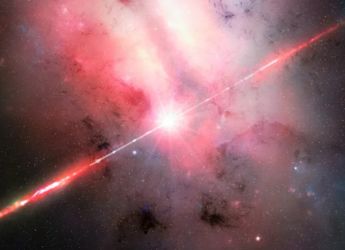
Photo Credit: NOIRLab/NSF/AURA/M. Garlick
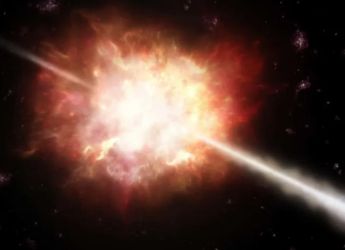
GRB 250702B, a seven-hour gamma-ray burst, was detected 8 billion light-years from Earth.
Click Here to Add Gadgets360 As A Trusted Source


Advertisement
Astronomers have spotted an extraordinarily long-lived cosmic explosion lasting more than seven hours, breaking the record as the longest known gamma-ray burst. The event, known as GRB 250702B, took place 8 billion light-years away from the solar system and produced an enormous amount of energy – so much that it stands out as unlike anything else NASA's Fermi Gamma-ray Space Telescope has recorded before. Scientists quickly enlisted a raft of world-class observatories to follow up on this afterglow and study its host galaxy — one that is highly obscured by dust and opaque at optical wavelengths, but transparent in X-rays as well as in the infrared range used by Gemini telescopes, the Very Large Telescope, Keck Observatory, and Hubble Space Telescope.
Unprecedented Seven-Hour Gamma-Ray Burst Challenges Existing Astrophysics Models
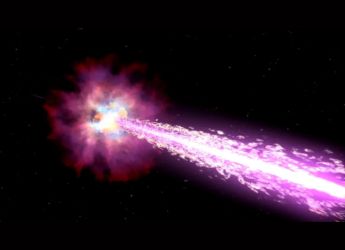
According to a report published in The Astrophysical Journal Letters on November 26, 2025, Jonathan Carney, lead author and a doctoral student at the University of North Carolina, mentioned that GRB long duration is uncommon for existing gamma-ray burst models. The event could have been caused by the collapse of a large star, a black hole devouring a star and ejecting matter at close to light speed, or the merger of an ultra-dense object and a massive velocity jet blasting directly towards Earth.
The find is a testament to global telescope coordination; GRB 250702B's long duration and remote location add precision to models of stellar death, black holes, and the physics of jets.
Seven-Hour GRB Suggests a New Class of Ultra-Long Cosmic Explosions
Researchers witnessed a seven-hour GRB, which would imply a new class of ultra-long GRBs; whether such processes apply or there is some new physics retained will be determined by future detections.
Such discoveries help to shed light on high-energy phenomena occurring across the universe, providing insights into the life cycle of massive stars and the formation of exotic objects such as black holes.
Comments
Get your daily dose of tech news, reviews, and insights, in under 80 characters on Gadgets 360 Turbo. Connect with fellow tech lovers on our Forum. Follow us on X, Facebook, WhatsApp, Threads and Google News for instant updates. Catch all the action on our YouTube channel.
Further reading:
Gamma-ray bursts, GRB 250702B, Cosmic explosion, Astrophysics, high-energy astronomy, Hubble Space Telescope, Space Science
Related Stories


Advertisement
Follow Us




-
05:20
Samsung Galaxy Watch Ultra 2 Review: Is This the Best Android Smartwatch? -
07:01
Samsung Galaxy Z Fold 8 Review: Is This the Best Foldable Phone? -
06:39
Samsung Galaxy Z Fold8 Ultra Review: Cameras, Battery, Performance Tested -
04:33
[Sponsored] JBL Live 780NC: Great Sound, Perfect Comfort, Smart ANC & 80-Hour Battery -
12:04
[Partner Content] OPPO Reno16 Series Deep Dive: Built for Creators?
Advertisement
Popular on Gadgets
- Samsung Galaxy S26 Ultra
- Motorola Razr Fold
- ChatGPT
- OPPO Find N6
- Mobiles Under Rs. 40,000
- Vivo X300 Ultra
- Asus Zenbook S14
- iQOO 15
- Vivo X300 Pro
- Lenovo Yoga Slim 7i Aura Edition
- iQOO 15R
- Vivo X Fold 5
- Sony PlayStation 5
- HP OmniPad 12
- OnePlus Nord CE 6 Lite
- OnePlus Pad 4
- OPPO F33 Pro 5G
- Cryptocurrency
- HP OmniBook Ultra 14 (2026)
- iPhone 17
- Eureka Forbes AP 355 Room Air Purifier
- Latest Mobile Phones
- Compare Phones
Latest Gadgets
- iPhone Duo
- OPPO A7 Pro
- Huawei Mate XT 2 Ultimate Design
- Realme 16 Pro Harry Potter Edition
- Samsung Galaxy A07s
- Huawei Pura X View
- Tecno Camon Slim 5G
- iQOO Z11xa
- Acer Aspire G 3D 16
- Acer Swift Air 16 (2026)
- Xiaomi Pad 9 Pro
- Xiaomi Pad 9
- Apple Watch Ultra 4
- Apple Watch Series 12
- Haier M70 Mini LED 65-inch
- Xiaomi TV FX Mini LED 65
- Acer Predator Atlas 8
- Asus ROG Ally
- Blue Star 1.5 Ton 5 Star Inverter Split AC (IE518ZNURS)
- Blue Star 2 Ton 3 Star Inverter Window AC (WIE324L)

- About Us
- Sitemaps
- Feedback
- Archives
- Contact Us
- RSS
- Advertise
- Career
- Privacy Policy
- Ethics
- Editorial Policy
- Terms & Conditions
- Complaint Redressal
Download Our Apps
Available in Hindi
© Copyright Red Pixels Ventures Limited 2026. All rights reserved.