-
 NASA’s PUNCH Mission Completes Final Orbit Manoeuvres, Opens Early Sun Data to the Public17 August 2025
 -
NASA’s Parker Probe Sends Closest-Ever Images from Inside the Sun’s Corona17 July 2025
-
Parker Solar Probe Witnesses Unprecedented Sunward Plasma Jet Driven by Magnetic Reconnection11 June 2025
-
NASA’s Parker Solar Probe Completes Second Close Flyby of the Sun at Record Speed7 April 2025
-
NASA Confirms Successful Flyby of Parker Solar Probe, Completes Closest Sun Approach30 December 2024
- Home
- Science
- Science News
- NASA’s Parker Solar Probe Observes Solar Wind Making ‘U Turn’, Shedding Light on Space Weather
NASA’s Parker Solar Probe Observes Solar Wind Making ‘U-Turn’, Shedding Light on Space Weather
Parker Solar Probe observed solar material reversing toward the sun, revealing new details about space weather.
Written by Gadgets 360 Staff | Updated: 17 December 2025 22:00 IST
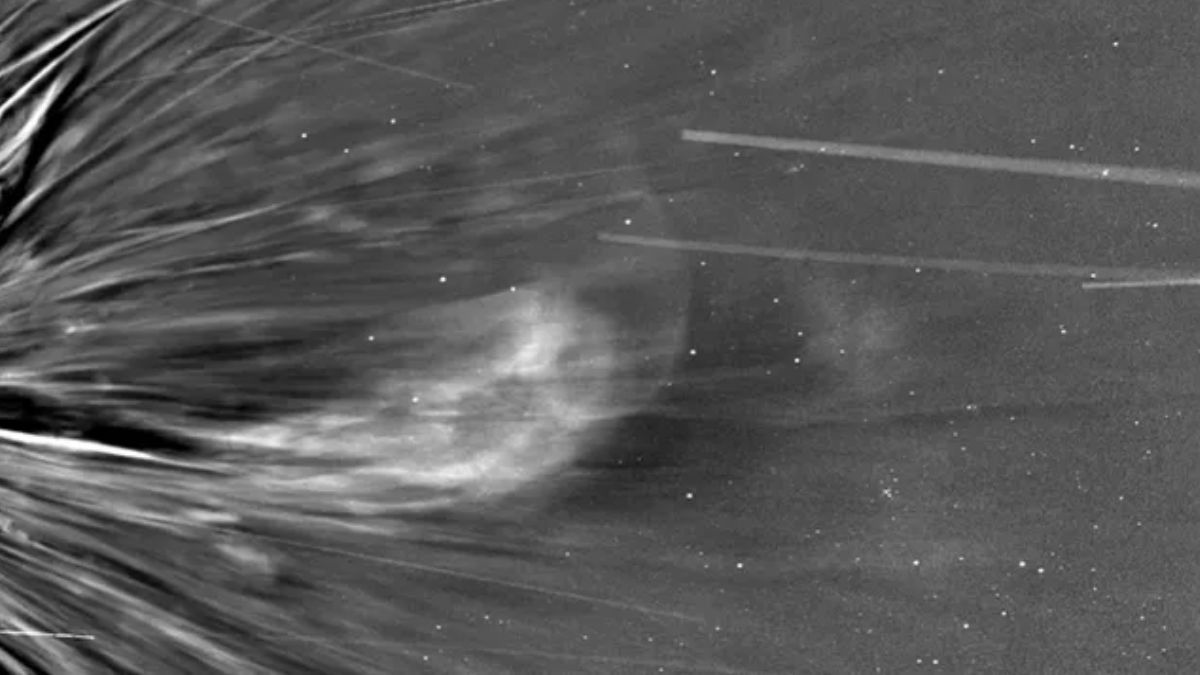
Photo Credit: NASA
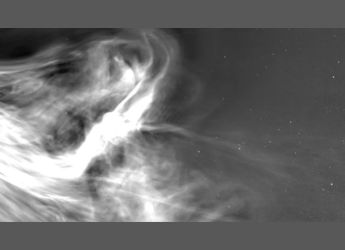
NASA’s Parker Probe captures solar wind looping back to the sun, showing magnetic recycling in action.
Click Here to Add Gadgets360 As A Trusted Source


Advertisement
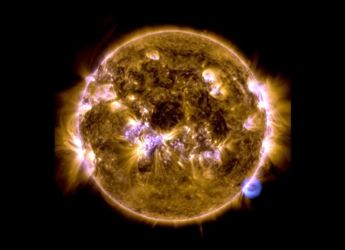
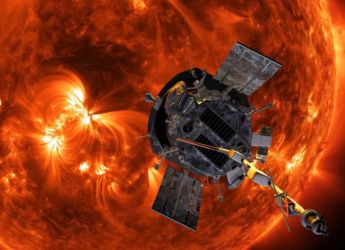
NASA's Parker Solar Probe has taken the clearest image so far of a solar wind performing a “U-turn”, providing rare glimpses into the sun's magnetic recycling. Passing within a scant 3.8 million miles of the solar surface on Dec. 24, 2024, the spacecraft witnessed a coronal mass ejection (CME) surge from the sun and explode out, but was followed by some superheated material raining back down to the sun. Incoming material trails along magnetic field lines, snapping and reconnecting in giant loops that reshape the sun's magnetic environment and may redirect future CMEs.
Parker Solar Probe Captures Sun's Magnetic Recycling and Coronal Material Inflows in Unprecedented Detail
According to a NASA report, this process, known as inflows, had been hinted at in previous distant observations, but Parker's close-up images revealed the returning blobs in unprecedented detail. Project scientist Nour Rawafi at Johns Hopkins Applied Physics Laboratory mentioned the observations provide “a fascinating glimpse into how the sun continuously recycles its coronal magnetic fields and material.” That could, possibly, have an impact on predicting the arrival of solar storms at planets such as Earth or Mars, noted by WISPR project scientist Angelos Vourlidas.
CMEs, explosions of superheated plasma, can damage power grids, satellites, and communications. Parker's video captures the magnetic fields stretching, snapping, looping, and moving off into space or hugging back with solar material.
Scientists Measure Sun-Falling Plasma Blobs, Enhancing Space Weather Forecasting and Solar Storm Predictions
For the first time, researchers calculated blobs falling into the sun and helped to improve models of space weather, as well as predictions for long-term solar storms in the solar system.
Observations and simulations with Parker in the coming years will further reveal the nature of solar magnetic fields and solar wind.
Comments
Get your daily dose of tech news, reviews, and insights, in under 80 characters on Gadgets 360 Turbo. Connect with fellow tech lovers on our Forum. Follow us on X, Facebook, WhatsApp, Threads and Google News for instant updates. Catch all the action on our YouTube channel.
Further reading:
Parker Solar Probe, solar wind, coronal mass ejection, space weather, solar magnetic fields, NASA, astronomy
Related Stories
NASA’s Parker Solar Probe Observes Solar Wind Making ‘U-Turn’, Shedding Light on Space Weather


Advertisement
Follow Us




-
06:32
Google Pixel 11 Pro XL Review: The Most Exciting Pixel Yet? | 120X Zoom + Tensor G6 -
05:20
Samsung Galaxy Watch Ultra 2 Review: Is This the Best Android Smartwatch? -
07:01
Samsung Galaxy Z Fold 8 Review: Is This the Best Foldable Phone? -
06:39
Samsung Galaxy Z Fold8 Ultra Review: Cameras, Battery, Performance Tested -
04:33
[Sponsored] JBL Live 780NC: Great Sound, Perfect Comfort, Smart ANC & 80-Hour Battery
Advertisement
Popular on Gadgets
- Samsung Galaxy S26 Ultra
- Motorola Razr Fold
- ChatGPT
- OPPO Find N6
- Mobiles Under Rs. 40,000
- Vivo X300 Ultra
- Asus Zenbook S14
- iQOO 15
- Vivo X300 Pro
- Lenovo Yoga Slim 7i Aura Edition
- iQOO 15R
- Vivo X Fold 5
- Sony PlayStation 5
- HP OmniPad 12
- OnePlus Nord CE 6 Lite
- OnePlus Pad 4
- OPPO F33 Pro 5G
- Cryptocurrency
- HP OmniBook Ultra 14 (2026)
- iPhone 17
- Eureka Forbes AP 355 Room Air Purifier
- Latest Mobile Phones
- Compare Phones
Latest Gadgets
- Samsung Galaxy A08
- Itel Muzik 450L
- OPPO K14 Lite
- Samsung Galaxy A18 4G
- iPhone Duo
- OPPO A7 Pro
- Huawei Mate XT 2 Ultimate Design
- Realme 16 Pro Harry Potter Edition
- Asus Vivobook S14 (S5452MA)
- Acer Aspire G 3D 16
- Xiaomi Pad 9 Pro
- Xiaomi Pad 9
- Apple Watch Ultra 4
- Apple Watch Series 12
- Haier M70 Mini LED 65-inch
- Xiaomi TV FX Mini LED 65
- Acer Predator Atlas 8
- Asus ROG Ally
- Blue Star 1.5 Ton 5 Star Inverter Split AC (IE518ZNURS)
- Blue Star 2 Ton 3 Star Inverter Window AC (WIE324L)

- About Us
- Sitemaps
- Feedback
- Archives
- Contact Us
- RSS
- Advertise
- Career
- Privacy Policy
- Ethics
- Editorial Policy
- Terms & Conditions
- Complaint Redressal
Download Our Apps
Available in Hindi
© Copyright Red Pixels Ventures Limited 2026. All rights reserved.