-
 NASA Plans Giant Moon Base at Lunar South Pole for Artemis Era27 May 2026
 -
Scientists Discover New Fuel-Saving Route to the Moon21 May 2026
-
Artemis 2 Commander Reid Wiseman Teams Up With Astrophotographer for Rare Lunar Mission Photos12 May 2026
-
NASA Plans Nuclear-Powered Spacecraft for Skyfall Mission to Mars26 March 2026
-
NASA Selects Three New Lunar Science Instruments for Artemis Moon Missions22 January 2026
- Home
- Science
- Science News
- Earth’s Atmosphere Has Been Leaking Onto the Moon for Billions of Years, Study Finds
Earth’s Atmosphere Has Been Leaking Onto the Moon for Billions of Years, Study Finds
Earth’s atmospheric atoms and molecules travel to the moon, offering a record and resources for lunar bases.
Written by Gadgets 360 Staff | Updated: 16 December 2025 23:15 IST
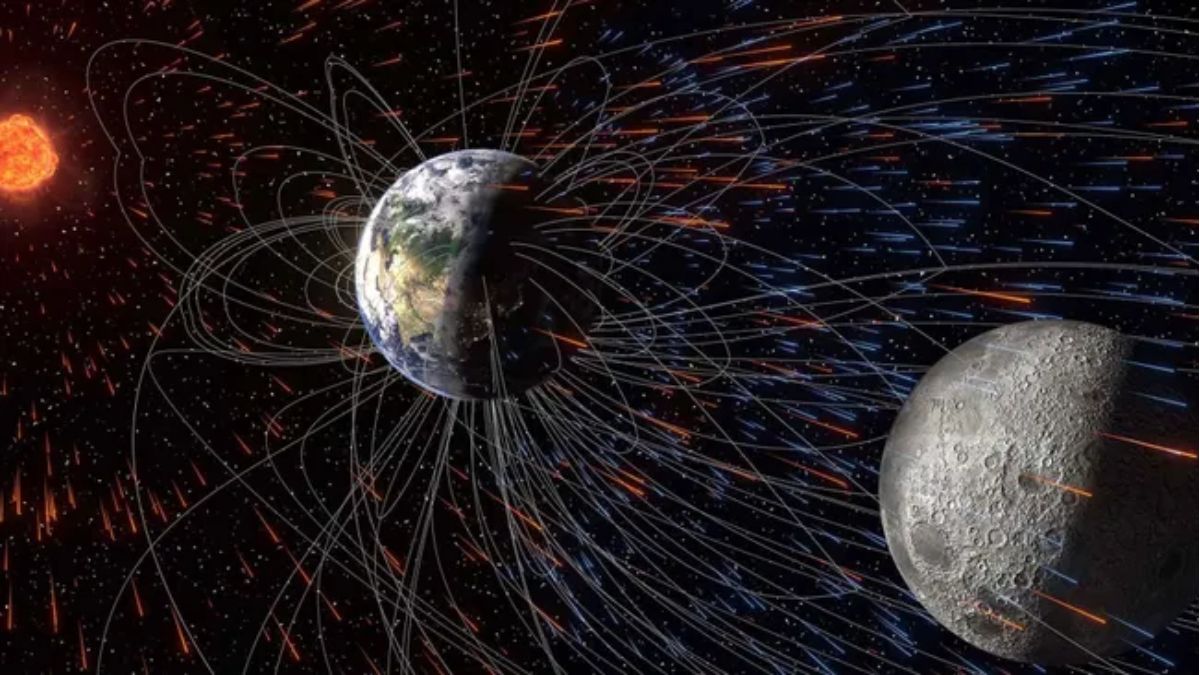
Photo Credit: University of Rochester illustration/Shubhonkar Paramanick
Particles from Earth’s atmosphere travel to the moon, potentially aiding future lunar bases.
Click Here to Add Gadgets360 As A Trusted Source


Advertisement
When astronauts return to the moon, they may find a small piece of Earth waiting for them. New research shows that atoms and molecules from Earth's atmosphere have been traveling across space to the lunar surface for billions of years. These include elements like nitrogen, water, carbon dioxide, helium, and argon, which were found in puzzling amounts in Apollo mission lunar samples. The findings imply that the moon may harbor a long-term record of Earth's atmosphere — as well as a supply of volatiles that could be useful to future lunar bases.
Earth's Magnetic Field Channels Atmospheric Particles to the Moon, Preserving Climate History
According to a report published in Communications Earth & Environment on December 11, 2025, researchers at the University of Rochester simulated how Earth's atmospheric particles could make their way to the moon. The study shows Earth's magnetic field directs particles toward the Moon, unlike earlier beliefs about early atmospheric escape.
The research demonstrates that this process of atmospheric transport persists from the ancient past to the present, resulting in a gradual and steady deposition of volatiles on the surface of the moon. The particles could also be used by scientists to study Earth's climate and environmental history, which has been saved in lunar soil for billions of years.
Earth's Atmospheric Leakage Offers Clues for Planetary Science and Lunar Resources
The findings also have wider relevance for planetary science, the researchers say. Understanding atmospheric escape from Earth allows scientists to learn about the climates, habitability, and magnetic fields of planets like Mars.
Long-term atomic leakage could also form water and volatile deposits directly on the moon over eons, favoring habitats and missions alongside comet and asteroid sources.
Comments
Get your daily dose of tech news, reviews, and insights, in under 80 characters on Gadgets 360 Turbo. Connect with fellow tech lovers on our Forum. Follow us on X, Facebook, WhatsApp, Threads and Google News for instant updates. Catch all the action on our YouTube channel.
Further reading:
Lunar exploration, Earth atmosphere, moon, lunar bases, Planetary Science, Space Research, Apollo Missions, volatiles
Related Stories



Advertisement
Follow Us




-
05:20
Samsung Galaxy Watch Ultra 2 Review: Is This the Best Android Smartwatch? -
07:01
Samsung Galaxy Z Fold 8 Review: Is This the Best Foldable Phone? -
06:39
Samsung Galaxy Z Fold8 Ultra Review: Cameras, Battery, Performance Tested -
04:33
[Sponsored] JBL Live 780NC: Great Sound, Perfect Comfort, Smart ANC & 80-Hour Battery -
12:04
[Partner Content] OPPO Reno16 Series Deep Dive: Built for Creators?
-
Ganesh Chaturthi Stickers: ऐसे डाउनलोड करें और भेजे गणपति बप्पा के स्टिकर
-
iQOO 16 में होगा दुनिया का पहला 2K 165Hz डिस्प्ले
-
Xiaomi का ये छोटा सा सॉकेट पुराने पंखे-लैंप को बना देगा सुपर स्मार्ट
-
150 इंच स्क्रीन पर 4K सिनेमा और बिल्ट-इन 2.1 चैनल स्पीकर सिस्टम! लॉन्च हुआ OBE R3 Ultra Max Projector
-
Vivo ला रही नया मिडरेंज फोन, 44W फास्ट चार्जिंग के साथ!
Advertisement
Popular on Gadgets
- Samsung Galaxy S26 Ultra
- Motorola Razr Fold
- ChatGPT
- OPPO Find N6
- Mobiles Under Rs. 40,000
- Vivo X300 Ultra
- Asus Zenbook S14
- iQOO 15
- Vivo X300 Pro
- Lenovo Yoga Slim 7i Aura Edition
- iQOO 15R
- Vivo X Fold 5
- Sony PlayStation 5
- HP OmniPad 12
- OnePlus Nord CE 6 Lite
- OnePlus Pad 4
- OPPO F33 Pro 5G
- Cryptocurrency
- HP OmniBook Ultra 14 (2026)
- iPhone 17
- Eureka Forbes AP 355 Room Air Purifier
- Latest Mobile Phones
- Compare Phones
Latest Gadgets
- iPhone Duo
- OPPO A7 Pro
- Huawei Mate XT 2 Ultimate Design
- Realme 16 Pro Harry Potter Edition
- Samsung Galaxy A07s
- Huawei Pura X View
- Tecno Camon Slim 5G
- iQOO Z11xa
- Acer Aspire G 3D 16
- Acer Swift Air 16 (2026)
- Xiaomi Pad 9 Pro
- Xiaomi Pad 9
- Apple Watch Ultra 4
- Apple Watch Series 12
- Haier M70 Mini LED 65-inch
- Xiaomi TV FX Mini LED 65
- Acer Predator Atlas 8
- Asus ROG Ally
- Blue Star 1.5 Ton 5 Star Inverter Split AC (IE518ZNURS)
- Blue Star 2 Ton 3 Star Inverter Window AC (WIE324L)

- About Us
- Sitemaps
- Feedback
- Archives
- Contact Us
- RSS
- Advertise
- Career
- Privacy Policy
- Ethics
- Editorial Policy
- Terms & Conditions
- Complaint Redressal
Download Our Apps
Available in Hindi
© Copyright Red Pixels Ventures Limited 2026. All rights reserved.