-
 NASA’s MAVEN Detects Rare Solar Wind Effect in Mars Atmosphere28 May 2026
 -
Scientists Develop Swarm Robots to Explore Hidden Lava Tubes on Mars27 May 2026
-
Mysterious Stacked Rocks Spotted by NASA Perseverance Rover on Mars22 May 2026
-
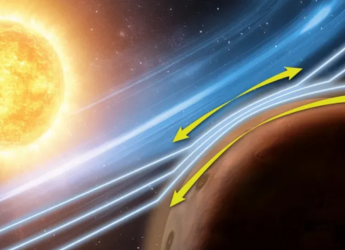
Massive Solar Storm Reveals How Mars Is Losing Its Atmosphere19 May 2026
-
New Biosignature Method Could Transform Search for Alien Life16 May 2026
- Home
- Science
- Science News
- NASA's Study Suggests Life Could Thrive Beneath Ice in Mars
NASA's Study Suggests Life Could Thrive Beneath Ice in Mars
A new NASA study explores the potential for microbial life beneath Mars’ ice.
Written by Gadgets 360 Staff | Updated: 18 October 2024 17:00 IST

Photo Credit: NASA/JPL-Caltech/University of Arizona
Mars features two primary types of ice: frozen water and frozen carbon dioxide
Click Here to Add Gadgets360 As A Trusted Source


Advertisement
NASA's latest study has sparked interest in the potential for microbial life beneath the icy surface of Mars. Although direct evidence of life on the Red Planet remains elusive, researchers suggest that meltwater trapped beneath layers of frozen water could create a suitable environment for microbial existence. Their findings, stem from sophisticated computer modelling that highlights how sunlight might penetrate water ice to enable photosynthesis in shallow meltwater pools.
Understanding Martian Ice
Mars features two primary types of ice: frozen water and frozen carbon dioxide. This study focuses on water ice, formed from ancient snow that accumulated dust during previous ice ages on the planet. As the dust particles absorb sunlight, they can raise temperatures within the ice, leading to melting beneath the surface. This process is significant because while the thin Martian atmosphere typically causes water ice to sublimate directly into gas, conditions beneath the ice layer could facilitate melting.
Analogies with Earth
Research on Earth shows that dust particles can create cryoconite holes—small water pockets within ice that provide habitats for microorganisms. Phil Christensen, a co-author and professor at Arizona State University, explains that this phenomenon allows sunlight to warm the ice from within, creating a nurturing environment for simple life forms. His earlier studies have laid the groundwork for this new paper by demonstrating that liquid water can exist within Martian ice under certain conditions.
Exploring Martian Conditions
The current research suggests that these shallow subsurface pools, potentially located in Mars' tropics (between 30 and 60 degrees latitude), could shield microbes from harmful radiation while preventing evaporation. This habitat could support a variety of life forms, including algae and cyanobacteria. Lead author Aditya Khuller from NASA's Jet Propulsion Laboratory plans to conduct laboratory experiments to replicate Martian dusty ice, which will help refine the search for potential life in the cosmos.
Comments
Get your daily dose of tech news, reviews, and insights, in under 80 characters on Gadgets 360 Turbo. Connect with fellow tech lovers on our Forum. Follow us on X, Facebook, WhatsApp, Threads and Google News for instant updates. Catch all the action on our YouTube channel.
Related Stories



Advertisement
Follow Us




-
04:17
[Sponsored] LG NANO 4K UHD AI TV NU885: Gemini Search, Dolby Atmos & 5 Years of Updates -
00:57
[Sponsored] Samsung Galaxy Z Fold8 My Fan Cam in Action: Find the Moment, Then Share It -
01:41
[Sponsored] What Do You Need To Know Before Your Next Run? | Samsung Galaxy Watch Ultra2 -
01:32
[Sponsored] Big Day Tomorrow? Prep Today | Samsung Galaxy Watch Ultra2 -
04:37
[Sponsored]: CP PLUS CarKam CP-F89B: 4K Dashcam With Rear Camera, GPS & Emergency Recording
-
आ गई हवा में उड़ने वाली Tesla Roadster कार, आखिर सच हुआ फिल्मों वाला कमाल
-
रोबोट ने की लड़की से छेड़छाड़, पीछे से पकड़ा और किए गंदे इशारे, जानें
-
PS5 कहां मिलेगा सस्ता, Flipkart या Amazon, जानें सबकुछ
-
RedMagic 12 Pro ग्लोबल मार्केट में 3 नवंबर को होगा लॉन्च, 8400mAh बैटरी
-
Lenovo ने सस्ता लैपटॉप ग्लोबल मार्केट में किया लॉन्च, Snapdragon X चिप से लैस
Advertisement
Popular on Gadgets
- Samsung Galaxy S26 Ultra
- Motorola Razr Fold
- ChatGPT
- OPPO Find N6
- Mobiles Under Rs. 40,000
- Vivo X300 Ultra
- Asus Zenbook S14
- iQOO 15
- Vivo X300 Pro
- Lenovo Yoga Slim 7i Aura Edition
- iQOO 15R
- Vivo X Fold 5
- Sony PlayStation 5
- HP OmniPad 12
- OnePlus Nord CE 6 Lite
- OnePlus Pad 4
- OPPO F33 Pro 5G
- Cryptocurrency
- HP OmniBook Ultra 14 (2026)
- iPhone 17
- Eureka Forbes AP 355 Room Air Purifier
- Latest Mobile Phones
- Compare Phones
Latest Gadgets
- Tecno Spark 50S 5G
- Vivo Y600s Pro
- Vivo Y32 (2026)
- Infinix Smart 20 HD
- Vivo V80
- Vivo S2 FE
- Vivo Y600K Turbo
- Realme P4s Lite
- HP ZBook Ultra G3a
- Dell Pro Rugged 14
- Amazon Alexa Tablet 8
- Amazon Alexa Tablet 11
- Amazfit T-Rex Dual Solar
- OPPO Watch S2
- Toshiba 65-Inch 4K Ultra HD Smart Mini LED QLED TV (65Z670SP)
- Haier M70 Mini LED 65-inch
- Acer Predator Atlas 8
- Asus ROG Ally
- Blue Star 1.5 Ton 5 Star Inverter Split AC (IE518ZNURS)
- Blue Star 2 Ton 3 Star Inverter Window AC (WIE324L)

- About Us
- Sitemaps
- Feedback
- Archives
- Contact Us
- RSS
- Advertise
- Career
- Privacy Policy
- Ethics
- Editorial Policy
- Terms & Conditions
- Complaint Redressal
Download Our Apps
Available in Hindi
© Copyright Red Pixels Ventures Limited 2026. All rights reserved.