

-
 Chandra Captures Sharpest-Ever X-Ray View of M87 Black Hole Jet18 June 2026
 -
Scientists Discover Giant Planet Formation Around Supermassive Black Holes17 June 2026
-
JWST Reveals the True Identity of Mysterious Little Red Dots11 June 2026
-
James Webb Space Telescope Weighs Most Distant Dormant Black Hole Ever Detected9 June 2026
-
James Webb Space Telescope Detects Most Distant Dormant Black Hole Ever Found6 June 2026
- Home
- Science
- Science News
- NASA Spots Starquakes in a Red Giant Orbiting One of the Galaxy’s Quietest Black Holes
NASA Spots Starquakes in a Red Giant Orbiting One of the Galaxy’s Quietest Black Holes
A red giant near a dormant black hole shows fast spin and puzzling chemistry.
Written by Gadgets 360 Staff | Updated: 28 December 2025 10:30 IST
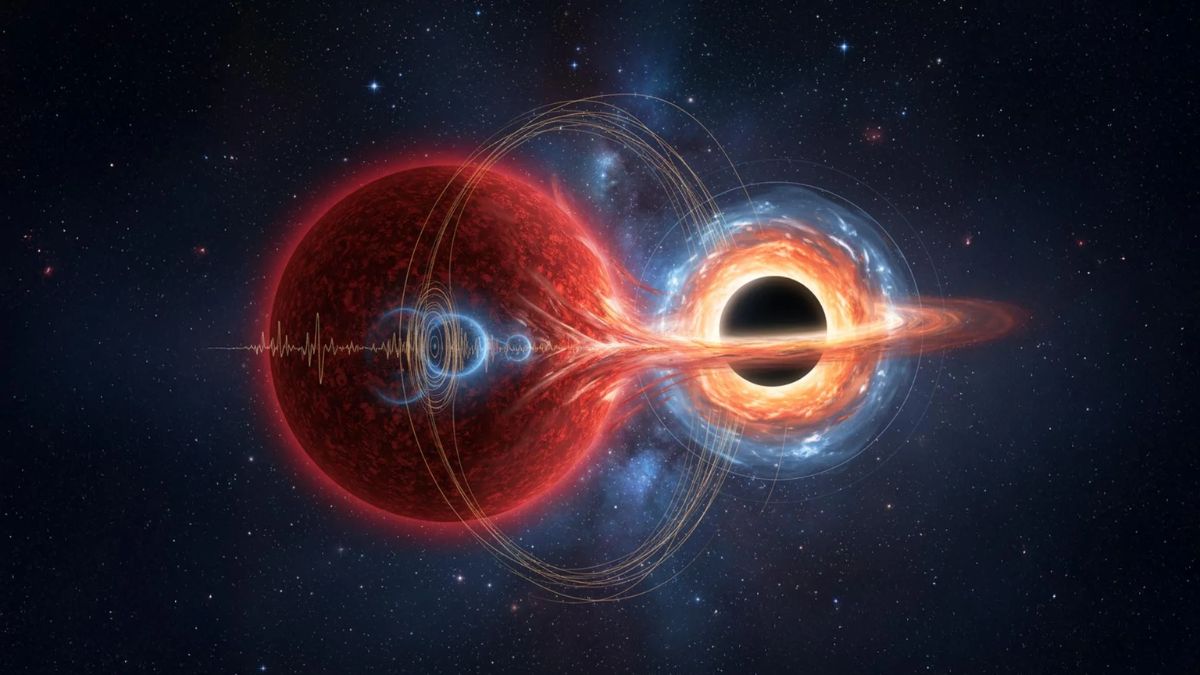
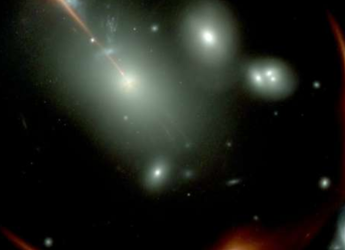
Photo Credit: NASA/JPL-Caltech
Astronomers detect unusual vibrations in a red giant orbiting a quiet black hole
Click Here to Add Gadgets360 As A Trusted Source


Advertisement
With an unusual spin and internal structure, a distant red giant star orbiting a quiet black hole is defying expectations. Tiny vibrations in the star's light, captured by NASA's TESS satellite, suggest it may have collided with another star in the past, spinning much faster than normal. Its chemical makeup indicates it should be ancient, yet internal “starquakes” reveal it is only about five billion years old. The star, part of the Gaia BH2 system first identified by ESA's Gaia mission in 2023, provides a rare glimpse into the hidden history of stars quietly orbiting dormant black holes.
Stellar “Quakes” Reveal Rapidly Rotating Star's Hidden History
According to an Astronomical Journal report, researchers at the University of Hawaiʻi Institute for Astronomy (IfA) used these vibrations to probe the star's interior. Lead author Daniel Hey noted that “just like seismologists use earthquakes to study Earth's interior, stellar oscillations reveal unexpected details of the star's history.” Co-author Joel Ong added that the star's unusually rapid rotation, completing a full spin every 398 days, points to interactions with its companion or a past merger.
Unusual Chemistry and Oscillations Challenge Models of Red Giant Evolution
The star's alpha-rich chemistry suggests it should be much older, creating a puzzle about its formation. Comparison with another resting black hole system, Gaia BH3, reveals surprising differences in the oscillations, which are inconsistent with current models of low-metallicity stellar evolution.
Future observations by TESS will seek to determine whether the red giant's peculiarities stem from an earlier stellar merger and investigate how quiet black hole systems like this evolve.
Comments
Get your daily dose of tech news, reviews, and insights, in under 80 characters on Gadgets 360 Turbo. Connect with fellow tech lovers on our Forum. Follow us on X, Facebook, WhatsApp, Threads and Google News for instant updates. Catch all the action on our YouTube channel.
Related Stories



Advertisement
Follow Us




-
04:23
[Partner Content] Your Phone Can Do WAY More Than You Think | OPPO ColorOS 16 -
01:59
Samsung Galaxy Z Fold8 Ultra: Unfold the Ultra Night -
03:24
Apple Pay Launches In India: Supported Devices, Cards And Payments Explained -
00:21
[Sponsored] Samsung Galaxy Z Fold8, Fold8 Ultra -
03:41
[Sponsored] Samsung Galaxy Z Fold8: How It Fits Into an Actor’s Busy Day | Camera, Multitasking & More
-
iQOO Pad Ultra 165Hz AMOLED डिस्प्ले के साथ हुआ लॉन्च
-
Apple Pay की भारत में एंट्री, सीधा iPhone और स्मार्टवॉच से होगी पेमेंट
-
भारत में बच्चों के सोशल मीडिया पर लगेगा बैन? सरकार उठा सकती है बड़ा कदम
-
Google Pixel 11a में मिल सकती है डुअल रियर कैमरा यूनिट, जल्द लॉन्च की तैयारी
-
Oppo F35 सीरीज में मिलेगा 50 मेगापिक्सल का प्राइमरी कैमरा, अगले सप्ताह भारत में लॉन्च
Advertisement
Popular on Gadgets
- Samsung Galaxy S26 Ultra
- Motorola Razr Fold
- ChatGPT
- OPPO Find N6
- Mobiles Under Rs. 40,000
- Vivo X300 Ultra
- Asus Zenbook S14
- iQOO 15
- Vivo X300 Pro
- Lenovo Yoga Slim 7i Aura Edition
- iQOO 15R
- Vivo X Fold 5
- Sony PlayStation 5
- HP OmniPad 12
- OnePlus Nord CE 6 Lite
- OnePlus Pad 4
- OPPO F33 Pro 5G
- Cryptocurrency
- HP OmniBook Ultra 14 (2026)
- iPhone 17
- Eureka Forbes AP 355 Room Air Purifier
- Latest Mobile Phones
- Compare Phones
Latest Gadgets
- OPPO K15x
- OPPO K15s
- HMD Vibe 2 Pro 5G
- OPPO K14 Plus 5G
- Lava Shark 2 Pro 5G
- Ai+ Pulse 2 FE
- OPPO Reno 16t
- Itel Zeno 300
- Dell 14 Plus 2-in-1 (AMD Ryzen AI 7 350, 2025)
- Microsoft Surface Laptop, 13-inch (2nd Edition)
- Samsung Galaxy Tab S12+
- Samsung Galaxy Tab S12 Ultra
- Amazfit T-Rex Dual Solar
- OPPO Watch S2
- Toshiba 65-Inch 4K Ultra HD Smart Mini LED QLED TV (65Z670SP)
- Haier M70 Mini LED 65-inch
- Acer Predator Atlas 8
- Asus ROG Ally
- Blue Star 1.5 Ton 5 Star Inverter Split AC (IE518ZNURS)
- Blue Star 2 Ton 3 Star Inverter Window AC (WIE324L)

- About Us
- Sitemaps
- Feedback
- Archives
- Contact Us
- RSS
- Advertise
- Career
- Privacy Policy
- Ethics
- Editorial Policy
- Terms & Conditions
- Complaint Redressal
Download Our Apps
Available in Hindi
© Copyright Red Pixels Ventures Limited 2026. All rights reserved.