
-
 New Study Claims There Might Be Way More Pulsars in Space Than We Previously Thought6 April 2026
 -
PSR J0922+0638 Pulsar Keeps Glitching Every 550 Days, Scientists Are Intrigued31 July 2025
-
New Study Confirms TeV Halos Are Common in Middle-Aged Pulsars22 May 2025
-
NASA Telescopes Reveal Hidden Properties of X-Ray Pulsar RX J0032.9-734812 May 2025
-
Magnetic Fields Could Significantly Influence Oscillations in Merging Neutron Stars, Study Finds26 April 2025
- Home
- Science
- Science News
- Astronomers Watch a Dormant Neutron Star Reignite After a Decade of Silence
Astronomers Watch a Dormant Neutron Star Reignite After a Decade of Silence
A neutron star’s decade-long brightening reveals new clues about extreme accretion and powerful X-ray sources.
Written by Gadgets 360 Staff | Updated: 15 December 2025 23:30 IST

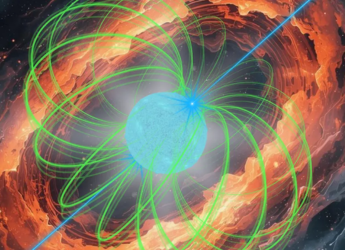
Photo Credit: NASA's Goddard Space Flight Center/S. Wiessinger
Neutron star P13 brightens dramatically after years of faint activity
Click Here to Add Gadgets360 As A Trusted Source


Advertisement
Astronomers have watched a neutron star that had seemed “dead” come back to life, which could teach them more about one of the most powerful X-ray sources in the universe. Over the course of a decade, the neutron star P13 has gone through extreme swings in brightness and speed of rotation, with its X-ray emissions increasing by hundreds of times. These shifts, scientists say, indicate the changing manner in which gas is falling on the star. The findings help explain how ultraluminous X-ray sources reach such extreme power and why they can switch between quiet and active phases over time.
Astronomers Track Neutron Star P13's Dramatic Brightening and Spin Changes Over a Decade
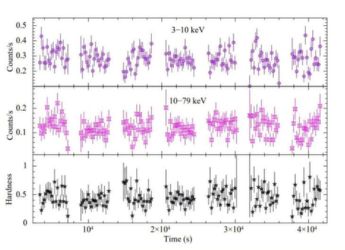
According to a report based on observations published by an international research team, the neutron star P13 is located in the galaxy NGC 7793, roughly 10 million light-years distant from Earth. Astronomers followed P13 from 2011 to 2024, observing a dim phase in 2021 and a more than a hundred-fold brightening by 2024.
Neutron stars produce very high-energy X-rays as matter falls onto their surface. In P13, gas flared from magnetic poles to create glowing columns, but the brightness didn't correspond to its 0.4-second spin.
Neutron Star's Rapid Spin-Up Tied to Structural Changes in Extreme Accretion Flow
The new analysis revealed that during the rebrightening phase, the neutron star's spin-up rate doubled and stayed high for years. This close link between brightness and rotation suggests the structure of the accretion flow itself changed during the quiet period.
Detailed pulse analyses suggest the accretion column's height changed over a decade, providing key insights into supercritical accretion, where matter falls onto compact objects at extreme rates.
Comments
Get your daily dose of tech news, reviews, and insights, in under 80 characters on Gadgets 360 Turbo. Connect with fellow tech lovers on our Forum. Follow us on X, Facebook, WhatsApp, Threads and Google News for instant updates. Catch all the action on our YouTube channel.
Further reading:
neutron star, ultraluminous X-ray source, accretion physics, Astronomy, Space Science
Related Stories





Advertisement
Follow Us




-
05:20
Samsung Galaxy Watch Ultra 2 Review: Is This the Best Android Smartwatch? -
07:01
Samsung Galaxy Z Fold 8 Review: Is This the Best Foldable Phone? -
06:39
Samsung Galaxy Z Fold8 Ultra Review: Cameras, Battery, Performance Tested -
04:33
[Sponsored] JBL Live 780NC: Great Sound, Perfect Comfort, Smart ANC & 80-Hour Battery -
12:04
[Partner Content] OPPO Reno16 Series Deep Dive: Built for Creators?
Advertisement
Popular on Gadgets
- Samsung Galaxy S26 Ultra
- Motorola Razr Fold
- ChatGPT
- OPPO Find N6
- Mobiles Under Rs. 40,000
- Vivo X300 Ultra
- Asus Zenbook S14
- iQOO 15
- Vivo X300 Pro
- Lenovo Yoga Slim 7i Aura Edition
- iQOO 15R
- Vivo X Fold 5
- Sony PlayStation 5
- HP OmniPad 12
- OnePlus Nord CE 6 Lite
- OnePlus Pad 4
- OPPO F33 Pro 5G
- Cryptocurrency
- HP OmniBook Ultra 14 (2026)
- iPhone 17
- Eureka Forbes AP 355 Room Air Purifier
- Latest Mobile Phones
- Compare Phones
Latest Gadgets
- iPhone Duo
- OPPO A7 Pro
- Huawei Mate XT 2 Ultimate Design
- Realme 16 Pro Harry Potter Edition
- Samsung Galaxy A07s
- Huawei Pura X View
- Tecno Camon Slim 5G
- iQOO Z11xa
- Acer Aspire G 3D 16
- Acer Swift Air 16 (2026)
- Infinix Xpad 30 Pro
- Lenovo Yoga Tab Gen 2
- Apple Watch Ultra 4
- Apple Watch Series 12
- Haier M70 Mini LED 65-inch
- Xiaomi TV FX Mini LED 65
- Acer Predator Atlas 8
- Asus ROG Ally
- Blue Star 1.5 Ton 5 Star Inverter Split AC (IE518ZNURS)
- Blue Star 2 Ton 3 Star Inverter Window AC (WIE324L)

- About Us
- Sitemaps
- Feedback
- Archives
- Contact Us
- RSS
- Advertise
- Career
- Privacy Policy
- Ethics
- Editorial Policy
- Terms & Conditions
- Complaint Redressal
Download Our Apps
Available in Hindi
© Copyright Red Pixels Ventures Limited 2026. All rights reserved.