- Home
- Science
- Science News
- Scientists Discover New Fuel Saving Route to the Moon
Scientists Discover New Fuel-Saving Route to the Moon
Researchers from Brazil and Portugal discovered a new low-fuel route to the Moon using hidden gravitational pathways in space. The trajectory saves more fuel than previous lunar routes while maintaining constant communication with Earth.
Written by Gadgets 360 Staff | Updated: 21 May 2026 22:03 IST
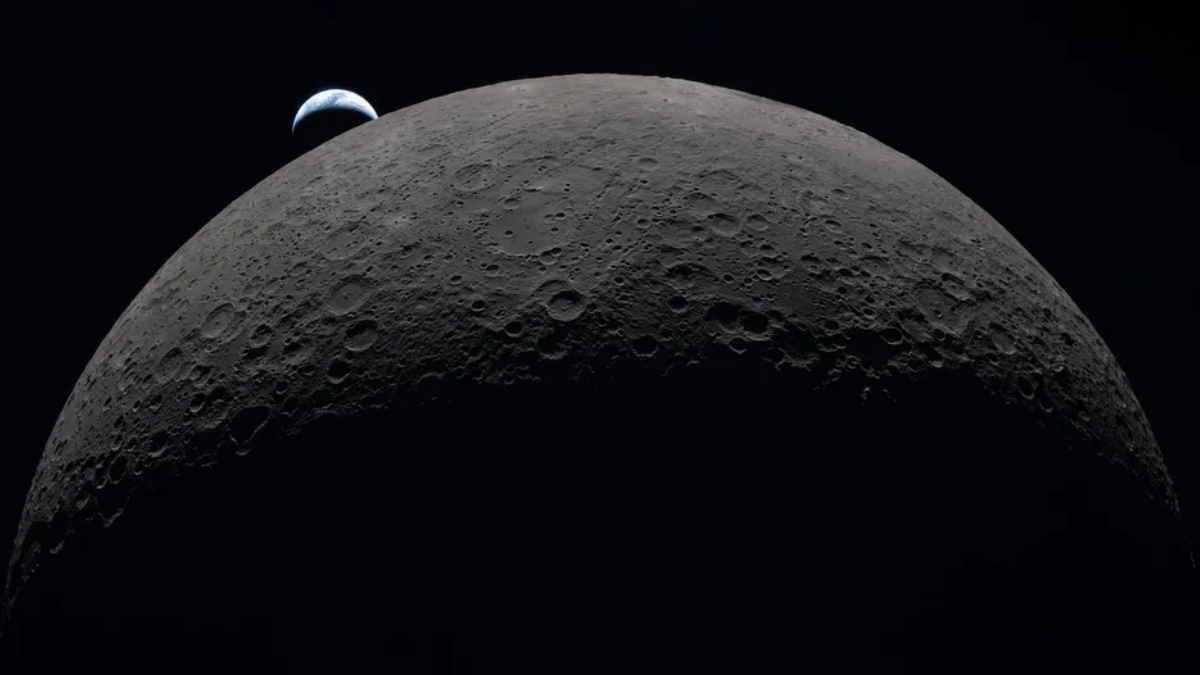
Photo Credit: NASA
Earth sets at on April 6, 2026, over the moon's curved limb in this photo captured by the Artemis 2.
Click Here to Add Gadgets360 As A Trusted Source


Advertisement
Travel to the Moon comes at a great cost, both monetary and in terms of fuel. The amount of propellant a spacecraft needs for its journey will increase launch costs and cut into payload space. For many years now, scientists have been using a trajectory approach to reach the Moon, which uses a very large amount of fuel. However, a research team from around the world has discovered a fuel-efficient path to the Moon that had never before been noticed.
Inside the New Study
The study, published in the journal Astrodynamics in April 2026 by researchers from the University of São Paulo and the University of Coimbra, used a technique called the theory of functional connections to reduce the computing power needed for complex orbital simulations. The team modelled 30 million different Earth–Moon trajectories, of which 280,000 are referenced in the paper. Rather than assuming that the shortest geometric path is the cheapest, the researchers applied a systematic analysis to explore non-obvious solutions — a methodology the authors say could be adopted widely in future mission planning.
Gravity's Counterintuitive Shortcut
Space is threaded with gravitational corridors shaped by the competing pulls of planets and moons, collectively known as the Interplanetary Transportation Network. The new research found that, rather than entering the Moon's gravitational "variate"—a natural trajectory leading to lunar orbit from its nearest point to Earth, approaching from the opposite side is more efficient. This counterintuitive path saves 58.8 meters per second of fuel over the previous best-known route and maintains uninterrupted communication with Earth — an advantage NASA's Artemis 2 mission lacked when its crew briefly passed behind the Moon.
Comments
Get your daily dose of tech news, reviews, and insights, in under 80 characters on Gadgets 360 Turbo. Connect with fellow tech lovers on our Forum. Follow us on X, Facebook, WhatsApp, Threads and Google News for instant updates. Catch all the action on our YouTube channel.
Further reading:
Astrodynamics, Moon missions, lunar exploration, spacecraft navigation, fuel-efficient spaceflight, orbital mechanics, Artemis program, interplanetary travel, space research


Advertisement
Follow Us




-
04:37
[Sponsored]: CP PLUS CarKam CP-F89B: 4K Dashcam With Rear Camera, GPS & Emergency Recording -
04:23
[Partner Content] Your Phone Can Do WAY More Than You Think | OPPO ColorOS 16 -
01:59
Samsung Galaxy Z Fold8 Ultra: Unfold the Ultra Night -
03:24
Apple Pay Launches In India: Supported Devices, Cards And Payments Explained -
00:21
[Sponsored] Samsung Galaxy Z Fold8, Fold8 Ultra
-
Flipkart Big Billion Days: Xiaomi के 5 Redmi स्मार्टफोन्स पर Deals रिवील
-
Delhi Pollution 2026: 50% Work From Home, बिना PUCC नहीं मिलेगा Fuel
-
Oppo K15x हुआ लॉन्च; 6500mAh बैटरी, 120Hz डिस्प्ले के साथ आया बजट 5G फोन
-
इलेक्ट्रिक मोटरसाइकिल्स के सेगमेंट में Oben Electric का पहला रैंक, 1,417 यूनिट्स की बिक्री
-
Tecno Pop 20C बजट फोन पेश, 13MP कैमरा, 5200mAh जैसे फीचर्स, जानें कीमत
Advertisement
Popular on Gadgets
- Samsung Galaxy S26 Ultra
- Motorola Razr Fold
- ChatGPT
- OPPO Find N6
- Mobiles Under Rs. 40,000
- Vivo X300 Ultra
- Asus Zenbook S14
- iQOO 15
- Vivo X300 Pro
- Lenovo Yoga Slim 7i Aura Edition
- iQOO 15R
- Vivo X Fold 5
- Sony PlayStation 5
- HP OmniPad 12
- OnePlus Nord CE 6 Lite
- OnePlus Pad 4
- OPPO F33 Pro 5G
- Cryptocurrency
- HP OmniBook Ultra 14 (2026)
- iPhone 17
- Eureka Forbes AP 355 Room Air Purifier
- Latest Mobile Phones
- Compare Phones
Latest Gadgets
- Samsung Galaxy F08
- Samsung Galaxy M08
- OPPO K15x
- OPPO K15s
- HMD Vibe 2 Pro 5G
- OPPO K14 Plus 5G
- Lava Shark 2 Pro 5G
- Ai+ Pulse 2 FE
- Dell 14 Plus 2-in-1 (AMD Ryzen AI 7 350, 2025)
- Microsoft Surface Laptop, 13-inch (2nd Edition)
- Samsung Galaxy Tab S12+
- Samsung Galaxy Tab S12 Ultra
- Amazfit T-Rex Dual Solar
- OPPO Watch S2
- Toshiba 65-Inch 4K Ultra HD Smart Mini LED QLED TV (65Z670SP)
- Haier M70 Mini LED 65-inch
- Acer Predator Atlas 8
- Asus ROG Ally
- Blue Star 1.5 Ton 5 Star Inverter Split AC (IE518ZNURS)
- Blue Star 2 Ton 3 Star Inverter Window AC (WIE324L)

- About Us
- Sitemaps
- Feedback
- Archives
- Contact Us
- RSS
- Advertise
- Career
- Privacy Policy
- Ethics
- Editorial Policy
- Terms & Conditions
- Complaint Redressal
Download Our Apps
Available in Hindi
© Copyright Red Pixels Ventures Limited 2026. All rights reserved.