-
 Celestis to Send Human Ashes Beyond the Moon on Deep-Space Memorial Flight in 202631 December 2025
 -
NASA’s PUNCH Mission Completes Final Orbit Manoeuvres, Opens Early Sun Data to the Public17 August 2025
-
New Interstellar Object 3I/ATLAS Could Reveal Secrets of Distant Worlds12 July 2025
-
Solar Orbiter Captures First-Ever Close-Up of Sun’s South Pole, Revealing Magnetic Field Chaos12 June 2025
-
Study Identifies Plasma Formation as a Pseudostreamer4 April 2025
- Home
- Science
- Science News
- ESA’s Solar Orbiter Reveals How Magnetic Avalanches Trigger Solar Flares
ESA’s Solar Orbiter Reveals How Magnetic Avalanches Trigger Solar Flares
ESA’s Solar Orbiter has observed a solar flare ignited by an avalanche of magnetic reconnections, showing how tiny instabilities rapidly cascade into powerful energy releases that heat plasma and launch particles into space.
Written by Gadgets 360 Staff | Updated: 27 January 2026 20:23 IST
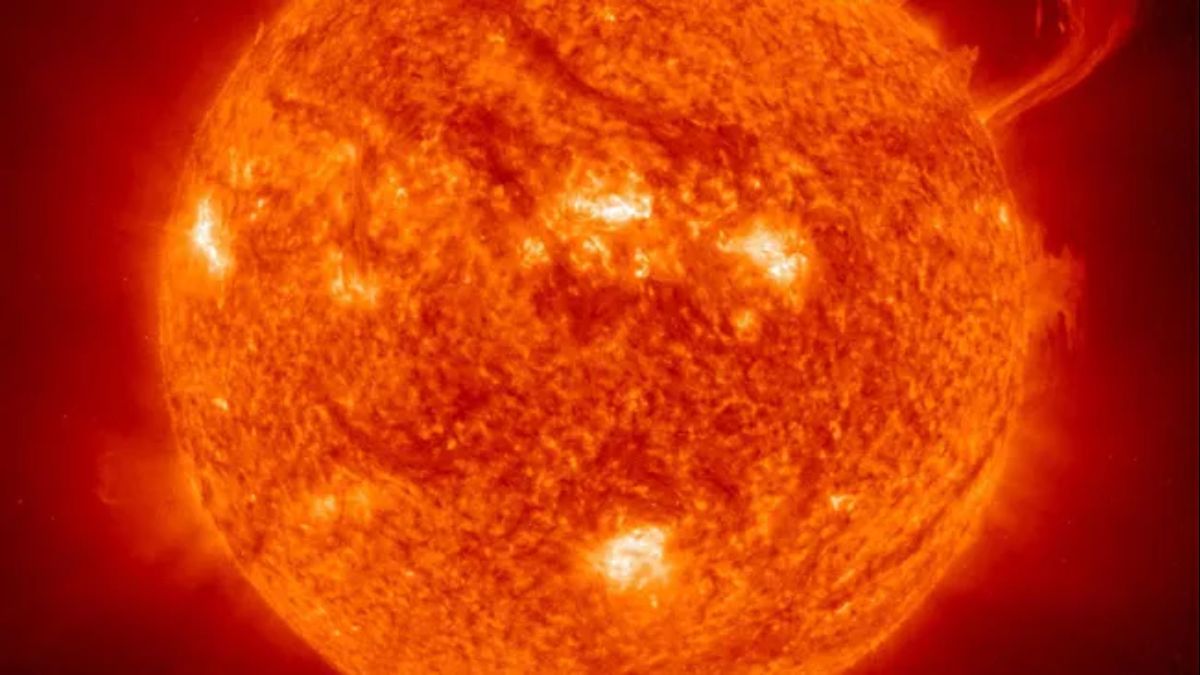
Photo Credit: ESA/NASA/SOHO
The sun lashes out with a powerful solar flare. Scientists may now know how these outflows are generated.
Click Here to Add Gadgets360 As A Trusted Source


Advertisement
In another recent research, the Solar Orbiter of ESA witnessed that an avalanche of magnetic disturbances propels a solar flare. These cascading reconnections increased a minor instability into a big burst to provide a new understanding of how solar flares release massive energy. The ultraviolet imager on the mission was able to take unprecedented detail of the accumulation of the flare. Twisted magnetic fields rupture and reconnect during a flare, heating plasma and sending particles into space.
Solar Orbiter Captures Magnetic Avalanche
According to the study, during a close approach on Sept. 30, 2024, Solar Orbiter observed a medium-sized flare from 27 million miles away. The spacecraft's Extreme Ultraviolet Imager (EUI) observed a twisted magnetic filament leading to a bright cross. EUI observed features no wider than a few hundred kilometers and observed strands breaking and reforming, causing bright flashes. The flashes initiated a magnetic "avalanche" that contributed to the large flare. Other instruments (SPICE, STIX, PHI) detected huge blobs of plasma falling through the corona as the energy was released.
Solar Flares and Magnetic Reconnection
Solar flares are violent bursts that occur with sudden magnetic reconnection. The huge energy contained within the twisted solar magnetic fields is abruptly discharged through the breaking and reformation of lines of the field. During this process, plasma is heated quickly to millions of degrees, and particles are thrown off at high velocities. Reconnection occurs when crossed lines of magnetic fields bend and burst out plasma violently. The biggest flares can also cause coronal mass ejections (CMEs) - enormous outbursts of plasma - which, on their way to the Earth, may trigger a geomagnetic storm, disrupting satellites or power systems and resulting in bright auroras.
Comments
Get your daily dose of tech news, reviews, and insights, in under 80 characters on Gadgets 360 Turbo. Connect with fellow tech lovers on our Forum. Follow us on X, Facebook, WhatsApp, Threads and Google News for instant updates. Catch all the action on our YouTube channel.
Further reading:
Solar Orbiter, Solar flares, Magnetic Reconnection, ESA, Space Weather, Sun, Astrophysics, solar physics
Related Stories




Advertisement
Follow Us




-
01:42
[Sponsored] Galaxy Watch9 for Everyday Health Insights | Smarter Wellness Choices -
01:15
[Sponsored] Galaxy Tab S10 Lite for Students: Notes, Solve Math and More -
04:17
[Sponsored] LG NANO 4K UHD AI TV NU885: Gemini Search, Dolby Atmos & 5 Years of Updates -
00:57
[Sponsored] Samsung Galaxy Z Fold8 My Fan Cam in Action: Find the Moment, Then Share It -
01:41
[Sponsored] What Do You Need To Know Before Your Next Run? | Samsung Galaxy Watch Ultra2
-
Flipkart Big Bang Diwali Sale होगी 28 अक्टूबर से शुरू, iPhone 17 पर छूट
-
Tata Punch EV आई सबसे ज्यादा पसंद, 284% की ग्रोथ के साथ बनी नंबर 1 कार
-
Samsung Galaxy S25 FE 5G दिवाली सेल में ₹17 हजार से ज्यादा सस्ता
-
Redmi K100 में मिलेगा 'Snow Rock White' का नया कलर ऑप्शन
-
OnePlus Ace 7 सीरीज में मिलेगा BOE डिस्प्ले, 9,000mAh बैटरी
Advertisement
Popular on Gadgets
- Samsung Galaxy S26 Ultra
- Motorola Razr Fold
- ChatGPT
- OPPO Find N6
- Mobiles Under Rs. 40,000
- Vivo X300 Ultra
- Asus Zenbook S14
- iQOO 15
- Vivo X300 Pro
- Lenovo Yoga Slim 7i Aura Edition
- iQOO 15R
- Vivo X Fold 5
- Sony PlayStation 5
- HP OmniPad 12
- OnePlus Nord CE 6 Lite
- OnePlus Pad 4
- OPPO F33 Pro 5G
- Cryptocurrency
- HP OmniBook Ultra 14 (2026)
- iPhone 17
- Eureka Forbes AP 355 Room Air Purifier
- Latest Mobile Phones
- Compare Phones
Latest Gadgets
- Vivo Y600
- HMD 2660 Flip Senior Edition
- Lava Aura Curve
- Poco X8s
- Samsung Galaxy F70 5G
- Tecno Spark 50S 5G
- Vivo Y600s Pro
- Vivo Y32 (2026)
- Lenovo Yoga 9n 2-in-1
- Lenovo Yoga Pro 9n
- Amazon Alexa Tablet 8
- Amazon Alexa Tablet 11
- Pebble Qore 2
- Amazfit T-Rex Dual Solar
- Toshiba 65-Inch 4K Ultra HD Smart Mini LED QLED TV (65Z670SP)
- Haier M70 Mini LED 65-inch
- Acer Predator Atlas 8
- Asus ROG Ally
- Blue Star 1.5 Ton 5 Star Inverter Split AC (IE518ZNURS)
- Blue Star 2 Ton 3 Star Inverter Window AC (WIE324L)

- About Us
- Sitemaps
- Feedback
- Archives
- Contact Us
- RSS
- Advertise
- Career
- Privacy Policy
- Ethics
- Editorial Policy
- Terms & Conditions
- Complaint Redressal
Download Our Apps
Available in Hindi
© Copyright Red Pixels Ventures Limited 2026. All rights reserved.