-
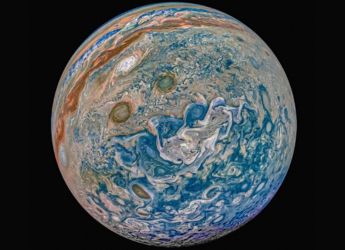
 James Webb Telescope Captures Rare Infrared Footprints of Io and Ganymede Inside Jupiter’s Auroras11 March 2026
 -
Jupiter Resumes Direct Motion This March as the Gas Giant Hits Peak Visibility for 2026 Skywatchers10 March 2026
-
NASA Juno Mission Uncovers Subtle Geometric Shifts That Challenge Existing Models of the Jovian Interior14 February 2026
-
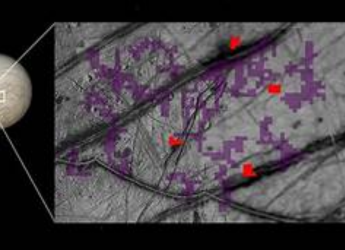
NASA Finds a Crucial Life-Building Chemical on Jupiter’s Moon31 January 2026
-
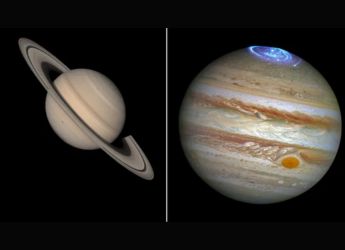
Scientists Reveal Why Jupiter and Saturn’s Polar Weather Looks So Different23 January 2026
- Home
- Science
- Science News
- Why Jupiter Has Four Giant Moons While Saturn Has Just One, Study Explains
Why Jupiter Has Four Giant Moons While Saturn Has Just One, Study Explains
A new study explains why Jupiter has multiple large moons while Saturn has only one. Researchers suggest Jupiter’s strong magnetic field created regions in its early disk where moons could form, while Saturn’s weaker field did not.
Written by Gadgets 360 Staff | Updated: 12 April 2026 18:26 IST
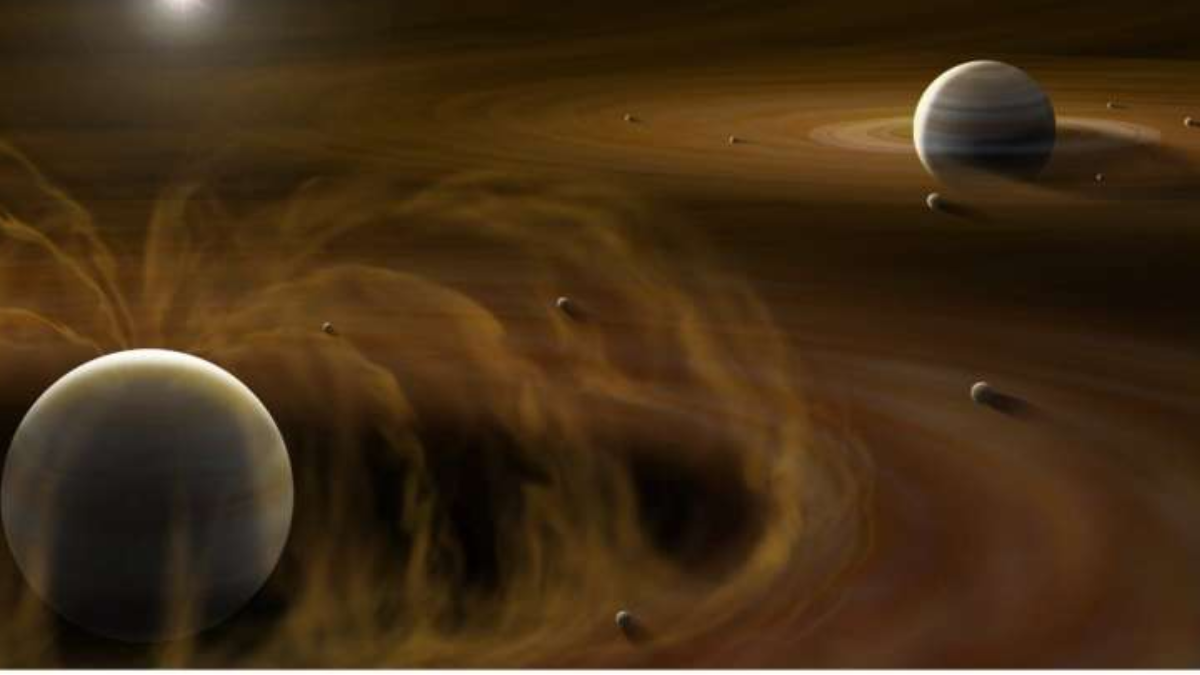
Photo Credit: NASA
Artist's impression of the simulations conducted in this research.
Click Here to Add Gadgets360 As A Trusted Source


Advertisement
The two largest planets in the solar system, Jupiter and Saturn, have massive belts of moons. However, there is a notable contrast between them: Jupiter has four big moons, Io, Europa, Ganymede, and Callisto, and Saturn, with all the moons of Saturn totaling more than 280, has only one big moon, Titan. What is the reason behind this contrast? Finally, in April 2026, researchers at Kyoto University published a new study in Nature Astronomy that provides a convincing answer.
The Magnetic Secret
According to the research, the reason behind this is the existence of magnetic fields around these two planets. In the beginning, when these two planets were formed, they both had a ring of gas and dust around them; in other words, circumplanetary disks. The strong magnetic field of Jupiter cut off a part of this ring, forming an isolated area where the moons could be formed. However, in the case of Saturn, no such area could be created because of its weak magnetic field, so migrating moons could not be formed around it.
Beyond Our Solar System
These findings extend beyond Jupiter and Saturn. The model of the research team predicts that any gas giant that is as large as Jupiter or larger would have the formation of a similarly compact, multi-moon system, and smaller Saturn-sized planets would have only one or two major moons. This has important implications for the discovery of exomoons, which are moons around planets in other star systems. Our solar system satellite systems, as stated by the author of the paper, Yuri Fujii, are unique, observable test beds of the theory of planetary formation that would otherwise be extremely difficult to test anywhere in the universe.
Comments
Get your daily dose of tech news, reviews, and insights, in under 80 characters on Gadgets 360 Turbo. Connect with fellow tech lovers on our Forum. Follow us on X, Facebook, WhatsApp, Threads and Google News for instant updates. Catch all the action on our YouTube channel.
Further reading:
Jupiter, saturn, moons, planetary science, astrophysics, exomoons, Solar system, magnetic fields, planet formation
Related Stories


Advertisement
Follow Us




-
03:11
[Sponsored] Samsung Galaxy A57 5G: The Perfect Phone Under Rs. 50,000? -
03:58
Dreame D20 Ultra Review: The Most Intelligent Robot Vacuum Cleaner Under ₹40,000? -
03:23
iPhone Fold Leaks & Rumors 2026 | Apple's Foldable iPhone Launch, Price & Specs Revealed -
04:12
Samsung Galaxy A37 Review: Camera, Gaming & Battery Tested! -
14:16
[Partner Content] OPPO F33 Pro 5G Explained: Built for the Big Moments
Advertisement
Popular on Gadgets
- Samsung Galaxy S26 Ultra
- Motorola Razr Fold
- ChatGPT
- OPPO Find N6
- Mobiles Under Rs. 40,000
- Vivo X300 Ultra
- Asus Zenbook S14
- iQOO 15
- Vivo X300 Pro
- Lenovo Yoga Slim 7i Aura Edition
- iQOO 15R
- Vivo X Fold 5
- Sony PlayStation 5
- HP OmniPad 12
- OnePlus Nord CE 6 Lite
- OnePlus Pad 4
- OPPO F33 Pro 5G
- Cryptocurrency
- HP OmniBook Ultra 14 (2026)
- iPhone 17
- Eureka Forbes AP 355 Room Air Purifier
- Latest Mobile Phones
- Compare Phones
Latest Gadgets
- Lava Shark 2 5G
- Infinix Hot 70
- Honor 600e
- Honor 600 Super Edition
- Honor 600 Vitality Edition
- Honor 600 Pro (China)
- OPPO A6c 4G
- OPPO Reno 16
- Microsoft Surface for Business (2026, 15-Inch)
- Microsoft Surface for Business (2026, 13.8-Inch)
- Poco Pad C1
- iQOO Pad 6 Pro
- Honor Watch 6 Plus
- Realme Watch S5
- Lumio Vision 9 (2026)
- Lumio Vision 7 (2026)
- Asus ROG Ally
- Nintendo Switch Lite
- IFB 1.5 Ton 3 Star Inverter Split AC (CI193GN22RGM3)
- IFB 2 Ton 3 Star Inverter Split AC (CI223GD32RGM3)

- About Us
- Sitemaps
- Feedback
- Archives
- Contact Us
- RSS
- Advertise
- Career
- Privacy Policy
- Ethics
- Editorial Policy
- Terms & Conditions
- Complaint Redressal
Download Our Apps
Available in Hindi
© Copyright Red Pixels Ventures Limited 2026. All rights reserved.