-
 JWST Watches HD 80606 bExoplanet Heat Up by 1,100 Degrees in Hours19 June 2026
 -
Why Jupiter Has Four Giant Moons While Saturn Has Just One, Study Explains12 April 2026
-
James Webb Telescope Captures Rare Infrared Footprints of Io and Ganymede Inside Jupiter’s Auroras11 March 2026
-
NASA Juno Mission Uncovers Subtle Geometric Shifts That Challenge Existing Models of the Jovian Interior14 February 2026
-
NASA Finds a Crucial Life-Building Chemical on Jupiter’s Moon31 January 2026
- Home
- Science
- Science News
- Jupiter Resumes Direct Motion This March as the Gas Giant Hits Peak Visibility for 2026 Skywatchers
Jupiter Resumes Direct Motion This March as the Gas Giant Hits Peak Visibility for 2026 Skywatchers
Jupiter's retrograde loop began in November 2025 and is going to end around March 10, 2026.
Written by Gadgets 360 Staff | Updated: 10 March 2026 20:18 IST
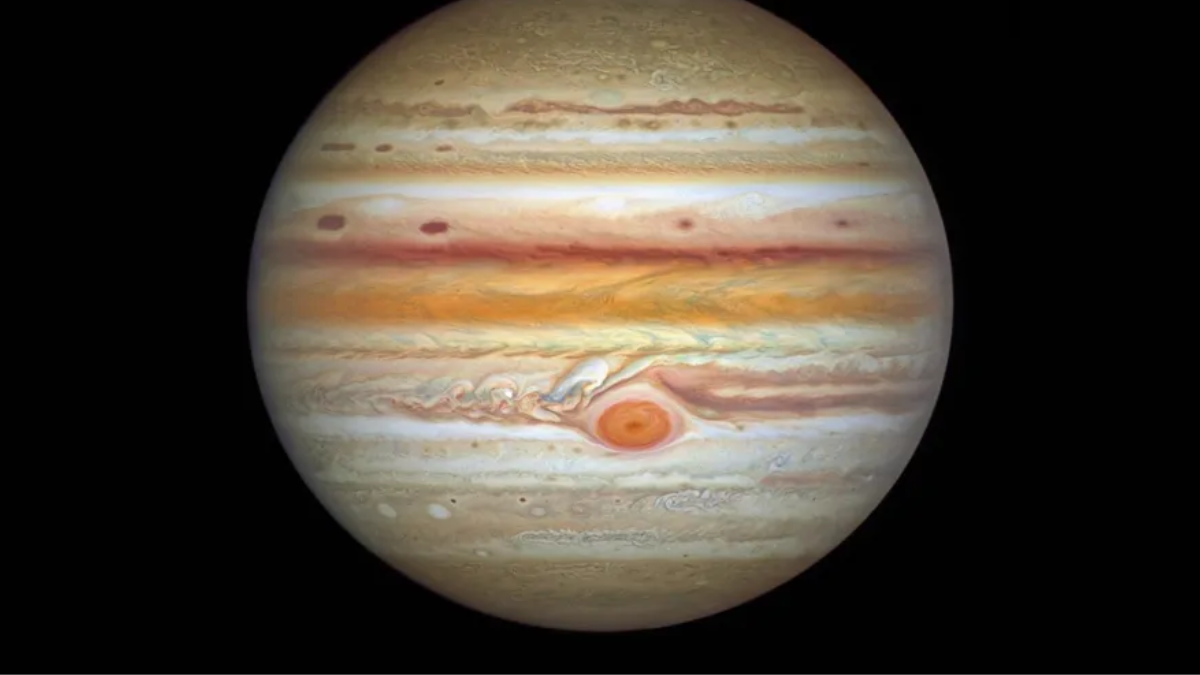
Photo Credit: NASA
A Hubble portrait of Jupiter captured in 2021
Click Here to Add Gadgets360 As A Trusted Source


Advertisement
On the evening of March 10, 2026, Jupiter will appear to reverse its direction in the sky. This phenomenon is known as retrograde motion. It is not the actual physical movement of the planet, but rather an optical illusion caused by Earth moving faster in its orbit and "lapping" Jupiter. As Earth passes between the Sun and Jupiter, the outer planet appears to drift backwards against the backdrop of stars. By mid-March, Jupiter will resume its normal eastward (prograde) motion through the constellation Gemini.
Why Jupiter Appears to Move Backwards
According to In the Sky, Jupiter normally moves eastward through the stars (its “prograde” motion), but near opposition it can appear to reverse course. This backward motion is an illusion caused by Earth's perspective. Because Earth moves faster than Jupiter, it eventually overtakes the gas giant.
As Earth passes between Jupiter and the Sun, Jupiter seems to slow, stop and drift westward for a time. Jupiter's retrograde loop that began in November 2025 is going to end around March 10, 2026.
Observing Jupiter in March
Jupiter will be visible in the evening sky. Jupiter is very bright because its magnitude is -2.3. After sunset, observers can look south to locate Jupiter in the sky at a high position in the constellation Gemini near two stars called Castor and Pollux. Jupiter will be visible as a brilliant "diamond" between these two stars. Even through binoculars, Jupiter's disk, along with its four large moons discovered by Galileo, can be viewed.
Jupiter's cloud bands can be viewed through a small telescope. Jupiter will be visible in the sky from dusk till near dawn. On March 25-26, a brilliant waxing gibbous Moon will be near Jupiter in the sky.
Comments
Get your daily dose of tech news, reviews, and insights, in under 80 characters on Gadgets 360 Turbo. Connect with fellow tech lovers on our Forum. Follow us on X, Facebook, WhatsApp, Threads and Google News for instant updates. Catch all the action on our YouTube channel.
Related Stories





Jupiter Resumes Direct Motion This March as the Gas Giant Hits Peak Visibility for 2026 Skywatchers


Advertisement
Follow Us




-
05:06
OnePlus N6 Full Review: Performance, Camera, Battery & Display Tested -
04:57
Samsung Galaxy Unpacked Everything You Need to Know | Galaxy Z Fold8, Z Fold8 Ultra, Z Flip8 -
04:22
Upcoming Foldable Smartphones in India | Upcoming Foldable Launches : Samsung, Apple, Google & more -
04:37
Redmi Turbo 5 Review: Battery, Cameras, Performance Tested -
09:19
Can the OPPO Find X9s Replace Your Camera on a Trip?
-
पीएम नरेंद्र मोदी के Instagram पर सिर्फ 4 दिनों में बढ़े 40 लाख फॉलोअर्स
-
₹47 हजार से ज्यादा सस्ता हुआ Samsung का फ्लैगशिप स्मार्टफोन, जानें
-
Flipkart Freedom sale vs Amazon Great Freedom Sale अगस्त में इस दिन से
-
भारत में Fusion Red कलर में लॉन्च हुआ Vivo T5x 5G, जानें प्राइस, फीचर्स
-
चुटकी में साफ होंगे लैपटॉप, कीबोर्ड और कार! Portronics भारत में लॉन्च किया बजट एयर डस्टर
Advertisement
Popular on Gadgets
- Samsung Galaxy S26 Ultra
- Motorola Razr Fold
- ChatGPT
- OPPO Find N6
- Mobiles Under Rs. 40,000
- Vivo X300 Ultra
- Asus Zenbook S14
- iQOO 15
- Vivo X300 Pro
- Lenovo Yoga Slim 7i Aura Edition
- iQOO 15R
- Vivo X Fold 5
- Sony PlayStation 5
- HP OmniPad 12
- OnePlus Nord CE 6 Lite
- OnePlus Pad 4
- OPPO F33 Pro 5G
- Cryptocurrency
- HP OmniBook Ultra 14 (2026)
- iPhone 17
- Eureka Forbes AP 355 Room Air Purifier
- Latest Mobile Phones
- Compare Phones
Latest Gadgets
- Vivo T5e
- Vivo X300 E
- Itel Zeno 100 Pro
- Itel Zeno 100 Lite
- Lava Virat V1
- Lava Virat V1 5G
- iQOO Z11 Lite
- OPPO K15
- Dell Alienware 18 Area-51 (2026)
- Dell Alienware 16 Area-51 (2026)
- Honor Pad X9 Max
- Red Magic Gaming Tablet 5 Pro
- Samsung Galaxy Watch 9 (44mm)
- Samsung Galaxy Watch 9 (44mm, LTE)
- Sony Bravia 9 II
- Haier HQLED P7 Pro
- Acer Predator Atlas 8
- Asus ROG Ally
- Blue Star 1.5 Ton 5 Star Inverter Split AC (IE518ZNURS)
- Blue Star 2 Ton 3 Star Inverter Window AC (WIE324L)

- About Us
- Sitemaps
- Feedback
- Archives
- Contact Us
- RSS
- Advertise
- Career
- Privacy Policy
- Ethics
- Editorial Policy
- Terms & Conditions
- Complaint Redressal
Download Our Apps
Available in Hindi
© Copyright Red Pixels Ventures Limited 2026. All rights reserved.