-
 Toshiba Z670SP MiniLED TV Series Launched in India With Up to 100-Inch 144Hz Screens: Price, Specifications20 April 2026
 -
Amazon Sale 2025: Top Deals on 65-Inch Smart TVs From Sony, TCL, Samsung and More29 September 2025
-
Amazon Great Summer Sale 2024: Best Deals on QLED Smart TVs3 May 2024
-
Here Are Deals on Smart TVs During Amazon Sale: From 32-inch to 65-inch TVs24 October 2023
-
Top Deals on 50-Inch and Above Smart TVs During Amazon Great Indian Festival Sale17 October 2023
- Home
- Tv
- Tv Reviews
- Toshiba Z670SP 65 inch Mini LED TV Review: Bright, Smooth and Well Balanced
Toshiba Z670SP 65-inch Mini-LED TV Review: Bright, Smooth and Well-Balanced
The Toshiba Z670SP 65-inch Mini-LED TV ticks all the right boxes with its overall package, but is it good enough to impress you? We try to find out.
Written by Ketan Pratap | Updated: 4 October 2026 16:10 IST
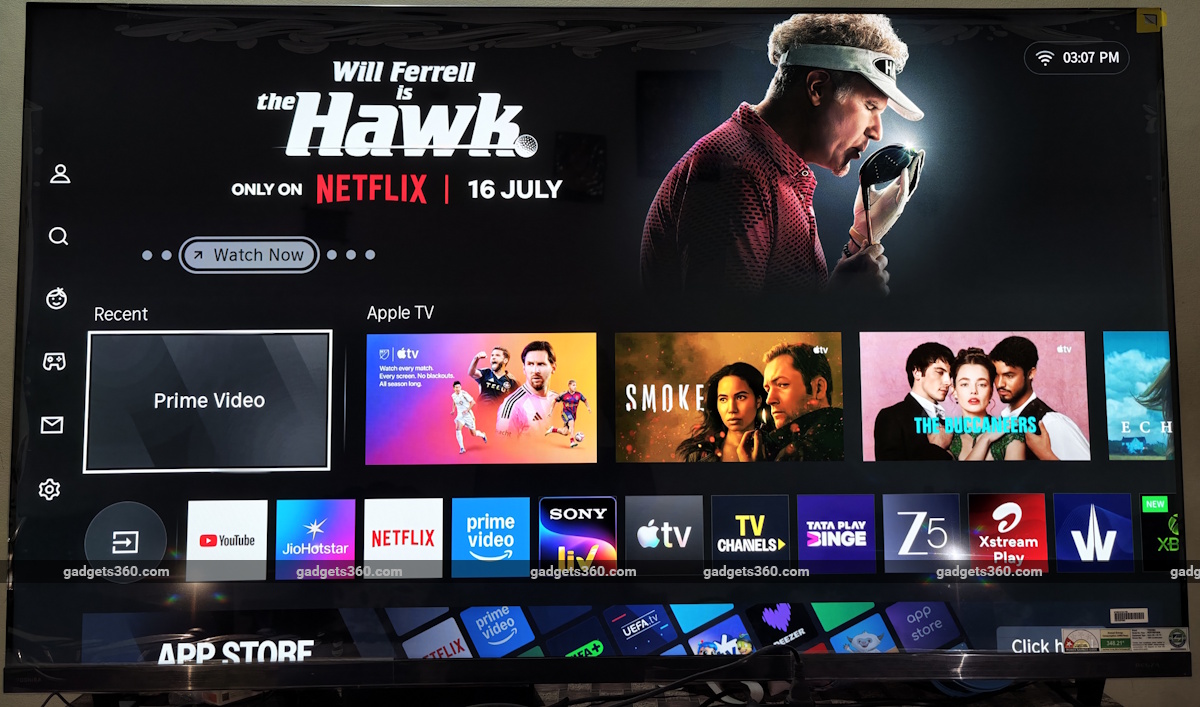
The Toshiba Z670SP Smart TV uses a 4K QD Mini-LED panel with local dimming
Click Here to Add Gadgets360 As A Trusted Source

Advertisement
The festive season is almost here, and the Smart TV category is getting more interesting this year, with Mini-LED models showing up across price segments. Xiaomi pushed its Mini-LED TVs into a more mainstream price bracket. At the same time, Samsung continues to offer Mini-LED across its Neo QLED and dedicated Mini-LED ranges at slightly higher price points. Sony, meanwhile, has its BRAVIA 5 Mini-LED TVs, but at a noticeably higher price. Toshiba's Z670SP arrives as a balanced package, with the 65-inch model priced at under Rs. 80,000, bringing features like Mini-LED, a 144Hz refresh rate, and front-firing speakers to a price point where festive-season competition gets interesting. On paper, it's missing very little. After spending time with the Toshiba Z670SP 65-inch Mini-LED TV, it's clear it offers a balanced package, with some software compromises. Let's break it down.
Toshiba Z670SP 65-inch Mini-LED TV Specifications
- Screen Resolution - 3840x2160 pixels
- Colour depth (bit) - 8bit
- Typical brightness - 400nits (peak brightness 600nits)
- Viewing Angle - 178 degrees
- HDMI inputs - 4
- Wi-Fi protocols IEEE 802.11 - a, b, g, n, ac
- Wi-Fi bands (GHz) - 2.4/5.0
- Bluetooth - Yes, 5.4
- Installed Apps - Netflix, YouTube, Prime Video
- Variable Refresh Rate - Up to 144Hz
- Audio power output per channel (Watt) - 2x10W + 2x10W
- Number of speakers - 4
- Speaker Type- Front Firing + Embedded 4-unit speakers
- Audio enhancement- Dolby Atmos support
- User interface/OS version - HomeOS U9.0.9
- Processor - MediaTek 9618G
- DDR RAM - 2GB
- Storage - 32GB
- Dimensions with stand (W x H x D) - 1446×902×316
- Dimensions with stand (W x H x D) - 1446×850×55
- Gross weight - 24.2 Kg
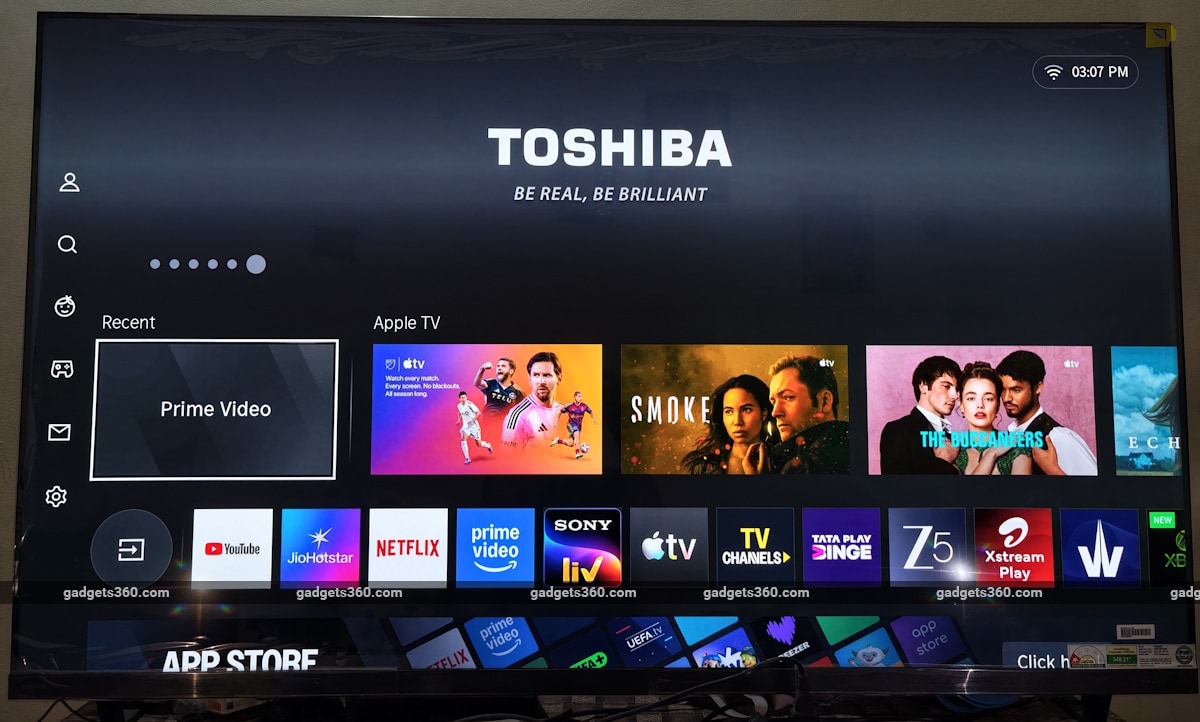
The Smart TV is powered by the REGZA Engine ZRi
Toshiba Z670SP 65-inch Smart TV: Design and Features
The Toshiba Z670SP 65-inch Smart TV doesn't try too hard to blend in like futuristic furniture. It sports slim bezels, a relatively clean back and a two-leg stand. The understated design actually works in the Smart TV's favour. Even if you plan to wall-mount it, it looks decent and blends in without looking odd in a typical home setup. The company describes it as a bezel-less design with a double-stand arrangement.
Interestingly, the feature list is much more interesting than the design. You get a 4K QD Mini-LED display with full-array local dimming, a REGZA Engine ZRi processor, Quantum Dot colour, and multiple HDR formats.
Toshiba's detailed specifications list Dolby Vision IQ, HDR10+ Adaptive, and HLG, along with Filmmaker Mode. The 65-inch model lists 160 local-dimming zones and a peak brightness of 600 nits. Keep that number in mind when comparing it with claims for the Z670SP series as a whole; some promotional material and videos quote higher figures for larger models, but those shouldn't automatically apply to the 65-inch version.
Connectivity is fairly generous, with four HDMI ports, eARC, USB, Ethernet, Bluetooth 5.4 and Wi-Fi. Notably, the Z670SP 65-inch Smart TV supports AirPlay and HomeKit.
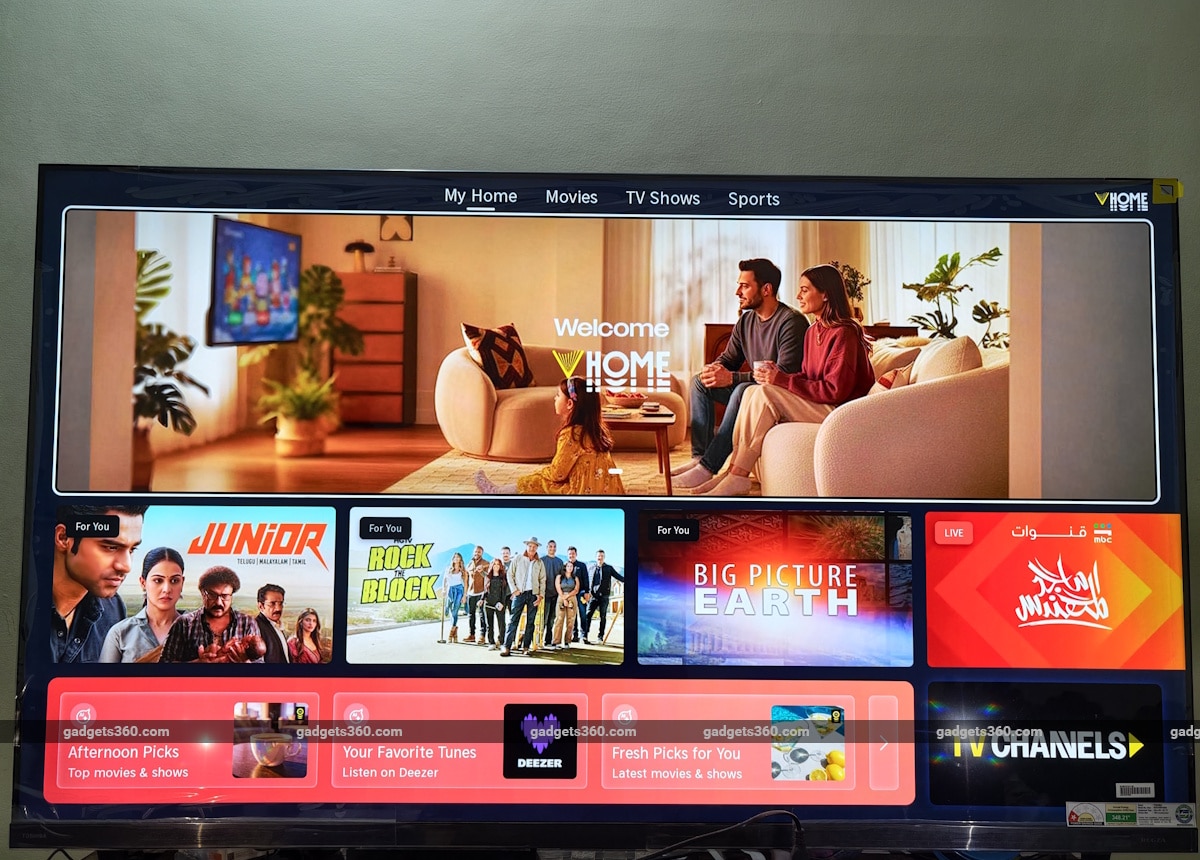
The Toshiba Z670SP Smart TV supports Dolby Vision IQ and HDR10+ Adaptive
Toshiba's marketing plays slightly fast and loose with the 144Hz claim. The panel natively refreshes at 120Hz and relies on 4K VRR to reach 144Hz for gaming. For most buyers, the takeaway is simple: this is a high-refresh-rate TV aimed at gaming and fast-moving content, but I wouldn't read "144Hz" as meaning every mode on the TV runs at 144Hz.
Toshiba Z670SP 65-inch Smart TV: Picture Quality
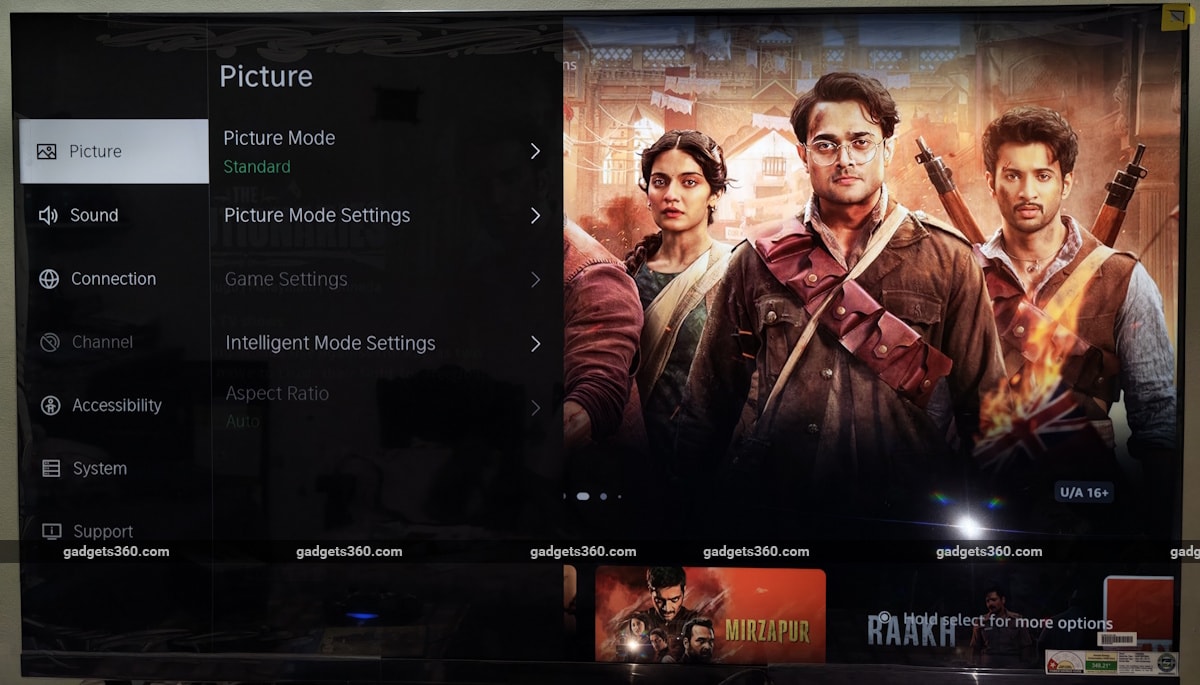
One strength of the Z670SP Smart TV is its picture quality. Mini-LED and local dimming give the TV much better contrast control than a conventional edge-lit LCD. During my review, I found that dark scenes looked deeper, while bright parts of an image had plenty of punch.
If you love binge-watching, the Z670SP is for you, as the contrast is impressive across movies and shows. Additionally, the shadow detail remained visible in darker scenes rather than disappearing into a black mess. As I mentioned earlier in this review, the Toshiba Z670SP 65-inch Smart TV comes out as a balanced package.
Night and dark scenes in movies and shows have more depth, highlights stand out better, and the picture feels less flat than you would normally expect from a mid-range television. All of that makes a noticeable difference when watching content. Of course, plenty of customisation options enhance the overall viewing experience.
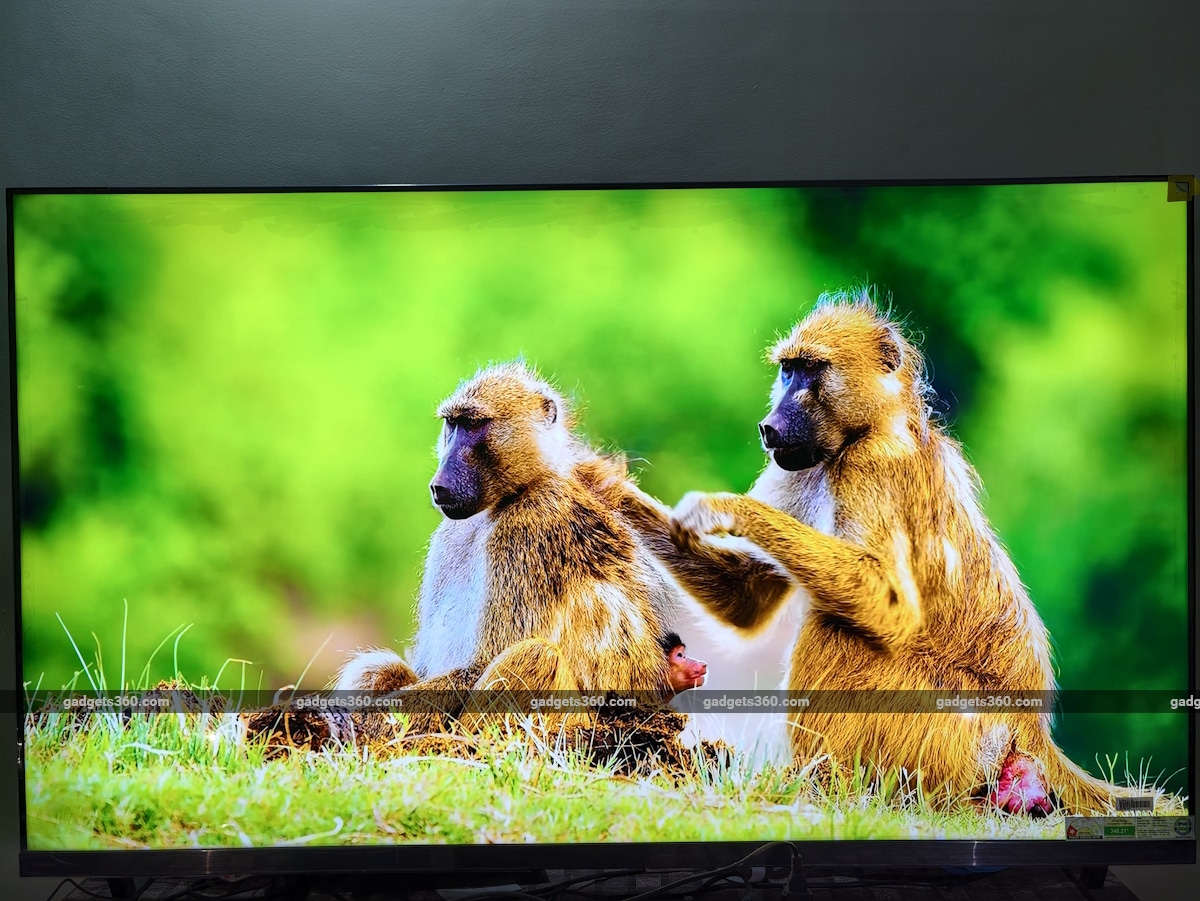
The Toshiba Z670SP supports a refresh rate of up to 144Hz
HDR is also one of the Z670SP's strengths. The combination of Quantum Dot colour and Mini-LED backlighting gives bright HDR scenes plenty of impact. At the same time, support for Dolby Vision IQ and HDR10+ Adaptive means there is broad compatibility with the formats used by current streaming services.
The Toshiba TV's colour tuning is generally sensible too, with skin tones reported to look natural and colours that don't constantly scream for attention. Of course, the Sports picture mode can be more aggressive, and you will notice it when watching a sporting event, as colours are excessively saturated in this mode. That is not a serious flaw, but it is a reminder that the best-looking preset isn't always the most accurate one.
Another area where the TV performs reasonably well is upscaling. Indian TV programming still involves plenty of HD content, live television and compressed streaming video, so how a 65-inch 4K panel handles those sources matters. I found the Toshiba Z670SP 65-inch Smart TV handled HD content and sports broadcasts well.
What I would have loved here is OLED-like control over every individual pixel, but that would have pushed the TV past the Rs. 1 lakh price point.
The Smart TV isn't perfect, and I did find some blooming when a very bright object sits against a dark background. It isn't particularly distracting during regular viewing, but it does show up in a dark room. That's the trade-off with Mini-LED. You get strong contrast and much higher brightness than many LCD TVs, but you're still dealing with a backlight rather than millions of individually controlled pixels.
The Toshiba Z670SP features a 54W four-speaker setup with front-firing speakers
Toshiba Z670SP 65-inch Smart TV: Sound Quality, Software, UI and Remote
The built-in sound system is one of the pleasant surprises of the Toshiba Z670SP 65-inch Smart TV. On paper, the 65-inch model gets a 54W, four-speaker, 2.0-channel setup with front-firing speakers, and it also supports Dolby Atmos and Eilex audio processing. The most important part is the front-firing design on the Toshiba Z670SP Smart TV. Instead of sending most of the sound downward or backwards, the speakers aim toward the viewer, which helps dialogue sound clearer. During my review time, I found dialogue and speech easy to follow, including during sports broadcasts where crowd noise can otherwise swallow commentary.
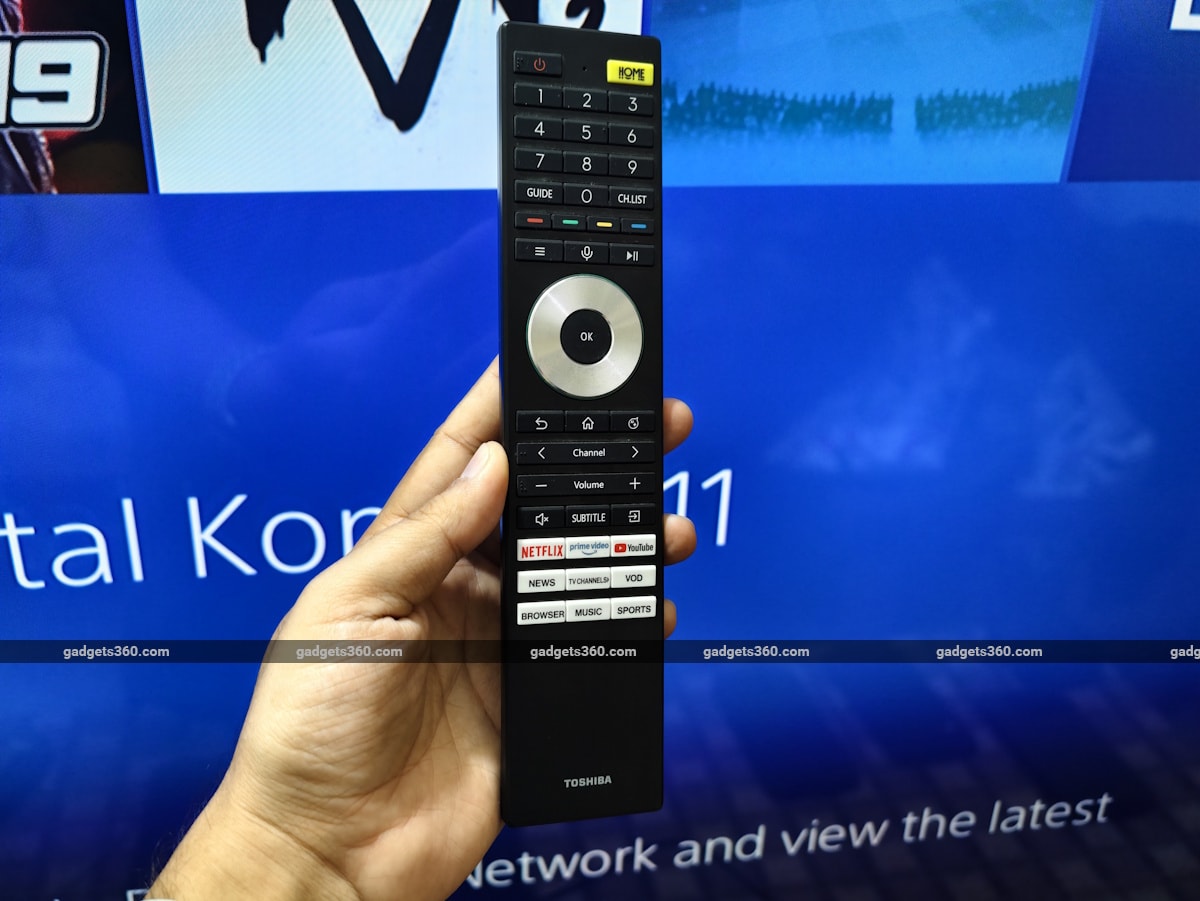
The Toshiba Z670SP supports far-field voice control and comes with a remote that supports voice commands. The remote design, however, seems dated
However, a TV still has limits. Bass is adequate, but it lacks the depth and physical impact you get from a dedicated speaker setup with a subwoofer. For everyday TV, though, this is a much more convincing built-in system than you usually get at this price. For me, this was the part of the Z670SP that takes the most getting used to.
On the software side, the Smart TV runs HomeOS U9.0.9 (also marketed as VIDAA) instead of Google TV. The operating system itself is fast and uncomplicated. Major streaming apps work as expected. But the trouble starts when you want something beyond the usual apps.
Comparatively, Google TV gives you access to a huge Play Store ecosystem, while VIDAA is much more limited. Needless to say, there is no equivalent Play Store experience, and the platform isn't as flexible with niche apps or sideloading. That shouldn't bother someone who mainly watches popular OTT platforms like Netflix, Prime Video, YouTube, and other mainstream streaming services, but it will matter to more adventurous users like me.
There's also an ad issue: the VIDAA home screen has a banner ad running almost constantly, and when you land on the page, you see it most of the time. It has some good features like AirPlay, HomeKit, screen sharing, far-field voice control, and the company's REGZA Intelligence features. Long story short, the software isn't bad, but it is simply less flexible than what you'd get from a good Google TV implementation. The UI is easy to navigate, so there's no learning curve.
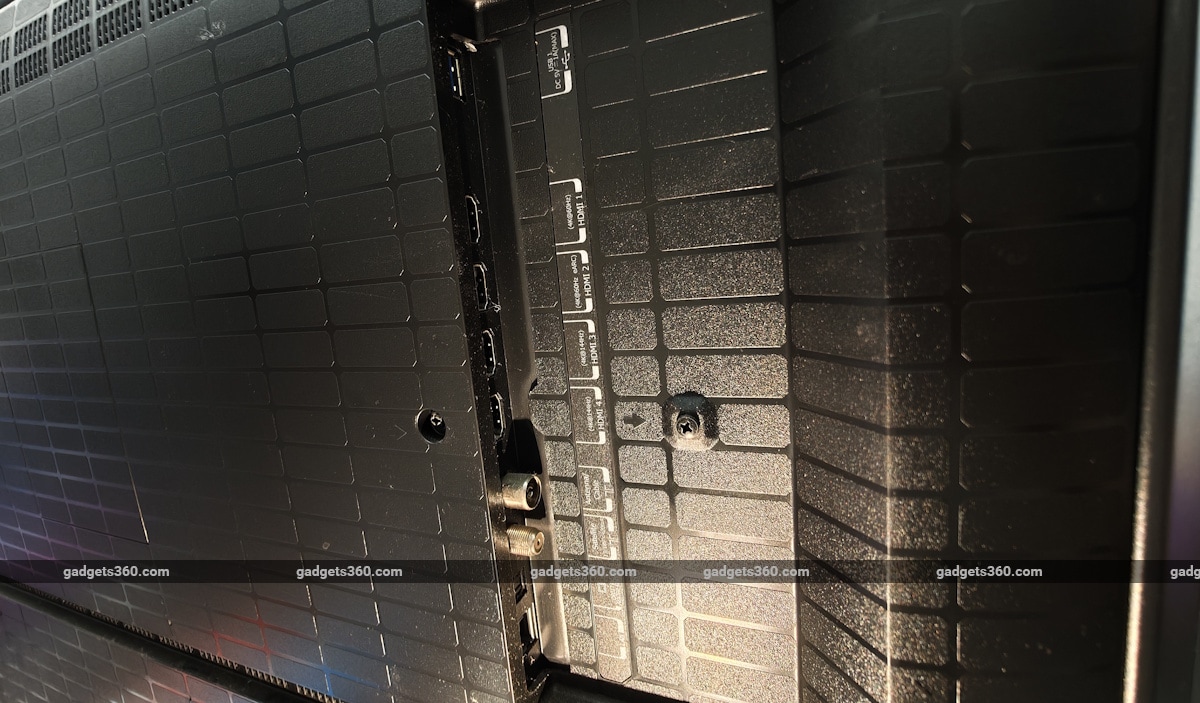
The connectivity ports include 4 x HDMI ports; HDMI 3 and HDMI 4 are HDMI 2.1-compliant; eARC is on HDMI 2; and there is 1 x USB 3.0 port. There's also 1 x Ethernet (RJ45) port on the TV
Finally, the Smart TV remote follows the same philosophy as the television itself: functional first. In an era when Smart TV makers are trying to make compact remotes, Toshiba takes us back in time with a large, 2010-era remote. It has all the controls, some of which could have been kept on-screen to reduce the size.
On paper, the Toshiba Z670SP takes gaming seriously, with a dedicated Game Mode Pro, Game Deck, VRR, ALLM, Dolby Vision Gaming, and HDR10+ Gaming support. The television is also designed for cloud gaming and supports controllers.
During my review, I found the Game Deck gave quick access to gaming-related information and settings, which is useful when you don't want to dig through the full settings menu. The main thing here to watch is the HDMI layout. Although there are four HDMI ports, Toshiba identifies only two as HDMI 2.1-compliant. That is perfectly fine for many users, especially those with one console, but it can get inconvenient if you have multiple current-generation consoles and other high-bandwidth devices connected at the same time. So yes, this is a gaming-friendly television. Just don't buy it assuming all four HDMI ports are identical.
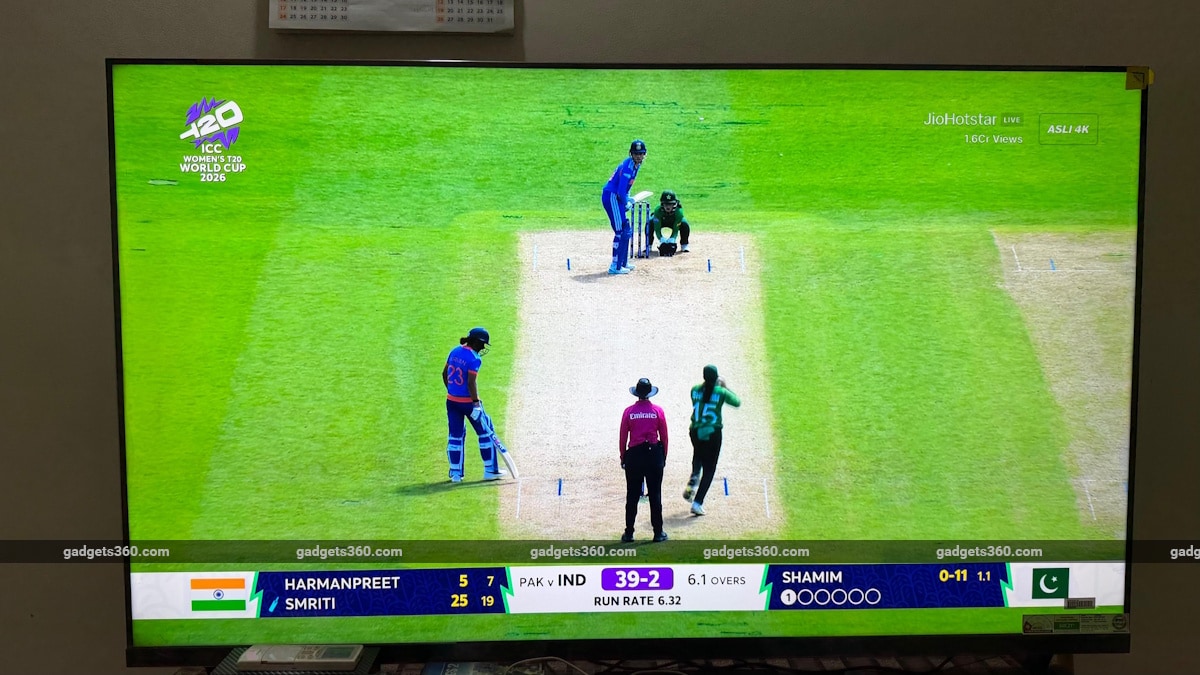
Watching live sports events on the Toshiba TV is a treat thanks to an excellent panel, and it also features a 54W four-speaker setup with front-firing speakers
Toshiba Z670SP 65-inch Smart TV: Verdict
The Toshiba Z670SP Smart TV gets the fundamentals right, with the picture quality as its biggest selling point. The Mini-LED backlight gives it the contrast and brightness needed to make HDR content look convincing. The TV handles motion smoothly, offers extensive gaming support, and does a good job with the sort of HD content many Indian households still watch every day.
The built-in speakers are also better than expected. The front-firing arrangement makes dialogue easy to follow, and the sound output is good enough that you don't immediately feel you need to add a soundbar. The compromises are mostly outside the picture.
VIDAA is quick and simple, but its limited app ecosystem is hard to ignore when comparing with Google TV-powered smart TVs. And while Mini-LED gets you close to OLED in many situations, blooming is still there if you look for it in a dark room.
At Rs. 79,990, the 65-inch Toshiba Z670SP is clearly aimed at buyers who want a more premium big-screen experience without necessarily paying OLED prices. The combination of Mini-LED picture quality, high-refresh-rate gaming support and front-firing audio gives it a strong hardware package. For someone who mainly watches streaming services, sports and movies and wants a big, bright television with good built-in sound, the Z670SP makes a lot of sense.
For buyers who strictly want a Smart TV experience, check out the Haier M70 Mini LED TV, which we found in our review to offer great picture and sound output. The Xiaomi TV FX Mini LED 65 is also a good option in this price bracket. If you want a truly great software experience, go for the Lumio Vision 9 (2026), which nails almost every aspect of what a modern Smart TV needs.
Comments
Get your daily dose of tech news, reviews, and insights, in under 80 characters on Gadgets 360 Turbo. Connect with fellow tech lovers on our Forum. Follow us on X, Facebook, WhatsApp, Threads and Google News for instant updates. Catch all the action on our YouTube channel.
Further reading:
Toshiba, Toshiba Z670SP MiniLED
Related Stories



Advertisement
Follow Us




-
![[Sponsored]: CP PLUS CarKam CP-F89B: 4K Dashcam With Rear Camera, GPS & Emergency Recording](https://www.gadgets360.com/static/desktop/images/spacer.png)
04:37
[Sponsored]: CP PLUS CarKam CP-F89B: 4K Dashcam With Rear Camera, GPS & Emergency Recording -
04:23
[Partner Content] Your Phone Can Do WAY More Than You Think | OPPO ColorOS 16 -
01:59
Samsung Galaxy Z Fold8 Ultra: Unfold the Ultra Night -
03:24
Apple Pay Launches In India: Supported Devices, Cards And Payments Explained -
00:21
[Sponsored] Samsung Galaxy Z Fold8, Fold8 Ultra
-
Flipkart Big Billion Days: Xiaomi के 5 Redmi स्मार्टफोन्स पर Deals रिवील
-
Delhi Pollution 2026: 50% Work From Home, बिना PUCC नहीं मिलेगा Fuel
-
Oppo K15x हुआ लॉन्च; 6500mAh बैटरी, 120Hz डिस्प्ले के साथ आया बजट 5G फोन
-
इलेक्ट्रिक मोटरसाइकिल्स के सेगमेंट में Oben Electric का पहला रैंक, 1,417 यूनिट्स की बिक्री
-
₹4 हजार तक सस्ते खरीदें Nothing Phone (4a), (4a) Pro, FBBD सेल में धांसू ऑफर
Advertisement
Popular on Gadgets
- Samsung Galaxy S26 Ultra
- Motorola Razr Fold
- ChatGPT
- OPPO Find N6
- Mobiles Under Rs. 40,000
- Vivo X300 Ultra
- Asus Zenbook S14
- iQOO 15
- Vivo X300 Pro
- Lenovo Yoga Slim 7i Aura Edition
- iQOO 15R
- Vivo X Fold 5
- Sony PlayStation 5
- HP OmniPad 12
- OnePlus Nord CE 6 Lite
- OnePlus Pad 4
- OPPO F33 Pro 5G
- Cryptocurrency
- HP OmniBook Ultra 14 (2026)
- iPhone 17
- Eureka Forbes AP 355 Room Air Purifier
- Latest Mobile Phones
- Compare Phones
Latest Gadgets
- Samsung Galaxy F08
- Samsung Galaxy M08
- OPPO K15x
- OPPO K15s
- HMD Vibe 2 Pro 5G
- OPPO K14 Plus 5G
- Lava Shark 2 Pro 5G
- Ai+ Pulse 2 FE
- Dell 14 Plus 2-in-1 (AMD Ryzen AI 7 350, 2025)
- Microsoft Surface Laptop, 13-inch (2nd Edition)
- Samsung Galaxy Tab S12+
- Samsung Galaxy Tab S12 Ultra
- Amazfit T-Rex Dual Solar
- OPPO Watch S2
- Toshiba 65-Inch 4K Ultra HD Smart Mini LED QLED TV (65Z670SP)
- Haier M70 Mini LED 65-inch
- Acer Predator Atlas 8
- Asus ROG Ally
- Blue Star 1.5 Ton 5 Star Inverter Split AC (IE518ZNURS)
- Blue Star 2 Ton 3 Star Inverter Window AC (WIE324L)

- About Us
- Sitemaps
- Feedback
- Archives
- Contact Us
- RSS
- Advertise
- Career
- Privacy Policy
- Ethics
- Editorial Policy
- Terms & Conditions
- Complaint Redressal
Download Our Apps
Available in Hindi
© Copyright Red Pixels Ventures Limited 2026. All rights reserved.