-
 Capcom Adds Original Versions of Resident Evil 1, 2 and Resident Evil 3 Nemesis to Steam2 April 2026
 -
Crimson Desert Has Sold 4 Million Copies, Pearl Abyss Announces1 April 2026
-
Crimson Desert Launch: System Requirements, Features, and All You Need to Know19 March 2026
-
Marathon Server Slam Impressions: Can Bungie's Live Service Shooter Go the Distance?4 March 2026
-
Valve Says Steam Deck OLED Is Out of Stock Due to RAM and Storage Shortages17 February 2026
- Home
- Games
- Games News
- Valve Changes AI Disclosure Guidelines on Steam for Game Developers
Valve Changes AI Disclosure Guidelines on Steam for Game Developers
Steam has required game developers to disclose generative AI use in game development since 2024.
Written by Manas Mitul | Updated: 19 January 2026 12:12 IST

Photo Credit: Valve
Steam requires a generative AI disclosure on a game's store page
Click Here to Add Gadgets360 As A Trusted Source

Advertisement
Valve seems to have redefined Steam's guidelines for disclosure of AI use in game development. The company has clarified that the use of AI-powered tools to speed up game development processes does not require the developer to provide an AI disclosure on its game's Steam page. The focus, Valve has explained, is on disclosing AI-generated content that ships with the game.
GameDiscoverCo's Simon Carless spotted (via VGC) the change in Valve's AI disclosure guidelines that mandate studios to detail AI use on their game's Steam page. The PC games storefront now acknowledges that AI tools may be built into many game development processes and hence do not need to be disclosed.
“We are aware that many modern game development environments have AI powered tools built into them. Efficiency gains through the use of these tools is not the focus of this section,” reads the generative AI disclosure form for developers, as seen in a screenshot posted by Carless on LinkedIn.
“Instead, it is concerned with the use of AI in creating content that ships with your game, and is consumed by players. This includes content such as artwork, sound, narrative, localization, etc.,” the form reads.
What Developers Need to Disclose
Developers still need to disclose use of generative AI to generate content — either pre-rendered or live generated — across the game, the Steam store page, Steam community assets or marketing materials.
Just like the earlier version of the form, developers also need to describe their use of generative AI in a text box. The studio's message will be displayed in the ‘About This Game' section of the game's Steam store page.
Steam also requires developers to disclose if their game uses AI to generate content or code during gameplay.
The guideline isn't doing away with AI disclosures, but it is clarifying the distinction between the use of AI-powered tools that aid or speed up various processes of game development and the inclusion of AI-generated assets within the game, its store page, or marketing materials.
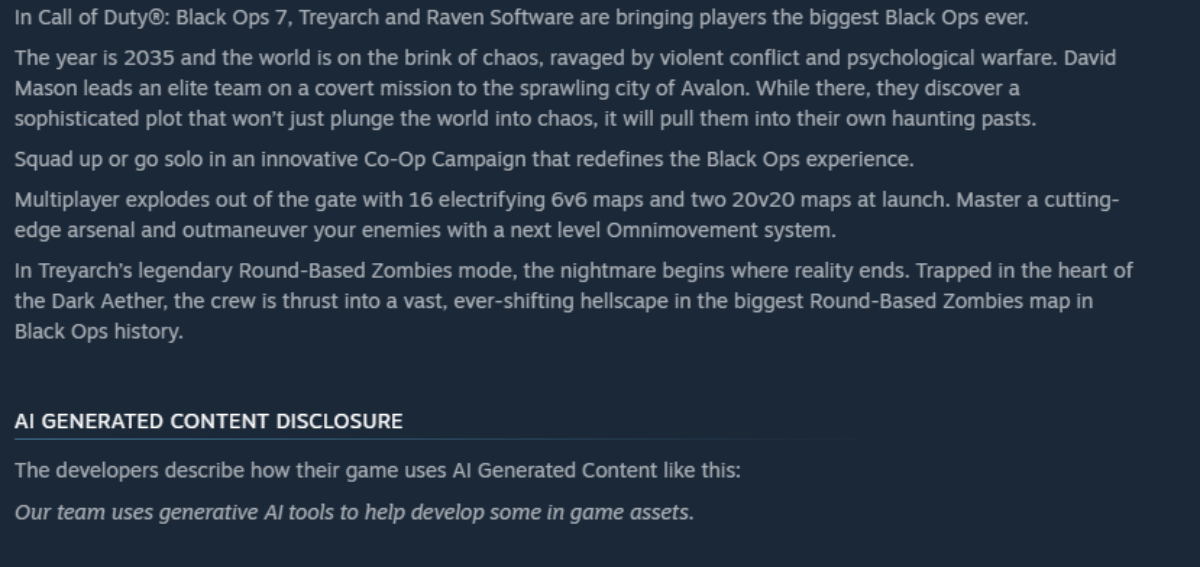
The AI disclosure section on Call of Duty: Black Ops 7's Steam store page
Generative AI in Game Development
Valve's move to tweak its AI disclosure guidelines comes at a time when AI in game development has become a hot button topic. While the use of generative AI in creating game assets, concept art, text, or other content is frowned upon and AI-generated content is often labelled “slop” by players, several developers have admitted to using the technology to speed up development times and cut down development costs.
Recently, Larian Studios received backlash after confirming it used AI in its game development processes, including concept art. Later, the studio clarified it won't use any GenAI art in its next game, Divinity.
“I know there's been a lot of discussion about us using AI tools as part of concept art exploration. We already said this doesn't mean the actual concept art is generated by AI but we understand it created confusion. So, to ensure there is no room for doubt, we've decided to refrain from using genAI tools during concept art development. That way there can be no discussion about the origin of the art,” Larian CEO Swen Vincke confirmed in a Reddit AMA earlier this month.
But Vincke said that AI could help the studio in other departments. The Larian boss said the company would use AI tools to help “refine ideas faster” and deliver a “higher-quality game”.
In a separate instance, Clair Obscur: Expedition 33's Game of the Year Win at Indie Game Awards was retracted over Sandfall Interactive's use of generative AI in the development process. The French developer later clarified that there were no generative Al-created assets in the game. Some AI-generated temporary placeholder textures were present in the game at launch due to oversight, but were patched out within five days, Sandfall explained.
Steam has required developers to provide AI disclosure on their game's store page since 2024. For instance, on Arc Raiders' Steam page, the AI generated content disclosure section reads: “During the development process, we may use procedural- and AI-based tools to assist with content creation. In all such cases, the final product reflects the creativity and expression of our own development team.”
The same section on Call of Duty: Black Ops 7's Steam page says: “Our team uses generative AI tools to help develop some in game assets.”
Both Arc Raiders and Black Ops 7 faced criticism from players over the use of AI-generated voice lines and artwork, respectively.
Epic Games CEO Tim Sweeney, however, believes AI labels on game storefronts make “no sense”. In November, Sweeney said that AI would be involved in nearly all future game production, making AI disclosures irrelevant.
Affiliate links may be automatically generated - see our ethics statement for details.
Comments
Get your daily dose of tech news, reviews, and insights, in under 80 characters on Gadgets 360 Turbo. Connect with fellow tech lovers on our Forum. Follow us on X, Facebook, WhatsApp, Threads and Google News for instant updates. Catch all the action on our YouTube channel.
Further reading:
Steam, Valve, AI, Steam AI Disclosure, AI in Game Development, Generative AI, PC Games
Related Stories






Advertisement
Follow Us




-

05:05
Goboult Mustang Racer Smartwatch Review: Should You Get This Mustang Smartwatch? -
04:58
OnePlus Nord Buds 4 Pro Review: Specs, Sound Quality, ANC, and Battery Backup Tested -
02:29
[Sponsored] Samsung Galaxy S26 Ultra First Look: AI Smartphone for Creators, Gaming & Productivity -
04:25
Vivo X200T Review - Full Camera, Gaming & Battery Test | Worth Buying? -
28:31
The Future of Productivity: Logitech's Anatoliy Polyanker On AI, Hybrid Work, And India's Tech Boom
-
200 मेगापिक्सल कैमरा, 7000mAh बैटरी के साथ Vivo V70 FE लॉन्च, जानें सबकुछ
-
Redmi Note 15 SE भारत में लेटेस्ट AI फीचर्स, 5800mAh बैटरी के साथ लॉन्च
-
5100mAh बैटरी, 50MP कैमरा वाला Pixel फोन हुआ 4700 रुपये सस्ता
-
ईरान और रूस में ड्रोन खरीदने के लिए हो रहा क्रिप्टोकरेंसी का इस्तेमाल
-
Ola की इलेक्ट्रिक मोटरसाइकिल Roadster X+ पर भारी डिस्काउंट, प्राइस में हुई 60,000 रुपये की कमी
Advertisement
Popular on Gadgets
- Samsung Galaxy Unpacked 2026
- iPhone 17 Pro Max
- ChatGPT
- iOS 26
- Laptop Under 50000
- Smartwatch Under 10000
- Apple Vision Pro
- Oneplus 12
- OnePlus Nord CE 3 Lite 5G
- iPhone 13
- Xiaomi 14 Pro
- Oppo Find N3
- Tecno Spark Go (2023)
- Realme V30
- Best Phones Under 25000
- Samsung Galaxy S24 Series
- Cryptocurrency
- iQoo 12
- Samsung Galaxy S24 Ultra
- Giottus
- Samsung Galaxy Z Flip 5
- Apple 'Scary Fast'
- Housefull 5
- GoPro Hero 12 Black Review
- Invincible Season 2
- JioGlass
- HD Ready TV
- Latest Mobile Phones
- Compare Phones
Latest Gadgets
- Honor Play 80
- Nord 6
- Honor X80i
- Honor Play 80 Pro
- Redmi Note 15 SE 5G
- Redmi A7 Pro
- OPPO K15 Pro
- OPPO K15 Pro+
- Xiaomi Book Pro 14
- MacBook Neo
- Vivo Pad 6 Pro
- Lenovo Legion Y700 Gen 5
- boAt Valour Watch 1R
- Xiaomi Watch S5
- Xiaomi QLED TV X Pro 75
- Haier H5E Series
- Asus ROG Ally
- Nintendo Switch Lite
- Haier 1.6 Ton 5 Star Inverter Split AC (HSU19G-MZAID5BN-INV)
- Haier 1.6 Ton 5 Star Inverter Split AC (HSU19G-MZAIM5BN-INV)

- About Us
- Sitemaps
- Feedback
- Archives
- Contact Us
- RSS
- Advertise
- Career
- Privacy Policy
- Ethics
- Editorial Policy
- Terms & Conditions
- Complaint Redressal
Download Our Apps
Available in Hindi
© Copyright Red Pixels Ventures Limited 2026. All rights reserved.