-
 Why Jupiter Has Four Giant Moons While Saturn Has Just One, Study Explains12 April 2026
 -
NASA’s Artemis 2 Crew to Spend Last Full Day in Space Before Earth Re-Entry10 April 2026
-
NASA’s Artemis 2 Astronauts Take Control of the Ship, Perform Key Tests Ahead of Earth Return9 April 2026
-
Artemis 2 Mission Starts Return Trip to Earth After Historic Lunar Flyby8 April 2026
-
NASA’s Artemis II Mission Completes Lunar Flyby, Sets Farthest Human Spaceflight Record7 April 2026
- Home
- Science
- Science News
- Scientists Trace Rare Cosmic Outburst to a Massive Planetary Collision Around Gaia20ehk
Scientists Trace Rare Cosmic Outburst to a Massive Planetary Collision Around Gaia20ehk
Researchers expect that surveys like the Vera Rubin Observatory's Legacy Survey of Space and Time will likely find many more such collisions.
Written by Gadgets 360 Staff | Updated: 14 March 2026 20:53 IST
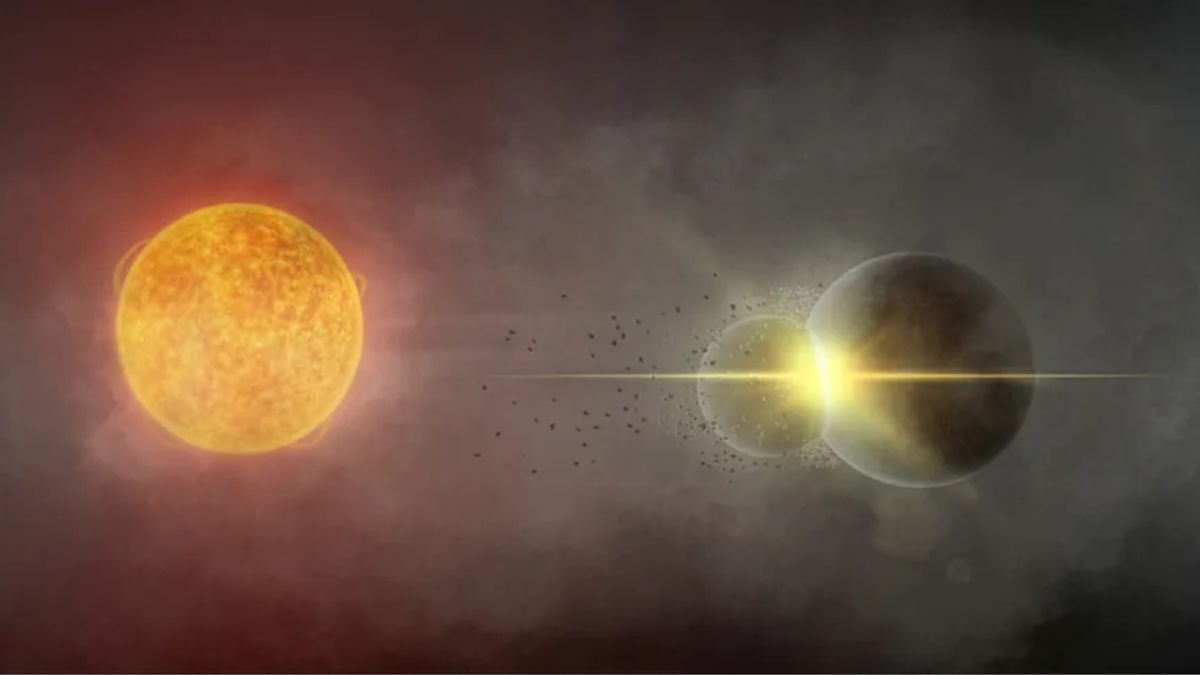
Photo Credit: Andy Tzanidakis
Astronomers detect infrared debris cloud after two planets collide near star Gaia20ehk
Click Here to Add Gadgets360 As A Trusted Source


Advertisement
Astronomers have reported evidence of two planets colliding around a distant Sun-like star, Gaia20ehk, located about 11,000 light-years away. The star's light output remained steady until 2016, when it exhibited three minor dimming events; by 2021, the light curve reportedly "went completely bonkers." Follow-up infrared observations revealed a burst of heat coinciding with the fading of visible light, a hallmark of a hot debris cloud resulting from a massive impact. This debris likely originated from a cataclysmic planet-on-planet smash-up.
Signs of a Planetary Smash-up
According to the research, the star's light curve showed long, irregular dips in visible light accompanied by bright infrared emission. “As the visible light began to flicker and dim, the infrared light spiked,” explained Anastasios Tzanidakis, indicating the blocking material is extremely hot.
This process is similar to what happened in the case of two planets that first grazed each other and then catastrophically collided, resulting in the heating of a superheated cloud of debris. Other theories, such as cometary debris, cannot account for such high infrared heating.
Implications for Planet Formation
Planetary smash-ups were common in early star systems, but witnessing one happening is extremely rare. Here, the cloud of debris will be orbiting just one astronomical unit (the Earth-Sun distance). Eventually, over millions of years, it might coalesce into a moon-like body as it cools. So far, only a handful of such events are known, and none resemble our Moon-forming event.
Researchers expect that surveys like the Vera Rubin Observatory's Legacy Survey of Space and Time will likely find many more such collisions. Co-author James Davenport notes that our own Moon may be a “magical ingredient” for life, so understanding these violent events helps reveal how common Earth-like worlds might be.
Comments
Get your daily dose of tech news, reviews, and insights, in under 80 characters on Gadgets 360 Turbo. Connect with fellow tech lovers on our Forum. Follow us on X, Facebook, WhatsApp, Threads and Google News for instant updates. Catch all the action on our YouTube channel.
Related Stories





Advertisement
Follow Us




-
04:49
Realme 16 Review: Air Design, 7000mAh, And More | Best Phone Under 35000 In 2026? -
05:05
Goboult Mustang Racer Smartwatch Review: Should You Get This Mustang Smartwatch? -
04:58
OnePlus Nord Buds 4 Pro Review: Specs, Sound Quality, ANC, and Battery Backup Tested -
02:29
[Sponsored] Samsung Galaxy S26 Ultra First Look: AI Smartphone for Creators, Gaming & Productivity -
04:25
Vivo X200T Review - Full Camera, Gaming & Battery Test | Worth Buying?
Advertisement
Popular on Gadgets
- Samsung Galaxy Unpacked 2026
- iPhone 17 Pro Max
- ChatGPT
- iOS 26
- Laptop Under 50000
- Smartwatch Under 10000
- Apple Vision Pro
- Oneplus 12
- OnePlus Nord CE 3 Lite 5G
- iPhone 13
- Xiaomi 14 Pro
- Oppo Find N3
- Tecno Spark Go (2023)
- Realme V30
- Best Phones Under 25000
- Samsung Galaxy S24 Series
- Cryptocurrency
- iQoo 12
- Samsung Galaxy S24 Ultra
- Giottus
- Samsung Galaxy Z Flip 5
- Apple 'Scary Fast'
- Housefull 5
- GoPro Hero 12 Black Review
- Invincible Season 2
- JioGlass
- HD Ready TV
- Latest Mobile Phones
- Compare Phones
Latest Gadgets
- OnePlus Ace 6 Ultra
- Poco C81 Pro
- Vivo Y500s
- Vivo Y600 Pro
- Infinix GT 50 Pro
- Vivo Y6 5G
- Vivo Y05 5G
- Poco C81x
- Dell XPS 16
- Dell XPS 14
- Redmi Pad 2 9.7 4G
- Redmi Pad 2 9.7
- NoiseFit Diva Araya
- OPPO Watch X3 Mini
- Xiaomi TV S Mini LED 2026 (75-inch)
- Xiaomi TV S Mini LED 2026 (65-inch)
- Asus ROG Ally
- Nintendo Switch Lite
- Haier 1.6 Ton 5 Star Inverter Split AC (HSU19G-MZAID5BN-INV)
- Haier 1.6 Ton 5 Star Inverter Split AC (HSU19G-MZAIM5BN-INV)

- About Us
- Sitemaps
- Feedback
- Archives
- Contact Us
- RSS
- Advertise
- Career
- Privacy Policy
- Ethics
- Editorial Policy
- Terms & Conditions
- Complaint Redressal
Download Our Apps
Available in Hindi
© Copyright Red Pixels Ventures Limited 2026. All rights reserved.