- Home
- Science
- Science News
- NASA’s Chandra Spots Champagne Cluster Formed by a Massive Galaxy Collision
NASA’s Chandra Spots Champagne Cluster Formed by a Massive Galaxy Collision
Astronomers using NASA’s Chandra Observatory have identified the Champagne Cluster, a pair of colliding galaxy clusters with bubble-like X-ray features.
Written by Gadgets 360 Staff | Updated: 31 December 2025 21:07 IST
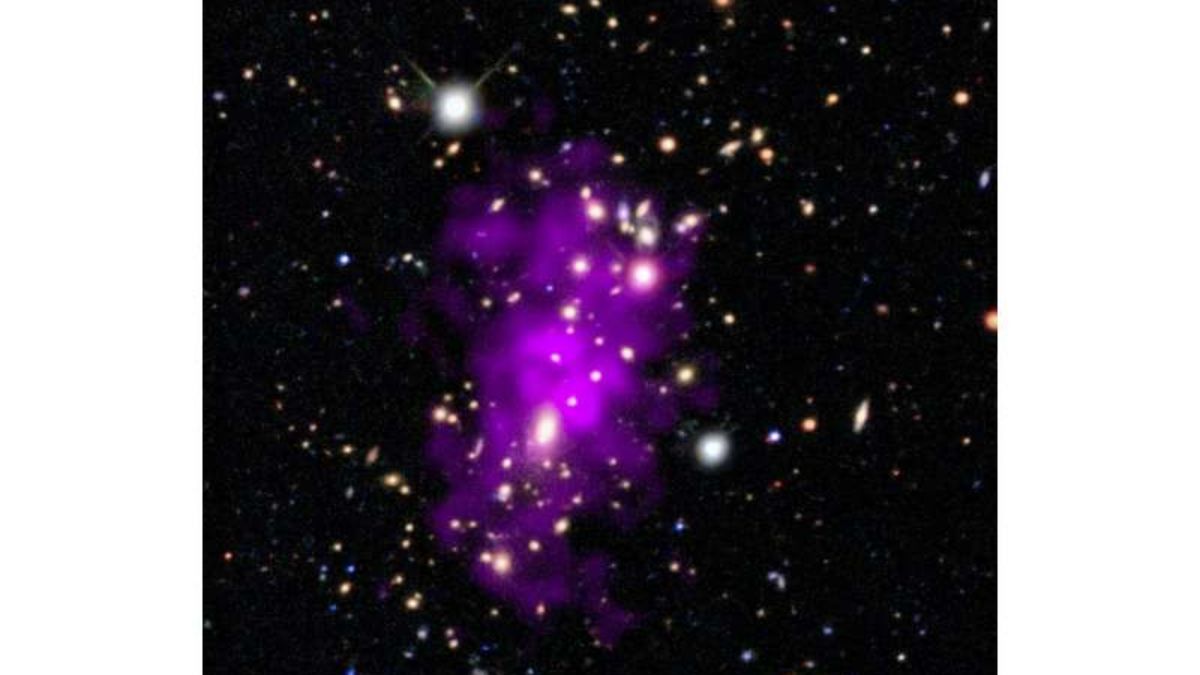
Photo Credit: NASA
NASA’s Chandra X-ray Observatory shows superheated gas stretched and distorted.
Click Here to Add Gadgets360 As A Trusted Source


Advertisement
The galaxy cluster discovered on New Year's Eve 2020 has been named the Champagne Cluster due to its bubble-like features and its date of discovery. The actual composite image, which is a mixture of the X-ray images taken by the Chandra Observatory of NASA and the surveys in visible light, indicates that the two galaxy clusters are actually colliding. The discovery was made by a team of UC Davis astronomers in The Astrophysical Journal, covering how galaxy cluster mergers are revealed even when using X-ray and optical light.
A Cosmic Collision
According to the paper, astronomers used Chandra's X-ray vision to probe the superheated gas in the cluster. Normally, gas in clusters appears as a roughly circular halo, but here it is stretched vertically, betraying the presence of two sub-clusters in collision. The image shows two clumps of galaxies flanking a purple cloud of multimillion-degree gas. This gas outweighs the total mass of the visible galaxies, and the clusters also contain a much larger amount of unseen dark matter.
Probing Dark Matter
Computer models indicate that these clusters likely collided more than 2 billion years ago and then came back together, or they might have had a single collision around 400 million years ago. Either way, looking into the Champagne Cluster could give scientists a better grasp of how dark matter acts during fast collisions. If we can see how dark matter either separates or stays with regular matter in these situations, researchers could uncover important insights about this mysterious stuff that makes up most of the universe.
Comments
Get your daily dose of tech news, reviews, and insights, in under 80 characters on Gadgets 360 Turbo. Connect with fellow tech lovers on our Forum. Follow us on X, Facebook, WhatsApp, Threads and Google News for instant updates. Catch all the action on our YouTube channel.
Further reading:
Champagne Cluster, galaxy clusters, cosmic collisions, Dark matter, Chandra Observatory, X-ray Astronomy


Advertisement
Follow Us




-
05:05
Goboult Mustang Racer Smartwatch Review: Should You Get This Mustang Smartwatch? -
04:58
OnePlus Nord Buds 4 Pro Review: Specs, Sound Quality, ANC, and Battery Backup Tested -
02:29
[Sponsored] Samsung Galaxy S26 Ultra First Look: AI Smartphone for Creators, Gaming & Productivity -
04:25
Vivo X200T Review - Full Camera, Gaming & Battery Test | Worth Buying? -
28:31
The Future of Productivity: Logitech's Anatoliy Polyanker On AI, Hybrid Work, And India's Tech Boom
-
200 मेगापिक्सल कैमरा, 7000mAh बैटरी के साथ Vivo V70 FE लॉन्च, जानें सबकुछ
-
Redmi Note 15 SE भारत में लेटेस्ट AI फीचर्स, 5800mAh बैटरी के साथ लॉन्च
-
5100mAh बैटरी, 50MP कैमरा वाला Pixel फोन हुआ 4700 रुपये सस्ता
-
Ola की इलेक्ट्रिक मोटरसाइकिल Roadster X+ पर भारी डिस्काउंट, प्राइस में हुई 60,000 रुपये की कमी
Advertisement
Popular on Gadgets
- Samsung Galaxy Unpacked 2026
- iPhone 17 Pro Max
- ChatGPT
- iOS 26
- Laptop Under 50000
- Smartwatch Under 10000
- Apple Vision Pro
- Oneplus 12
- OnePlus Nord CE 3 Lite 5G
- iPhone 13
- Xiaomi 14 Pro
- Oppo Find N3
- Tecno Spark Go (2023)
- Realme V30
- Best Phones Under 25000
- Samsung Galaxy S24 Series
- Cryptocurrency
- iQoo 12
- Samsung Galaxy S24 Ultra
- Giottus
- Samsung Galaxy Z Flip 5
- Apple 'Scary Fast'
- Housefull 5
- GoPro Hero 12 Black Review
- Invincible Season 2
- JioGlass
- HD Ready TV
- Latest Mobile Phones
- Compare Phones
Latest Gadgets
- Nord 6
- Honor X80i
- Honor Play 80 Pro
- Redmi Note 15 SE 5G
- Redmi A7 Pro
- OPPO K15 Pro
- OPPO K15 Pro+
- Lava Bold N2 Lite
- Xiaomi Book Pro 14
- MacBook Neo
- Vivo Pad 6 Pro
- Lenovo Legion Y700 Gen 5
- boAt Valour Watch 1R
- Xiaomi Watch S5
- Xiaomi QLED TV X Pro 75
- Haier H5E Series
- Asus ROG Ally
- Nintendo Switch Lite
- Haier 1.6 Ton 5 Star Inverter Split AC (HSU19G-MZAID5BN-INV)
- Haier 1.6 Ton 5 Star Inverter Split AC (HSU19G-MZAIM5BN-INV)

- About Us
- Sitemaps
- Feedback
- Archives
- Contact Us
- RSS
- Advertise
- Career
- Privacy Policy
- Ethics
- Editorial Policy
- Terms & Conditions
- Complaint Redressal
Download Our Apps
Available in Hindi
© Copyright Red Pixels Ventures Limited 2026. All rights reserved.