-
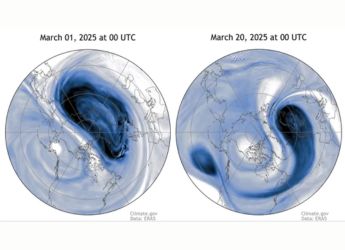
 Major Disruption Has Left Arctic Polar Vortex Away from North Pole, Scientists Alert8 April 2025
 -
Extreme Arctic Warming Sees North Pole Temperatures Rise Above Freezing7 February 2025
-
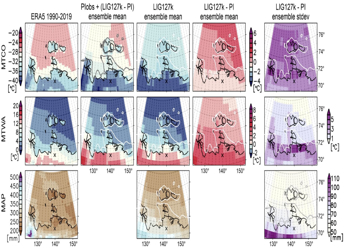
Arctic Siberia Summers 10 Degree Celsius Warmer in Last Interglacial, New Study Reveals23 December 2024
-
New Study Reveals Weaker Atlantic Current Could Mitigate Arctic Warming4 November 2024
-
Thawing Permafrost Releases Greenhouse Gases, Contributing to Global Warming1 November 2024
- Home
- Science
- Science News
- New Study Explains Why Earth’s Poles Are Heating Up at an Alarming Rate
New Study Explains Why Earth’s Poles Are Heating Up at an Alarming Rate
A Penn State–led study reveals that sea-ice openings and industrial pollution amplify Arctic warming through cloud formation and chemical feedbacks, accelerating ice melt and influencing global climate patterns.
Written by Gadgets 360 Staff | Updated: 30 December 2025 23:00 IST

Photo Credit: Wikipedia Common
New airborne research reveals sea-ice leads and pollution accelerating Arctic warming
Click Here to Add Gadgets360 As A Trusted Source


Advertisement
The warming at the poles of the Earth is increasing at the fastest rate; a new study conducted by Penn State demonstrates that feedback loops of polar air contribute to the trend. Scientists discovered that leads in the sea ice (so-called leads) promote cloud formation and chemical interactions. In contrast, emissions from oil wells in Prudhoe Bay, Alaska, contaminated the atmosphere of the Arctic. These effects serve as a strong positive feedback loop, accelerating the melting of ice quickly, and it feeds itself to produce further warming in the Arctic.
New airborne study reveals hidden Arctic feedbacks
According to the new research, the Penn State-led team sampled Arctic air in spring 2022 with two instrumented research aircraft and ground sensors. Professor Jose D. Fuentes called this “an unprecedented opportunity to explore chemical changes in the boundary layer … and to understand how human influence is altering the climate in this important region. He said the data provide an “improved understanding of the interactions” between aerosols, clouds, and pollutants in the new Arctic.
Implications for global climate
The findings have wider significance for Earth's climate. Researchers are preparing detailed datasets so climate models can capture these Arctic feedbacks. The team plans to create data to “better understand how global climate may evolve as a result of these localised factors in the Arctic”. Accurately modelling such feedback is crucial because Arctic changes can influence weather patterns far beyond the pole. This will help climate scientists refine models and predict how Arctic changes feed into global weather. It underscores how shifts in a remote region like the Arctic can have far-reaching effects on climate and warming worldwide.
Comments
Get your daily dose of tech news, reviews, and insights, in under 80 characters on Gadgets 360 Turbo. Connect with fellow tech lovers on our Forum. Follow us on X, Facebook, WhatsApp, Threads and Google News for instant updates. Catch all the action on our YouTube channel.
Related Stories





Advertisement
Follow Us




-
00:21
[Sponsored] Samsung Galaxy Z Fold8, Fold8 Ultra -
03:41
[Sponsored] Samsung Galaxy Z Fold8: How It Fits Into an Actor’s Busy Day | Camera, Multitasking & More -
09:53
iPhone 18 Goes On Sale In India: Huge Crowds, Long Queues At Apple Stores -
06:32
Google Pixel 11 Pro XL Review: The Most Exciting Pixel Yet? | 120X Zoom + Tensor G6 -
05:20
Samsung Galaxy Watch Ultra 2 Review: Is This the Best Android Smartwatch?
-
Amazon vs Flipkart Sale: iPhone 17 ₹79,999 में, iPhone 15 ₹63,999 से शुरू
-
HMD 106 Pure लेटेस्ट फीचर फोन हुआ पेश, कीमत ₹1,100 के करीब
-
1 स्पीकर में 3 के मजे! Portronics ने भारत में लॉन्च किया AuraTrio
-
₹2508 डिस्काउंट पर मिल रहा Vivo Y सीरीज फोन! 50MP कैमरा, 5500mAh है बैटरी
-
बच्चों की हर एक्टिविटी पर नजर रखेगा JioShield, ₹1 हजार में 1 साल की सर्विस और वापस मिलेंगे ₹1,000 के वाउचर
Advertisement
Popular on Gadgets
- Samsung Galaxy S26 Ultra
- Motorola Razr Fold
- ChatGPT
- OPPO Find N6
- Mobiles Under Rs. 40,000
- Vivo X300 Ultra
- Asus Zenbook S14
- iQOO 15
- Vivo X300 Pro
- Lenovo Yoga Slim 7i Aura Edition
- iQOO 15R
- Vivo X Fold 5
- Sony PlayStation 5
- HP OmniPad 12
- OnePlus Nord CE 6 Lite
- OnePlus Pad 4
- OPPO F33 Pro 5G
- Cryptocurrency
- HP OmniBook Ultra 14 (2026)
- iPhone 17
- Eureka Forbes AP 355 Room Air Purifier
- Latest Mobile Phones
- Compare Phones
Latest Gadgets
- HMD Vibe 2 Pro 5G
- OPPO K14 Plus 5G
- Lava Shark 2 Pro 5G
- Ai+ Pulse 2 FE
- OPPO Reno 16t
- Itel Zeno 300
- Vivo Y600i
- Mivi One 5G
- Dell 14 Plus 2-in-1 (AMD Ryzen AI 7 350, 2025)
- Microsoft Surface Laptop, 13-inch (2nd Edition)
- Ai+ NovaTab
- Microsoft Surface Pro, 12-inch (2nd Edition)
- Amazfit T-Rex Dual Solar
- OPPO Watch S2
- Toshiba 65-Inch 4K Ultra HD Smart Mini LED QLED TV (65Z670SP)
- Haier M70 Mini LED 65-inch
- Acer Predator Atlas 8
- Asus ROG Ally
- Blue Star 1.5 Ton 5 Star Inverter Split AC (IE518ZNURS)
- Blue Star 2 Ton 3 Star Inverter Window AC (WIE324L)

- About Us
- Sitemaps
- Feedback
- Archives
- Contact Us
- RSS
- Advertise
- Career
- Privacy Policy
- Ethics
- Editorial Policy
- Terms & Conditions
- Complaint Redressal
Download Our Apps
Available in Hindi
© Copyright Red Pixels Ventures Limited 2026. All rights reserved.