- Home
- Science
- Science News
- Electricity Driven Nitrogen Insertion Opens a Sustainable Path to Drug Ready Heterocycles
Electricity-Driven Nitrogen Insertion Opens a Sustainable Path to Drug-Ready Heterocycles
Electricity-driven chemistry enables a cleaner, controllable route to valuable nitrogen heterocycles for drug research.
Written by Gadgets 360 Staff | Updated: 20 December 2025 20:49 IST
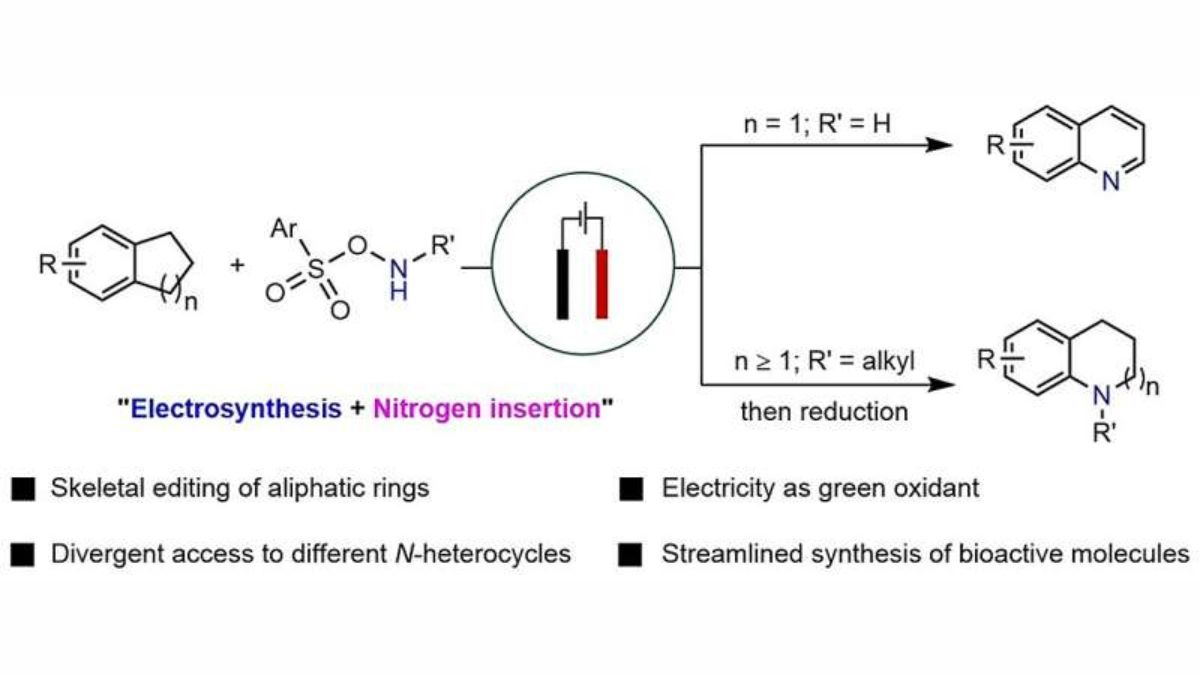
Photo Credit: Wikimedia Commons
Electricity-driven reactions enable greener synthesis of nitrogen heterocycles used in drug development.
Click Here to Add Gadgets360 As A Trusted Source


Advertisement
Electricity-powered chemistry is providing a cleaner route to chemical Compounds containing nitrogen that are found in many of today's pharmaceuticals. Scientists at the National University of Singapore have created a new process for inserting nitrogen atoms into difficult nitrogen-heterocycles, a stable carbon ring, using their special catalyst without taking too much time. The method is clean and waste-free, bypassing harmful chemicals that often accompany such changes and enabling almost pinpoint control over the resulting molecular structure. Silicon-containing compounds are common materials used in pharmaceuticals, agrochemicals, and advanced materials; hence, the development is important for a more sustainable drug design.
Electricity Enables Cleaner Nitrogen Insertion Into Drug-Ready Carbon Rings
According to a report published in Nature Synthesis, the research team led by Associate Professor Koh Ming Joo and Professor Zhao Yu demonstrated that electricity can drive nitrogen atom insertion into saturated carbocycles that are usually difficult to modify. The study explains how careful control of electrochemical conditions allows the same starting material to be converted into either functionalised quinolines or N-alkylated saturated nitrogen heterocycles, both of which are highly valued in medicinal chemistry.
Nitrogen heterocycles are essential building blocks in drug discovery, but making them often requires strong oxidising agents and produces large amounts of chemical waste. Directly breaking carbon–carbon single bonds to insert nitrogen has remained rare because these bonds are highly stable and resistant to reaction.
To overcome this issue, the NUS researchers employed electricity as a clean redox reagent. The reaction operates under ambient conditions and is highly tolerant to sensitive functional groups, which indicates that it can be used on complex molecules in a broad range without destroying them.
The researchers also demonstrated the method's practical value by synthesising two potential ion-channel antagonist candidates. The strategy is now being trialled on other bioactive heterocycles, suggesting a wider application for electricity-driven synthesis in greener pharmaceutical production.
Comments
Get your daily dose of tech news, reviews, and insights, in under 80 characters on Gadgets 360 Turbo. Connect with fellow tech lovers on our Forum. Follow us on X, Facebook, WhatsApp, Threads and Google News for instant updates. Catch all the action on our YouTube channel.
Further reading:
electrochemistry, nitrogen heterocycles, green chemistry, drug discovery, NUS research


Advertisement
Follow Us




-
09:53
iPhone 18 Goes On Sale In India: Huge Crowds, Long Queues At Apple Stores -
06:32
Google Pixel 11 Pro XL Review: The Most Exciting Pixel Yet? | 120X Zoom + Tensor G6 -
05:20
Samsung Galaxy Watch Ultra 2 Review: Is This the Best Android Smartwatch? -
07:01
Samsung Galaxy Z Fold 8 Review: Is This the Best Foldable Phone? -
06:39
Samsung Galaxy Z Fold8 Ultra Review: Cameras, Battery, Performance Tested
-
10 मिनट में घर पहुंचेंगे iPhone 18 Pro, Pro Max: सेल हुई शुरू
-
Lava ने लॉन्च किया 6000mAh बैटरी वाला Bold N4 Pro 5G
-
itel Zeno 300 भारत में होगा लॉन्च, मिलेगी 6,000mAh बैटरी और डुअल कैमरा
-
Motorola Signature 27 होगा 22 सितंबर को पेश, 200MP दो कैमरा के साथ, टीजर जारी
-
Flipkart Big Billion Days सेल में Samsung Galaxy S25, S25 FE को ₹50,000 से कम में खरीदने का मौका!
Advertisement
Popular on Gadgets
- Samsung Galaxy S26 Ultra
- Motorola Razr Fold
- ChatGPT
- OPPO Find N6
- Mobiles Under Rs. 40,000
- Vivo X300 Ultra
- Asus Zenbook S14
- iQOO 15
- Vivo X300 Pro
- Lenovo Yoga Slim 7i Aura Edition
- iQOO 15R
- Vivo X Fold 5
- Sony PlayStation 5
- HP OmniPad 12
- OnePlus Nord CE 6 Lite
- OnePlus Pad 4
- OPPO F33 Pro 5G
- Cryptocurrency
- HP OmniBook Ultra 14 (2026)
- iPhone 17
- Eureka Forbes AP 355 Room Air Purifier
- Latest Mobile Phones
- Compare Phones
Latest Gadgets
- Lava Bold N4 Pro 5G
- Samsung Galaxy A08
- Itel Muzik 450L
- OPPO K14 Lite
- Samsung Galaxy A18 4G
- iPhone Duo
- OPPO A7 Pro
- Huawei Mate XT 2 Ultimate Design
- Asus Vivobook S14 (S5452MA)
- Acer Aspire G 3D 16
- Xiaomi Pad 9 Pro
- Xiaomi Pad 9
- Apple Watch Ultra 4
- Apple Watch Series 12
- Haier M70 Mini LED 65-inch
- Xiaomi TV FX Mini LED 65
- Acer Predator Atlas 8
- Asus ROG Ally
- Blue Star 1.5 Ton 5 Star Inverter Split AC (IE518ZNURS)
- Blue Star 2 Ton 3 Star Inverter Window AC (WIE324L)

- About Us
- Sitemaps
- Feedback
- Archives
- Contact Us
- RSS
- Advertise
- Career
- Privacy Policy
- Ethics
- Editorial Policy
- Terms & Conditions
- Complaint Redressal
Download Our Apps
Available in Hindi
© Copyright Red Pixels Ventures Limited 2026. All rights reserved.