
-
 Best Smartphones Under Rs. 45,000 with Snapdragon Processor: Redmi Note 17 Pro, OnePlus Nord 6 and More18 October 2026
 -
Best Gaming Smartphones Under Rs. 50,000: Redmi Turbo 5, OnePlus Nord 6, and more4 October 2026
-
Nothing Deals Revealed for Phone 4 Series, CMF Buds Lineup, More Ahead of Flipkart's Big Billion Days Sale2 October 2026
-
Nothing Phone (4a) and Phone (4b) Get New Base Variants in India With 6GB of RAM: Price, Specifications28 September 2026
-
Best Mobiles Under Rs. 70,000 With Telephoto Cameras in India27 September 2026
- Home
- Mobiles
- Mobiles Features
- Nothing Phone 4a vs Motorola Edge 70: Price in India, Features and Specifications Compared
Nothing Phone 4a vs Motorola Edge 70: Price in India, Features and Specifications Compared
Nothing Phone 4a offers a Glyph interface and periscope lens, while the Motorola Edge 70 focuses on a slimmer design and stronger durability ratings.
Written by Sucharita Ganguly, Edited by David Delima | Updated: 5 March 2026 20:18 IST
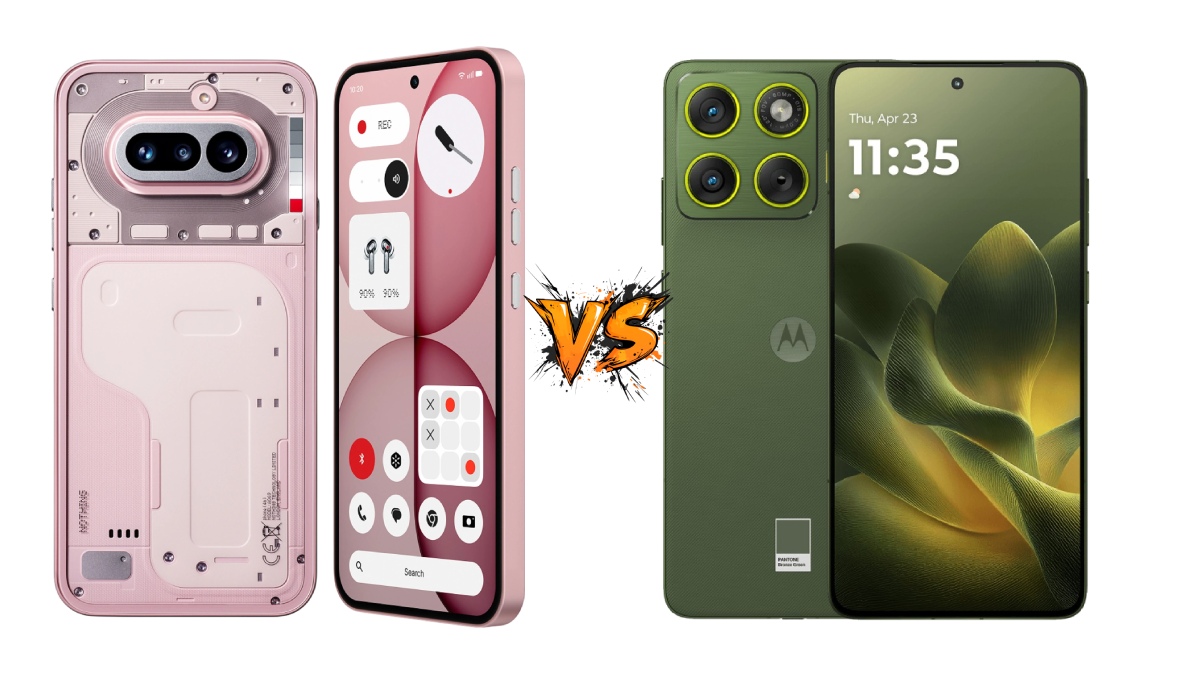
Nothing Phone 4a vs Moto Edge 70
Click Here to Add Gadgets360 As A Trusted Source

 Nothing Phone 4A FAQs
Advertisement
Nothing Phone 4a is the company's latest midrange smartphone in India, offering various upgrades over last year's Phone 3a model, such as a new Snapdragon chip, a redesigned Glyph Bar interface, and a large battery. It enters a competitive segment where devices like the Motorola Edge 70 aim to deliver strong performance, durable designs, and AI-powered software features at a similar price point. Both phones offer AMOLED displays, triple rear cameras, and Android 16-based software experiences.
So, should you choose the Nothing Phone 4a with its distinctive Glyph interface and periscope camera, or the Motorola Edge 70 with its slimmer design and stronger durability ratings? We compare the two smartphones to help you decide.
- Motorola Edge 70 Pro vs Vivo V70 vs Nothing Phone 4a Pro
- Is the Nothing Phone (4a) the most "stylish" phone under 25k?
- Phones like Nothing Phone 4a, 4a Pro are launching soon. Will these compete with Redmi, Realme phones?
- Best budget 5G phone under ₹30,000?
- MWC 2026 is starting soon. What kind of announcements do you expect this year?
Nothing Phone 4a vs Motorola Edge 70: Price in India
Nothing Phone 4a: In India, the Nothing Phone 4a carries a starting price of Rs. 31,999 for the 8GB + 128GB variant. The company also sells the handset in 8GB + 256GB and 12GB + 256GB versions at Rs. 34,999 and Rs. 37,999, respectively. Buyers can pick from Black, Blue, Pink, and White finishes, and sales will begin on Flipkart from March 13.
Motorola Edge 70: The Motorola Edge 70 is priced at Rs. 29,999 for the only configuration that includes 8GB of RAM and 256GB of internal storage. It will be offered in Pantone Bronze Green, Pantone Gadget Grey, and Pantone Lily Pad colour options.
Nothing Phone 4a vs Motorola Edge 70: Design
Nothing Phone 4a: The Nothing Phone 4a retains the brand's distinctive transparent-style design and introduces the new Glyph Bar lighting system on the back. It uses 63 mini-LEDs split across six zones and supports features such as Glyph Timer, Essential Notifications, Volume Indicator, Live Notifications, and Camera Countdown. The handset carries an IP64 rating for dust and splash resistance and measures 163.95x77.57x8.55mm, with a weight of 204.5g.
Motorola Edge 70: In contrast, the Motorola Edge 70 emphasises a thinner and lighter build with an aircraft-grade aluminium frame. The handset measures 159.9x74.3x5.99mm and weighs around 159g, making it significantly slimmer and lighter than the Nothing Phone 4a. Motorola also equips the phone with stronger durability features, including IP68 and IP69 ratings for protection against dust and water ingress, as well as MIL-STD-810H military-grade certification.
Nothing Phone 4a vs Motorola Edge 70: Display
Nothing Phone 4a: You get a 6.78-inch LTPS Flexible AMOLED screen on the Nothing Phone 4a that offers a resolution of 1,224 x 2,720 pixels and a 120Hz refresh rate. It can reach up to 4,500 nits of peak brightness and delivers a 440ppi pixel density along with support for 1.07 billion colours. The display also supports up to 2,500Hz touch sampling during gaming, uses 2,160Hz PWM dimming for brightness control, and is protected by Corning Gorilla Glass 7i.
Motorola Edge 70: The Motorola Edge 70, on the other hand, uses a slightly smaller 6.7-inch AMOLED display with a 1.5K resolution and a 120Hz refresh rate. The panel can also reach up to 4,500 nits of peak brightness and supports Dolby Vision and HDR10+ content. Like the Nothing phone, it is protected by Corning Gorilla Glass 7i.
Nothing Phone 4a vs Motorola Edge 70: Performance and Software
Nothing Phone 4a: The Nothing Phone 4a is powered by a 4nm Snapdragon 7s Gen 4 chipset coupled with up to 12GB of LPDDR4x RAM and up to 256GB of UFS 3.1 storage. It runs Android 16-based Nothing OS 4.1, with the company promising three years of OS updates and six years of security patches.
Nothing OS 4.1 introduces a more customisable lock screen, relaxation-focused widgets, improved Live Notifications across the interface and Glyph system, and a Voice-to-Text AI tool. It also includes Essential AI tools such as Essential Space with cloud support, Essential Search, Essential Memory, and Playground for creating AI-powered apps.
Motorola Edge 70: On the other hand, runs on the Snapdragon 7 Gen 4 chipset paired with 8GB of LPDDR5x RAM and 256GB of UFS 3.1 storage. The handset ships with Android 16 and Motorola's Hello UI, and it is slated to receive three major Android upgrades along with four years of security updates.
Motorola also bundles several Moto AI tools, including Next Move, Catch Me Up 2.0, Pay Attention 2.0, Remember This + Recall, and Copilot.
Nothing Phone 4a vs Motorola Edge 70: Cameras
Nothing Phone 4a: For optics, the Nothing Phone 4a is equipped with a triple rear camera setup that includes a 50-megapixel primary sensor with OIS using Samsung's GN9 sensor. It also features a 50-megapixel periscope camera with OIS and support for up to 70x Ultra Zoom, along with an 8-megapixel ultrawide camera offering a 120-degree field of view. For selfies and video calls, the handset includes a 32-megapixel front camera and supports video recording at up to 4K resolution at 30fps.
Motorola Edge 70: There's a triple rear camera system on the Motorola Edge 70, headlined by a 50-megapixel primary sensor with OIS. It is paired with a 50-megapixel ultrawide camera and a three-in-one light sensor. On the front, the smartphone houses a 50-megapixel selfie camera. The device supports video recording at up to 4K resolution at 60fps and includes AI-based tools such as AI Video Enhancement, AI Action Shot, and AI Photo Enhancement.
Nothing Phone 4a vs Motorola Edge 70: Battery Life
Nothing Phone 4a: The Nothing Phone 4a is equipped with a 5,400mAh battery and supports 50W wired fast charging. According to the company, the handset can charge from 1 percent to 100 percent in around 64 minutes.
Motorola Edge 70: Motorola's handset packs a slightly smaller 5,000mAh silicon-carbon battery. It supports faster 68W wired charging as well as 15W wireless charging. Motorola claims the device can provide up to 31 hours of continuous video playback on a single charge.
Nothing Phone 4a vs Motorola Edge 70: Conclusion
Nothing Phone 4a: Both smartphones offer distinct advantages in the midrange segment. The Nothing Phone 4a stands out with its unique Glyph Bar interface, larger battery capacity, and a periscope camera that supports high zoom levels. These features may appeal to users who prefer a distinctive design and a more versatile camera setup.
Motorola Edge 70: Meanwhile, the Motorola Edge 70, focuses on a slimmer and lighter build, stronger durability ratings, faster wired charging, and a range of AI-powered software features. Buyers who prioritise portability and durability may find the Motorola handset to be the more practical choice.
Nothing Phone 4A FAQsWhat are the main features of the Nothing Phone 4a?
The Nothing Phone 4a is available with up to 12GB of RAM paired with 256GB of internal storage. It features a dual rear camera setup comprising a 50MP main camera and a 50MP secondary sensor, along with a 32MP front-facing selfie camera. The phone supports fast charging with 50W wired charging, backed by a 5400mAh battery. It is powered by the 4 nm TSMC processor and comes with a 6.78-inch flexible AMOLED display that supports up to a 120Hz refresh rate. The Nothing Phone 4a is available in 4 colour options.
When was the Nothing Phone 4a released?
The Nothing Phone 4a was launched on March 5, 2026
Where can I buy the Nothing Phone 4a?
You can buy the Nothing Phone 4a through the official Nothing website, e-commerce platforms such as Flipkart, and select retail stores across India.
Nothing Phone 4a vs Motorola Edge 70 comparison

|

|
|
| Key Specs | ||
| Display | 6.78-inch | 6.70-inch |
| Processor | Snapdragon 7s Gen 4 | Qualcomm Snapdragon 7 Gen 4 |
| Front Camera | 32-megapixel | 50-megapixel |
| Rear Camera | 50-megapixel + 50-megapixel + 8-megapixel | 50-megapixel + 50-megapixel |
| RAM | 6GB, 8GB, 12GB | 12GB |
| Storage | 128GB, 256GB | 512GB |
| Battery Capacity | 5400mAh | 4800mAh |
| OS | Android 16 | Android 16 |
| Resolution | 1,224x2,720 pixels | 1220x2712 pixels |
Comments
Get your daily dose of tech news, reviews, and insights, in under 80 characters on Gadgets 360 Turbo. Connect with fellow tech lovers on our Forum. Follow us on X, Facebook, WhatsApp, Threads and Google News for instant updates. Catch all the action on our YouTube channel.
Further reading:
Nothing Phone 4a, Nothing Phone 4a price in India, Nothing Phone 4a Specifications, Motorola Edge 70, Motorola Edge 70 Price in India, Motorola Edge 70 Specifications, Nothing
Related Stories



Advertisement
Follow Us




-
![[Sponsored] LG NANO 4K UHD AI TV NU885: Gemini Search, Dolby Atmos & 5 Years of Updates](https://www.gadgets360.com/static/desktop/images/spacer.png)
04:17
[Sponsored] LG NANO 4K UHD AI TV NU885: Gemini Search, Dolby Atmos & 5 Years of Updates -
00:57
[Sponsored] Samsung Galaxy Z Fold8 My Fan Cam in Action: Find the Moment, Then Share It -
01:41
[Sponsored] What Do You Need To Know Before Your Next Run? | Samsung Galaxy Watch Ultra2 -
01:32
[Sponsored] Big Day Tomorrow? Prep Today | Samsung Galaxy Watch Ultra2 -
04:37
[Sponsored]: CP PLUS CarKam CP-F89B: 4K Dashcam With Rear Camera, GPS & Emergency Recording
-
iPhone 16 आज भी Amazon सेल में मिल रहा ₹15 हजार से ज्यादा सस्ता
-
OnePlus 15 को Amazon Great Indian Festival Sale में खरीदें सस्ता
-
₹2250 सस्ता मिल रहा Motorola का 7000mAh बैटरी वाला फोन! Flipkart पर ऑफर
-
Moto G47 Power लॉन्च होगा 7,000mAh बैटरी के साथ! IP64 रेटिंग
-
HMD Vibe 2 Max बजट फोन लॉन्च होगा 108MP कैमरा, 6,000mAh बैटरी फीचर के साथ!
Advertisement
Popular on Gadgets
- Samsung Galaxy S26 Ultra
- Motorola Razr Fold
- ChatGPT
- OPPO Find N6
- Mobiles Under Rs. 40,000
- Vivo X300 Ultra
- Asus Zenbook S14
- iQOO 15
- Vivo X300 Pro
- Lenovo Yoga Slim 7i Aura Edition
- iQOO 15R
- Vivo X Fold 5
- Sony PlayStation 5
- HP OmniPad 12
- OnePlus Nord CE 6 Lite
- OnePlus Pad 4
- OPPO F33 Pro 5G
- Cryptocurrency
- HP OmniBook Ultra 14 (2026)
- iPhone 17
- Eureka Forbes AP 355 Room Air Purifier
- Latest Mobile Phones
- Compare Phones
Latest Gadgets
- Samsung Galaxy F70 5G
- Tecno Spark 50S 5G
- Vivo Y600s Pro
- Vivo Y32 (2026)
- Infinix Smart 20 HD
- Vivo V80
- Vivo S2 FE
- Vivo Y600K Turbo
- HP ZBook Ultra G3a
- Dell Pro Rugged 14
- Amazon Alexa Tablet 8
- Amazon Alexa Tablet 11
- Amazfit T-Rex Dual Solar
- OPPO Watch S2
- Toshiba 65-Inch 4K Ultra HD Smart Mini LED QLED TV (65Z670SP)
- Haier M70 Mini LED 65-inch
- Acer Predator Atlas 8
- Asus ROG Ally
- Blue Star 1.5 Ton 5 Star Inverter Split AC (IE518ZNURS)
- Blue Star 2 Ton 3 Star Inverter Window AC (WIE324L)

- About Us
- Sitemaps
- Feedback
- Archives
- Contact Us
- RSS
- Advertise
- Career
- Privacy Policy
- Ethics
- Editorial Policy
- Terms & Conditions
- Complaint Redressal
Download Our Apps
Available in Hindi
© Copyright Red Pixels Ventures Limited 2026. All rights reserved.