
-
 Pulsar Observations Could Reveal Gravitational Wave Interference From Black Holes15 October 2025
 -
Supermassive Black Hole Burps Matter at Near-Light Speeds After Consuming Gas Too Fast25 June 2025
-
The Universe’s Brightest Lights Have Surprisingly Dark and Mysterious Origins3 May 2025
-
New Study Uncovers Shadowy Origins of Universe’s Most Luminous Phenomena2 May 2025
-
Supermassive Black Hole May Be Hiding in Large Magellanic Cloud, Scientists Suggest10 March 2025
- Home
- Science
- Science News
- James Webb Confirms First Runaway Supermassive Black Hole Rocking Through Space
James Webb Confirms First Runaway Supermassive Black Hole Rocking Through Space
JWST confirms a runaway supermassive black hole moving at 2.2 million mph, forming stars along its path.
Written by Gadgets 360 Staff | Updated: 18 December 2025 22:31 IST
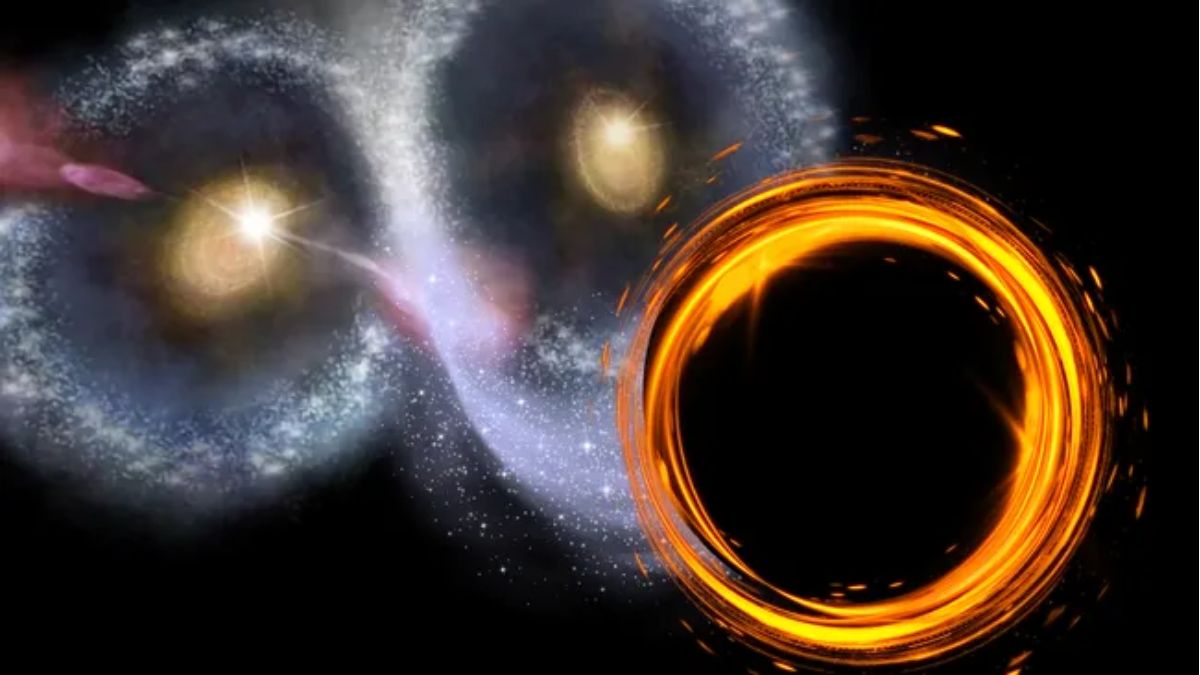
Photo Credit: NASA
A runaway supermassive black hole leaves a massive tail of gas and star formation in its wake
Click Here to Add Gadgets360 As A Trusted Source


Advertisement
Astronomers have verified a runaway supermassive black hole by observing it with the James Webb Space Telescope (JWST), tearing across space at 2.2 million mph within a pair of galaxies known as the “Cosmic Owl”. This black hole, which weighs 10 million times the mass of the sun, is blasting a galaxy-sized shock wave in front of it and has left a 200,000 light-year-long trail of gas behind that is stimulating star formation. Its extreme velocity makes it the first known runaway supermassive black hole, all of which makes it one of the fastest-moving objects in the Universe.
Runaway Black Hole Confirmed by JWST, Racing at 1,000 km/s After Galaxy Merger
According to a Space.com report, the black hole was initially spotted in 2023 with the Hubble Space Telescope as a streak of disturbed gas, indicating a massive object in motion. JWST observations have now confirmed its presence at the tip of this streak, moving at roughly 1,000 kilometres per second, far faster than most cosmic bodies, and escaping the gravity of its home galaxies.
The runaway black hole was created after the central black holes of two galaxies merged, generating gravitational waves and hurtling it away, leaving the new galaxy empty except for newborn stars along its path.
Rare Runaway Black Hole Spotted 9 Billion Light-Years Away, Confirming Galaxy Merger Theories
The Cosmic Owl galaxies, 9 billion light-years from us, are in no imminent danger - indicating that such black hole kicks, while rarely detected, may be more common when two galaxies collide.
Pieter van Dokkum's team emphasises that space-based imaging was key to spotting the runaway black hole; future telescopes may reveal more and study their galactic impact.
Comments
Get your daily dose of tech news, reviews, and insights, in under 80 characters on Gadgets 360 Turbo. Connect with fellow tech lovers on our Forum. Follow us on X, Facebook, WhatsApp, Threads and Google News for instant updates. Catch all the action on our YouTube channel.
Further reading:
supermassive black hole, James Webb Space Telescope, runaway black hole, Cosmic Owl galaxies, star formation, astronomy
Related Stories






Advertisement
Follow Us




-
07:03
Vivo X300 Pro Review | Best Camera Phone You Can Buy For 2026 -
04:56
Vivo X300 Review | Best Flagship of 2025? | Unbelievable Camera & Performance Test -
03:49
Lava Agni 4 Review - Best Indian 5G Phone Under Budget? -
05:23
Motorola G67 Power Review: The Real Battery Beast of 2025? -
06:14
[Partner Content] OPPO F31 Series: The Durable Champion That Stays Smooth & Powerful
-
15000 रुपये सस्ता मिल रहा OnePlus का फ्लैगशिप स्मार्टफोन, ये है पूरी डील
-
OnePlus 15R, Pad Go 2 आज भारत में हो रहे लॉन्च, ऐसे देखें लाइव स्ट्रीमिंग
-
वायु प्रदूषण की स्थिति गंभीर, फेस मास्क खरीदते हुए 5 बातों पर दें ध्यान
-
Hollywood में बड़ा उलटफेर, 50 साल बाद टूटेगी परंपरा! Oscars अब TV पर नहीं बल्कि...
Advertisement
Popular on Gadgets
- Samsung Galaxy Unpacked 2025
- ChatGPT
- Redmi Note 14 Pro+
- iPhone 16
- Apple Vision Pro
- Oneplus 12
- OnePlus Nord CE 3 Lite 5G
- iPhone 13
- Xiaomi 14 Pro
- Oppo Find N3
- Tecno Spark Go (2023)
- Realme V30
- Best Phones Under 25000
- Samsung Galaxy S24 Series
- Cryptocurrency
- iQoo 12
- Samsung Galaxy S24 Ultra
- Giottus
- Samsung Galaxy Z Flip 5
- Apple 'Scary Fast'
- Housefull 5
- GoPro Hero 12 Black Review
- Invincible Season 2
- JioGlass
- HD Ready TV
- Laptop Under 50000
- Smartwatch Under 10000
- Latest Mobile Phones
- Compare Phones
Latest Gadgets
- OnePlus 15R
- Realme Narzo 90x 5G
- Realme Narzo 90 5G
- Vivo S50 Pro Mini
- Vivo S50
- OPPO Reno 15c
- Redmi Note 15 5G
- Redmi Note 15 Pro 5G
- Asus ProArt P16
- MacBook Pro 14-inch (M5, 2025)
- Infinix Xpad Edge
- OnePlus Pad Go 2
- OnePlus Watch Lite
- Just Corseca Skywatch Pro
- Acerpure Nitro Z Series 100-inch QLED TV
- Samsung 43 Inch LED Ultra HD (4K) Smart TV (UA43UE81AFULXL)
- Asus ROG Ally
- Nintendo Switch Lite
- Haier 1.6 Ton 5 Star Inverter Split AC (HSU19G-MZAID5BN-INV)
- Haier 1.6 Ton 5 Star Inverter Split AC (HSU19G-MZAIM5BN-INV)

- About Us
- Sitemaps
- Feedback
- Archives
- Contact Us
- RSS
- Advertise
- Career
- Privacy Policy
- Ethics
- Editorial Policy
- Terms & Conditions
- Complaint Redressal
Download Our Apps
Available in Hindi
© Copyright Red Pixels Ventures Limited 2025. All rights reserved.