-
 SETI Scientists Searched Interstellar Comet 3I/ATLAS for Alien Signals7 June 2026
 -
A Visitor from Another Star: Interstellar Comet Reveals Alien Origins26 April 2026
-
SPHEREx Captures Dramatic Outburst of Interstellar Comet 3I/ATLAS11 February 2026
-
NASA’s SPHEREx Spots Interstellar Comet Flaring With Gas and Organic Molecules9 February 2026
-
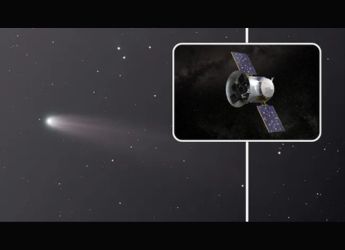
NASA’s TESS Captures First Images of Rare Interstellar Comet 3I/ATLAS29 January 2026
- Home
- Science
- Science News
- Interstellar Comet 3I/ATLAS to Make Closest Approach to Earth on December 19
Interstellar Comet 3I/ATLAS to Make Closest Approach to Earth on December 19
Interstellar comet 3I/ATLAS safely flies past Earth on Dec. 19, giving scientists a rare research opportunity.
Written by Gadgets 360 Staff | Updated: 18 December 2025 22:09 IST

Photo Credit: NASA
Interstellar comet 3I/ATLAS captured as it speeds through the inner solar system
Click Here to Add Gadgets360 As A Trusted Source


Advertisement
Comet 3I/ATLAS is an interstellar comet that will pass by Earth next Friday, Dec. 19, in a rare appearance for scientists observing from the planet. Traveling at a blistering speed, the comet will safely fly past at about 1.8 astronomical units, or approximately 168 million miles away. While nowhere near Earth itself, this event gives scientists a front-row seat as they try to observe material that was created around another star, the closest thing yet to being there from a research perspective, even if there's no danger to the planet.
ESA Confirms 3I/ATLAS as Rare Interstellar Comet Passing Safely Through the Solar System
According to a report by the European Space Agency, the comet was detected on July 1 by NASA-funded ATLAS telescopes. Scientists from the ESA confirmed that its trajectory indicates a clear interstellar origin, which implies that it entered our solar system from elsewhere in space and will eventually depart again. During its flyby, the object will stay far outside the orbit of Mars, so Earth and other planetary bodies are in no danger at all, the agency added.
3I/ATLAS, which represents just the third confirmed interstellar interloper, after 1I/‘Oumuamua and 2I/Borisov, has ejected gas and dust that could provide fresh clues about planetary material formation around faraway stars.
Global Observatories Track 3I/ATLAS as Scientists and Skywatchers Follow Its Brief Passage
Observatories, including the Hubble and JUICE instruments in one case, followed the fast-moving comet, collecting data to better estimate its size, speed, and composition before it leaves the inner solar system.
Skywatchers can watch online with a free Virtual Telescope Project livestream that's scheduled to begin late on Dec. 18, weather permitting, while scientists focus on the enduring scientific value of seeing a comet that will be difficult to observe.
Comments
Get your daily dose of tech news, reviews, and insights, in under 80 characters on Gadgets 360 Turbo. Connect with fellow tech lovers on our Forum. Follow us on X, Facebook, WhatsApp, Threads and Google News for instant updates. Catch all the action on our YouTube channel.
Related Stories






Advertisement
Follow Us




-
09:53
iPhone 18 Goes On Sale In India: Huge Crowds, Long Queues At Apple Stores -
06:32
Google Pixel 11 Pro XL Review: The Most Exciting Pixel Yet? | 120X Zoom + Tensor G6 -
05:20
Samsung Galaxy Watch Ultra 2 Review: Is This the Best Android Smartwatch? -
07:01
Samsung Galaxy Z Fold 8 Review: Is This the Best Foldable Phone? -
06:39
Samsung Galaxy Z Fold8 Ultra Review: Cameras, Battery, Performance Tested
-
10 मिनट में घर पहुंचेंगे iPhone 18 Pro, Pro Max: सेल हुई शुरू
-
Lava ने लॉन्च किया 6000mAh बैटरी वाला Bold N4 Pro 5G
-
itel Zeno 300 भारत में होगा लॉन्च, मिलेगी 6,000mAh बैटरी और डुअल कैमरा
-
₹1 में BSNL दे रही फ्री SIM, 24GB डेटा, अनलिमिटिड कॉलिंग और बहुत कुछ
-
200 इंच की स्क्रीन पर 4K सिनेमा और 240Hz की गेमिंग! लॉन्च हुआ Dangbei X9 Max Projector
Advertisement
Popular on Gadgets
- Samsung Galaxy S26 Ultra
- Motorola Razr Fold
- ChatGPT
- OPPO Find N6
- Mobiles Under Rs. 40,000
- Vivo X300 Ultra
- Asus Zenbook S14
- iQOO 15
- Vivo X300 Pro
- Lenovo Yoga Slim 7i Aura Edition
- iQOO 15R
- Vivo X Fold 5
- Sony PlayStation 5
- HP OmniPad 12
- OnePlus Nord CE 6 Lite
- OnePlus Pad 4
- OPPO F33 Pro 5G
- Cryptocurrency
- HP OmniBook Ultra 14 (2026)
- iPhone 17
- Eureka Forbes AP 355 Room Air Purifier
- Latest Mobile Phones
- Compare Phones
Latest Gadgets
- Lava Bold N4 Pro 5G
- Samsung Galaxy A08
- Itel Muzik 450L
- OPPO K14 Lite
- Samsung Galaxy A18 4G
- iPhone Duo
- OPPO A7 Pro
- Huawei Mate XT 2 Ultimate Design
- Asus Vivobook S14 (S5452MA)
- Acer Aspire G 3D 16
- Xiaomi Pad 9 Pro
- Xiaomi Pad 9
- Apple Watch Ultra 4
- Apple Watch Series 12
- Haier M70 Mini LED 65-inch
- Xiaomi TV FX Mini LED 65
- Acer Predator Atlas 8
- Asus ROG Ally
- Blue Star 1.5 Ton 5 Star Inverter Split AC (IE518ZNURS)
- Blue Star 2 Ton 3 Star Inverter Window AC (WIE324L)

- About Us
- Sitemaps
- Feedback
- Archives
- Contact Us
- RSS
- Advertise
- Career
- Privacy Policy
- Ethics
- Editorial Policy
- Terms & Conditions
- Complaint Redressal
Download Our Apps
Available in Hindi
© Copyright Red Pixels Ventures Limited 2026. All rights reserved.