-
 JWST Reveals Salt Clouds in the Atmosphere of the ‘Pink Planet’ GJ 504b21 June 2026
 -
JWST Watches HD 80606 bExoplanet Heat Up by 1,100 Degrees in Hours19 June 2026
-
Scientists May Have Solved the Missing Sulfur Mystery in Star-Forming Clouds16 June 2026
-
Astronomers Discover Why Massive Galaxies Died Early in the Universe13 June 2026
-
JWST Reveals the True Identity of Mysterious Little Red Dots11 June 2026
- Home
- Science
- Science News
- NASA James Webb Telescope Reveals ‘Jekyll and Hyde’ Star System Hiding a Supermassive Black Hole
NASA James Webb Telescope Reveals ‘Jekyll and Hyde’ Star System Hiding a Supermassive Black Hole
The black hole appears far too massive for its host galaxy, placing it in a rare category of “overmassive” black holes.
Written by Gadgets 360 Staff | Updated: 4 January 2026 13:31 IST
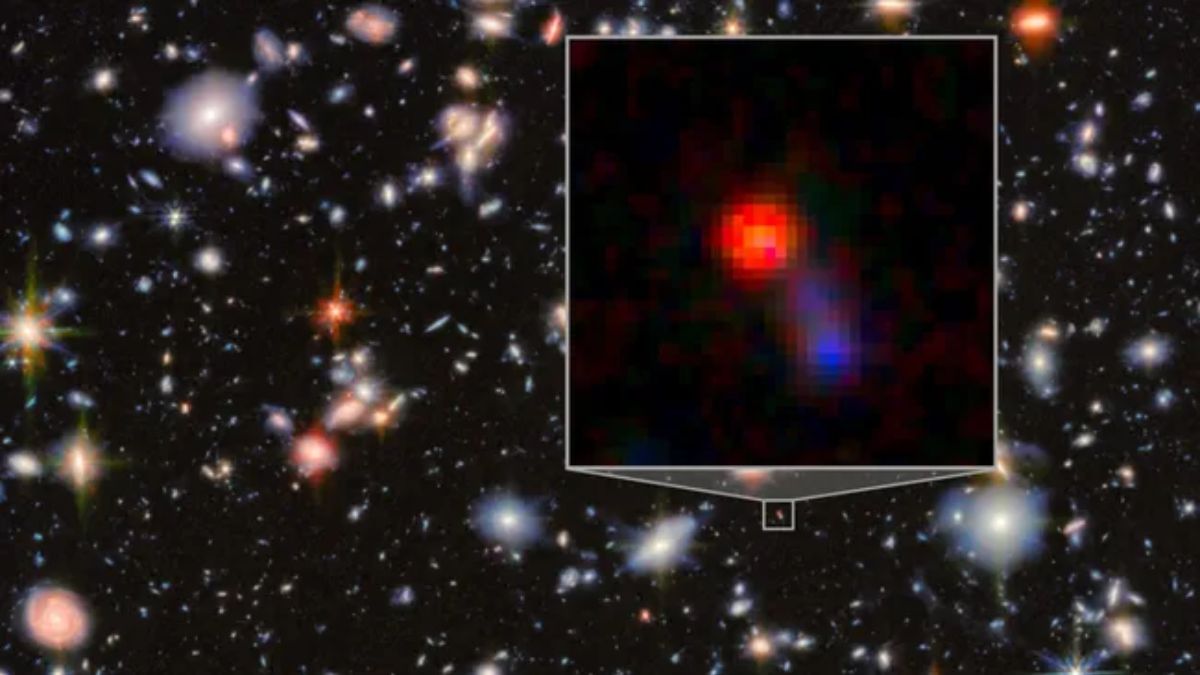
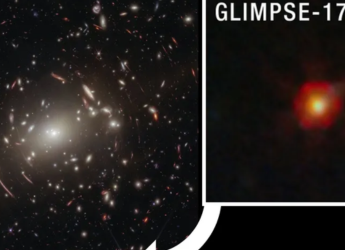
Photo Credit: ESA/Webb, NASA & CSA, G. Östlin, P. G. Perez-Gonzalez, J. Melinder, the JADES Collaboration, M. Zamani
Click Here to Add Gadgets360 As A Trusted Source


Advertisement
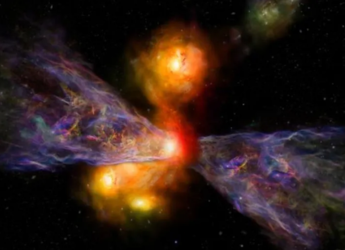
For decades, astronomers have studied galaxy formation, but the James Webb Space Telescope (JWST) has now revealed a galaxy with a dual personality, earning it the nickname “Jekyll and Hyde.” Known as Virgil, the galaxy shows a mild-mannered side, forming stars quietly, while its hidden core harbours a heavily obscured supermassive black hole that pours out immense energy. The black hole appears far too massive for its host galaxy, placing it in a rare category of “overmassive” black holes and challenging existing models of galaxy and black hole co-evolution.
Hidden Power of Early-Universe Black Hole
According to a NASA report, JWST's Mid-Infrared Instrument (MIRI) unveiled Virgil's monstrous side. “UV and optical observations show the ‘good' side, but MIRI data reveal the black hole's intense energy output,” said co-team leader George Rieke of the University of Arizona. The study suggests that many dust-obscured black holes could be hiding in galaxies once thought ordinary, waiting to be uncovered by infrared observations.
Virgil is a member of a class of early-universe galaxies known as Little Red Dots, which the JWST has detected in significant numbers appearing around 600 million years after the Big Bang.
JWST's MIRI Uncovers Hidden Galaxies
These galaxies largely disappear by two billion years, and Virgil may help identify their descendants. MIRI can peer beyond UV and visible light to show the universe as it's never been seen before, explained Pierluigi Rinaldi of the Space Telescope Science Institute.
The discovery of Virgil is an example of the mastery of the telescope to reveal previously invisible monsters in the cosmos and add clarity to our perceptions of the universe's early evolution.
Comments
Get your daily dose of tech news, reviews, and insights, in under 80 characters on Gadgets 360 Turbo. Connect with fellow tech lovers on our Forum. Follow us on X, Facebook, WhatsApp, Threads and Google News for instant updates. Catch all the action on our YouTube channel.
Related Stories
NASA James Webb Telescope Reveals ‘Jekyll and Hyde’ Star System Hiding a Supermassive Black Hole


Advertisement
Follow Us




-
04:37
[Sponsored]: CP PLUS CarKam CP-F89B: 4K Dashcam With Rear Camera, GPS & Emergency Recording -
04:23
[Partner Content] Your Phone Can Do WAY More Than You Think | OPPO ColorOS 16 -
01:59
Samsung Galaxy Z Fold8 Ultra: Unfold the Ultra Night -
03:24
Apple Pay Launches In India: Supported Devices, Cards And Payments Explained -
00:21
[Sponsored] Samsung Galaxy Z Fold8, Fold8 Ultra
-
Infinix लाया गजब का फोन, बिना सिम भी कर पाएंगे कॉल
-
Vivo S2 FE लॉन्च: 10000mAh बैटरी, 50 मेगापिक्सल कैमरा से लैस, जानें कीमत
-
Vivo X Fold 6 लॉन्च; 200MP कैमरा और 6900mAh बैटरी के साथ आया फोल्डेबल फोन
-
भारत में महंगे प्राइस पर लॉन्च हो सकता है iQOO 16
-
23K सस्ता मिलेगा Samsung Galaxy S25 5G, Flipkart Big Billion Days Sale में क्या है डील
Advertisement
Popular on Gadgets
- Samsung Galaxy S26 Ultra
- Motorola Razr Fold
- ChatGPT
- OPPO Find N6
- Mobiles Under Rs. 40,000
- Vivo X300 Ultra
- Asus Zenbook S14
- iQOO 15
- Vivo X300 Pro
- Lenovo Yoga Slim 7i Aura Edition
- iQOO 15R
- Vivo X Fold 5
- Sony PlayStation 5
- HP OmniPad 12
- OnePlus Nord CE 6 Lite
- OnePlus Pad 4
- OPPO F33 Pro 5G
- Cryptocurrency
- HP OmniBook Ultra 14 (2026)
- iPhone 17
- Eureka Forbes AP 355 Room Air Purifier
- Latest Mobile Phones
- Compare Phones
Latest Gadgets
- Infinix Smart 20 HD
- Vivo V80
- Vivo S2 FE
- Vivo Y600K Turbo
- Realme P4s Lite
- Vivo S60t
- OPPO F35 5G
- OPPO F35 Pro 5G
- Dell 14 Plus 2-in-1 (AMD Ryzen AI 7 350, 2025)
- Microsoft Surface Laptop, 13-inch (2nd Edition)
- Samsung Galaxy Tab S12+
- Samsung Galaxy Tab S12 Ultra
- Amazfit T-Rex Dual Solar
- OPPO Watch S2
- Toshiba 65-Inch 4K Ultra HD Smart Mini LED QLED TV (65Z670SP)
- Haier M70 Mini LED 65-inch
- Acer Predator Atlas 8
- Asus ROG Ally
- Blue Star 1.5 Ton 5 Star Inverter Split AC (IE518ZNURS)
- Blue Star 2 Ton 3 Star Inverter Window AC (WIE324L)

- About Us
- Sitemaps
- Feedback
- Archives
- Contact Us
- RSS
- Advertise
- Career
- Privacy Policy
- Ethics
- Editorial Policy
- Terms & Conditions
- Complaint Redressal
Download Our Apps
Available in Hindi
© Copyright Red Pixels Ventures Limited 2026. All rights reserved.