-
 James Webb Telescope Captures Rare Infrared Footprints of Io and Ganymede Inside Jupiter’s Auroras11 March 2026
 -
NASA’s Webb Telescope Confirms Asteroid 2024 YR4 Will Safely Pass the Moon in 20329 March 2026
-
NASA's James Webb Space Telescope Confirms Asteroid 2024 YR4 Will Not Strike the Moon6 March 2026
-
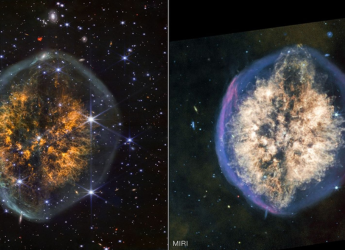
James Webb Telescope Captures Stunning Infrared View of Exposed Cranium Nebula26 February 2026
-
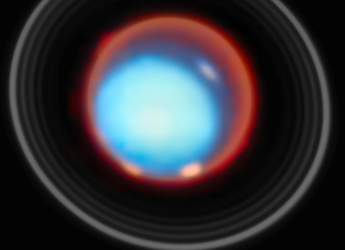
James Webb Telescope Maps Uranus in 3D for the First Time; Data Reveals Hidden Storms, Methane Clouds25 February 2026
- Home
- Science
- Science News
- James Webb Telescope Discovers Most Distant Galaxy From Just 300 Million Years After the Big Bang
James Webb Telescope Discovers Most Distant Galaxy From Just 300 Million Years After the Big Bang
NASA’s James Webb Space Telescope has identified JADES-GS-z14-0, the most distant galaxy ever observed. Seen just 300 million years after the Big Bang, its brightness and chemical complexity challenge current theories of early galaxy formation.
Updated: 5 February 2026 22:26 IST
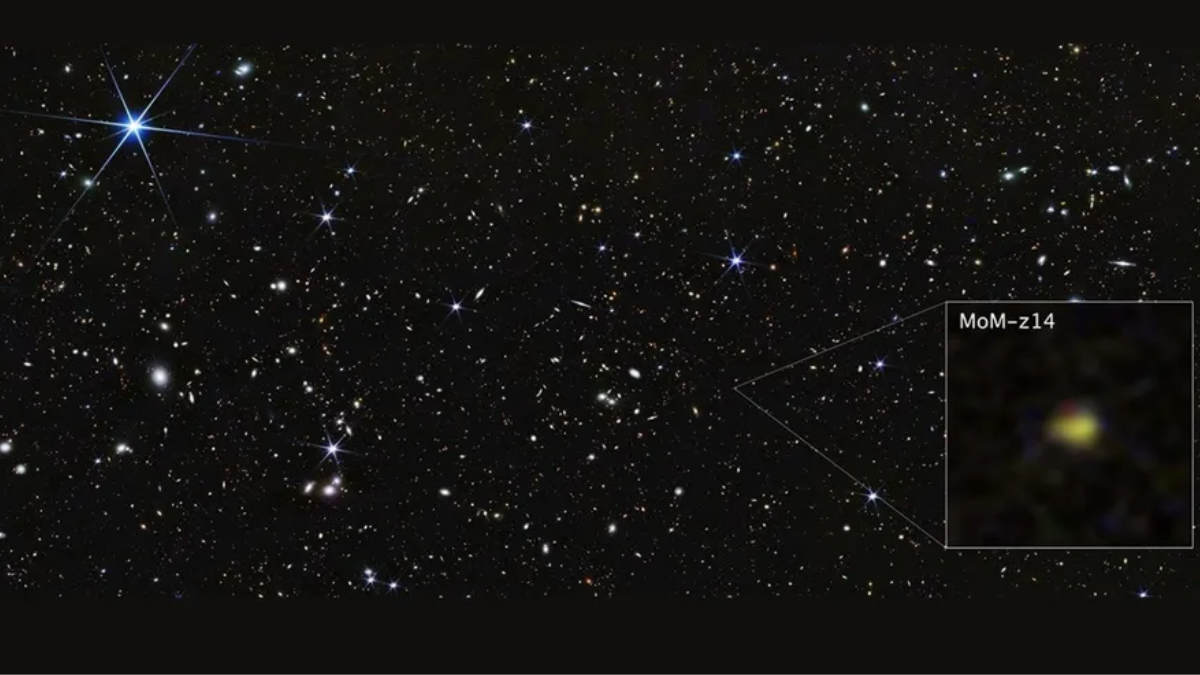
Photo Credit: NASA
JWST spotted most distant galaxy JADES-GS-z14-0, bright and chemically mature
Click Here to Add Gadgets360 As A Trusted Source

Advertisement
In May 2024, the James Webb Space Telescope (JWST), operated by NASA, discovered the most distant galaxy ever observed, named JADES-GS-z14-0, as part of its deep space survey called JADES. The light from this galaxy has taken approximately 13.5 billion years to reach us, so we are viewing it as it appeared about 300 million years after the Big Bang, during the “cosmic dawn” era when the first stars and galaxies were forming.
Discovery of JADES-GS-z14-0
According to NASA, the infrared camera (NIRCam) on the James Webb Space Telescope (JWST) took the image of JADES-GS-z14-0 in ultradeep exposures of a very small region of the sky. Follow-up spectroscopy (NIRSpec) determined a redshift of approximately 14.3, making it the most distant galaxy known at the time. This redshift indicates an age of approximately 300 million years and a distance of 13.5 billion light-years. This broke the record for cosmic distance by about 100 million years. The observation (announced in early 2024) demonstrated the capability of JWST to observe galaxies at distances further back in time than ever before.
A Surprisingly Bright, Mature Galaxy
Astronomers were surprised to see that JADES-GS-z14-0 was very bright and evolved for its time. Scientists describe it as “unexpectedly bright and chemically complex.” It holds about half a billion suns' worth of stars, which is indicative of very active star formation. What is particularly interesting is that the mid-infrared observations made by JWST revealed a strong oxygen signal, which indicated that several generations of stars had already lived and died. (Substances heavier than helium are known as “metals” in the field of astronomy. This indicates very active metal production.) Most theories had suggested that the first galaxies would be small, faint, and very metal-poor.
Comments
Get your daily dose of tech news, reviews, and insights, in under 80 characters on Gadgets 360 Turbo. Connect with fellow tech lovers on our Forum. Follow us on X, Facebook, WhatsApp, Threads and Google News for instant updates. Catch all the action on our YouTube channel.
Further reading:
James Webb Space Telescope, JWST, distant galaxies, NASA, eJADES survey, cosmic daw
Related Stories


James Webb Telescope Discovers Most Distant Galaxy From Just 300 Million Years After the Big Bang


Advertisement
Follow Us




-
05:05
Goboult Mustang Racer Smartwatch Review: Should You Get This Mustang Smartwatch? -
04:58
OnePlus Nord Buds 4 Pro Review: Specs, Sound Quality, ANC, and Battery Backup Tested -
02:29
[Sponsored] Samsung Galaxy S26 Ultra First Look: AI Smartphone for Creators, Gaming & Productivity -
04:25
Vivo X200T Review - Full Camera, Gaming & Battery Test | Worth Buying? -
28:31
The Future of Productivity: Logitech's Anatoliy Polyanker On AI, Hybrid Work, And India's Tech Boom
Advertisement
Popular on Gadgets
- Samsung Galaxy Unpacked 2026
- iPhone 17 Pro Max
- ChatGPT
- iOS 26
- Laptop Under 50000
- Smartwatch Under 10000
- Apple Vision Pro
- Oneplus 12
- OnePlus Nord CE 3 Lite 5G
- iPhone 13
- Xiaomi 14 Pro
- Oppo Find N3
- Tecno Spark Go (2023)
- Realme V30
- Best Phones Under 25000
- Samsung Galaxy S24 Series
- Cryptocurrency
- iQoo 12
- Samsung Galaxy S24 Ultra
- Giottus
- Samsung Galaxy Z Flip 5
- Apple 'Scary Fast'
- Housefull 5
- GoPro Hero 12 Black Review
- Invincible Season 2
- JioGlass
- HD Ready TV
- Latest Mobile Phones
- Compare Phones
Latest Gadgets
- Honor Play 80
- Nord 6
- Honor X80i
- Honor Play 80 Pro
- Redmi Note 15 SE 5G
- Redmi A7 Pro
- OPPO K15 Pro
- OPPO K15 Pro+
- Xiaomi Book Pro 14
- MacBook Neo
- Vivo Pad 6 Pro
- Lenovo Legion Y700 Gen 5
- boAt Valour Watch 1R
- Xiaomi Watch S5
- Xiaomi QLED TV X Pro 75
- Haier H5E Series
- Asus ROG Ally
- Nintendo Switch Lite
- Haier 1.6 Ton 5 Star Inverter Split AC (HSU19G-MZAID5BN-INV)
- Haier 1.6 Ton 5 Star Inverter Split AC (HSU19G-MZAIM5BN-INV)

- About Us
- Sitemaps
- Feedback
- Archives
- Contact Us
- RSS
- Advertise
- Career
- Privacy Policy
- Ethics
- Editorial Policy
- Terms & Conditions
- Complaint Redressal
Download Our Apps
Available in Hindi
© Copyright Red Pixels Ventures Limited 2026. All rights reserved.