-
 JWST Reveals Salt Clouds in the Atmosphere of the ‘Pink Planet’ GJ 504b21 June 2026
 -
JWST Watches HD 80606 bExoplanet Heat Up by 1,100 Degrees in Hours19 June 2026
-
Scientists May Have Solved the Missing Sulfur Mystery in Star-Forming Clouds16 June 2026
-
Astronomers Discover Why Massive Galaxies Died Early in the Universe13 June 2026
-
JWST Reveals the True Identity of Mysterious Little Red Dots11 June 2026
- Home
- Science
- Science News
- JWST Spots Most Distant Supernova Ever, From 730 Million Years After Big Bang
JWST Spots Most Distant Supernova Ever, From 730 Million Years After Big Bang
Astronomers have confirmed the most distant supernova yet, exploding just 730 million years after the Big Bang.
Written by Gadgets 360 Staff | Updated: 29 December 2025 23:30 IST
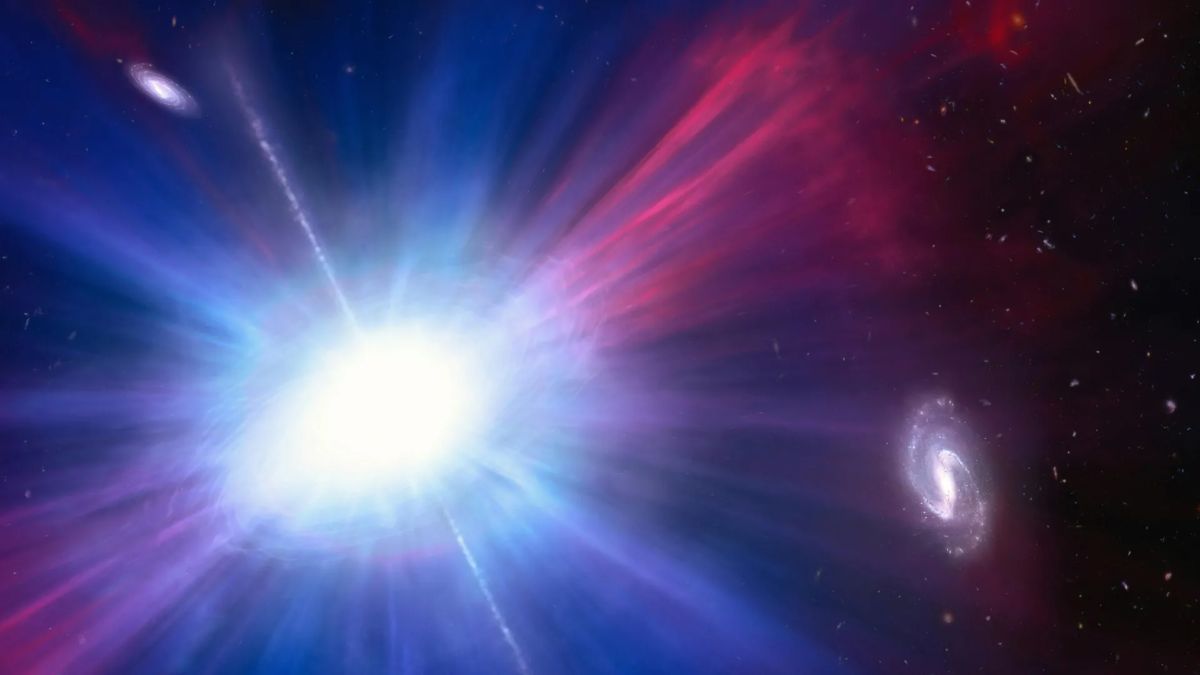
Photo Credit: NASA, ESA, NSF's NOIRLab, Mark Garlick, Mahdi Zamani
This is an artist's concept of one of brightest explosions ever seen in space.
Click Here to Add Gadgets360 As A Trusted Source


Advertisement
Scientists have detected a supernova, the explosive death of a star, from only 730 million years after the Big Bang, deep into the era of reionisation. This stellar explosion, catalogued as SN in GRB 250314A, was initially indicated by a high-energy gamma ray burst (GRB) in March 2025 and subsequently confirmed by the follow-up observations with the James Webb Space Telescope. The discovery provides a rare view of the first stars that died in the early universe.
Distant Supernova Discovered
According to the paper, astronomers used JWST and other telescopes to identify the explosion (SN in GRB 250314A). It was first flagged by a powerful gamma-ray burst on 14 March 2025, caught by the SVOM satellite, and its great distance confirmed by ESO's Very Large Telescope. About 110 days later, Webb's infrared camera separated the fading supernova from its dim host galaxy. These observations place the blast at just ~730 million years after the Big Bang, deep in the era of reionisation. This makes it the most distant supernova yet confirmed.
Unexpectedly Familiar Explosion
Subsequent analysis revealed the ancient explosion to be surprisingly ordinary. Its light and spectrum are very similar to those of a well-known local GRB supernova (SN 1998bw), thus an extremely bright super luminous event is ruled out. Basically, the first star to die in the universe appears to have been a star of the current generation. This is a surprise to those who expected the first stars to explode in an entirely different manner. Researchers emphasise that it is just one instance, and more observations with JWST are scheduled.
Comments
Get your daily dose of tech news, reviews, and insights, in under 80 characters on Gadgets 360 Turbo. Connect with fellow tech lovers on our Forum. Follow us on X, Facebook, WhatsApp, Threads and Google News for instant updates. Catch all the action on our YouTube channel.
Further reading:
James Webb Space Telescope, supernova discovery, early universe, Gamma Ray Bursts, cosmic reionisation, stellar evolution
Related Stories


Advertisement
Follow Us




-
00:21
[Sponsored] Samsung Galaxy Z Fold8, Fold8 Ultra -
03:41
[Sponsored] Samsung Galaxy Z Fold8: How It Fits Into an Actor’s Busy Day | Camera, Multitasking & More -
09:53
iPhone 18 Goes On Sale In India: Huge Crowds, Long Queues At Apple Stores -
06:32
Google Pixel 11 Pro XL Review: The Most Exciting Pixel Yet? | 120X Zoom + Tensor G6 -
05:20
Samsung Galaxy Watch Ultra 2 Review: Is This the Best Android Smartwatch?
Advertisement
Popular on Gadgets
- Samsung Galaxy S26 Ultra
- Motorola Razr Fold
- ChatGPT
- OPPO Find N6
- Mobiles Under Rs. 40,000
- Vivo X300 Ultra
- Asus Zenbook S14
- iQOO 15
- Vivo X300 Pro
- Lenovo Yoga Slim 7i Aura Edition
- iQOO 15R
- Vivo X Fold 5
- Sony PlayStation 5
- HP OmniPad 12
- OnePlus Nord CE 6 Lite
- OnePlus Pad 4
- OPPO F33 Pro 5G
- Cryptocurrency
- HP OmniBook Ultra 14 (2026)
- iPhone 17
- Eureka Forbes AP 355 Room Air Purifier
- Latest Mobile Phones
- Compare Phones
Latest Gadgets
- OPPO Reno 16t
- Itel Zeno 300
- Vivo Y600i
- Mivi One 5G
- Xiaomi 18 Pro Max
- Motorola Signature 27
- OPPO Find X10 E
- OnePlus N6 Lite 4G
- Microsoft Surface Laptop, 13-inch (2nd Edition)
- Lenovo LOQ 15AHP11
- Microsoft Surface Pro, 12-inch (2nd Edition)
- Xiaomi Pad 9 Pro
- Amazfit T-Rex Dual Solar
- OPPO Watch S2
- Toshiba 65-Inch 4K Ultra HD Smart Mini LED QLED TV (65Z670SP)
- Haier M70 Mini LED 65-inch
- Acer Predator Atlas 8
- Asus ROG Ally
- Blue Star 1.5 Ton 5 Star Inverter Split AC (IE518ZNURS)
- Blue Star 2 Ton 3 Star Inverter Window AC (WIE324L)

- About Us
- Sitemaps
- Feedback
- Archives
- Contact Us
- RSS
- Advertise
- Career
- Privacy Policy
- Ethics
- Editorial Policy
- Terms & Conditions
- Complaint Redressal
Download Our Apps
Available in Hindi
© Copyright Red Pixels Ventures Limited 2026. All rights reserved.