-
 Artemis 2: Astronauts Aboard Orion Spacecraft Begin Journey Towards the Moon on Day 23 April 2026
 -
iPhones in Deep Space: NASA Breaks Rules for Artemis 2 Crew; 5 Key Facts2 April 2026
-
Artemis II Launched: NASA’s First Crewed Mission in 50 Years Aims for the Moon2 April 2026
-
Artemis 2: NASA's Astronaut Moon Mission Explained in Five Points1 April 2026
-
Hubble Telescope Captures Comet Reversing Its Rotation for the First Time27 March 2026
- Home
- Science
- Science News
- NASA Tests New Wing Design That Could Transform Airliner Efficiency
NASA Tests New Wing Design That Could Transform Airliner Efficiency
NASA has tested a scaled laminar-flow wing design beneath an F-15B aircraft, showing promise for reducing aerodynamic drag by up to 10%. The technology could significantly cut fuel use and emissions for future commercial airliners.
Written by Gadgets 360 Staff | Updated: 23 January 2026 23:30 IST
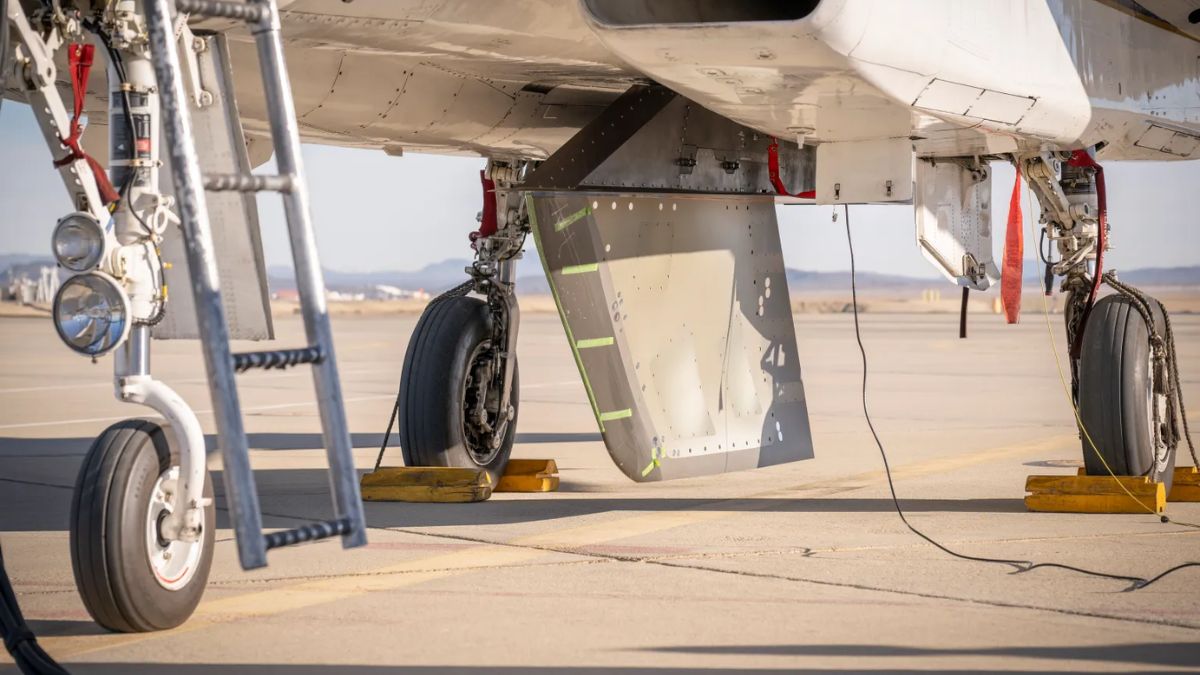
Photo Credit: NASA/Christopher LC Clark
NASA tests laminar-flow wing on F-15B, potentially cutting drag, fuel use 10%
Click Here to Add Gadgets360 As A Trusted Source


Advertisement
NASA scientists have been working on a new wing design at the Armstrong Flight Research Center in California. They tested a 3-foot (about 1 meter) scale model of the CATNLF wing, which was mounted under a NASA-F15B aircraft. During the high-speed taxi test, the plane reached about 144 mph (230 kilometers per hour). So far, the initial results from NASA indicate that this design could reduce drag by 10 percent for commercial airliners.
Laminar-flow wing design trialled
According to NASA, in January 2026, the 3-foot CATNLF model, slung underneath an F-15B research aircraft, achieved approximately 144 mph on the runway. The configuration enables engineers to test the concept in actual airflow conditions without installing a full-scale wing. The aim of the CATNLF device is to keep airflow over the wing's surface laminar-smooth-for as long as possible, thereby delaying the onset of turbulence, which increases drag. Keeping the boundary layer air smooth longer means the design reduces friction on the wing and, correspondingly, cuts fuel burn.
Potential fuel savings
A study conducted by NASA revealed that the installation of the CATNLF in a significant aircraft, the Boeing 777, for example, would help trim fuel consumption by a total of 10 percent per annum. Not surprisingly, a few percent improvement in fuel efficiency translates into significant savings of millions of dollars per aircraft per year for the airlines. NASA claims that the real flight tests will begin shortly. When successful, the technology may be adapted in a wide range of aircraft, perhaps even supersonic aircraft.
Comments
Get your daily dose of tech news, reviews, and insights, in under 80 characters on Gadgets 360 Turbo. Connect with fellow tech lovers on our Forum. Follow us on X, Facebook, WhatsApp, Threads and Google News for instant updates. Catch all the action on our YouTube channel.
Further reading:
NASA, aviation research, laminar flow, aircraft efficiency, fuel savings, Armstrong Flight Research Center, aerospace engineering, F-15B
Related Stories






Advertisement
Follow Us




-
05:05
Goboult Mustang Racer Smartwatch Review: Should You Get This Mustang Smartwatch? -
04:58
OnePlus Nord Buds 4 Pro Review: Specs, Sound Quality, ANC, and Battery Backup Tested -
02:29
[Sponsored] Samsung Galaxy S26 Ultra First Look: AI Smartphone for Creators, Gaming & Productivity -
04:25
Vivo X200T Review - Full Camera, Gaming & Battery Test | Worth Buying? -
28:31
The Future of Productivity: Logitech's Anatoliy Polyanker On AI, Hybrid Work, And India's Tech Boom
Advertisement
Popular on Gadgets
- Samsung Galaxy Unpacked 2026
- iPhone 17 Pro Max
- ChatGPT
- iOS 26
- Laptop Under 50000
- Smartwatch Under 10000
- Apple Vision Pro
- Oneplus 12
- OnePlus Nord CE 3 Lite 5G
- iPhone 13
- Xiaomi 14 Pro
- Oppo Find N3
- Tecno Spark Go (2023)
- Realme V30
- Best Phones Under 25000
- Samsung Galaxy S24 Series
- Cryptocurrency
- iQoo 12
- Samsung Galaxy S24 Ultra
- Giottus
- Samsung Galaxy Z Flip 5
- Apple 'Scary Fast'
- Housefull 5
- GoPro Hero 12 Black Review
- Invincible Season 2
- JioGlass
- HD Ready TV
- Latest Mobile Phones
- Compare Phones
Latest Gadgets
- Honor Play 80
- Nord 6
- Honor X80i
- Honor Play 80 Pro
- Redmi Note 15 SE 5G
- Redmi A7 Pro
- OPPO K15 Pro
- OPPO K15 Pro+
- Xiaomi Book Pro 14
- MacBook Neo
- Vivo Pad 6 Pro
- Lenovo Legion Y700 Gen 5
- boAt Valour Watch 1R
- Xiaomi Watch S5
- Xiaomi QLED TV X Pro 75
- Haier H5E Series
- Asus ROG Ally
- Nintendo Switch Lite
- Haier 1.6 Ton 5 Star Inverter Split AC (HSU19G-MZAID5BN-INV)
- Haier 1.6 Ton 5 Star Inverter Split AC (HSU19G-MZAIM5BN-INV)

- About Us
- Sitemaps
- Feedback
- Archives
- Contact Us
- RSS
- Advertise
- Career
- Privacy Policy
- Ethics
- Editorial Policy
- Terms & Conditions
- Complaint Redressal
Download Our Apps
Available in Hindi
© Copyright Red Pixels Ventures Limited 2026. All rights reserved.