

-
 Total Solar Eclipse Today: How to Watch Live Online, Timings, Safety Tips, and More12 August 2026
 -
JWST Watches HD 80606 bExoplanet Heat Up by 1,100 Degrees in Hours19 June 2026
-
Chandra Captures Sharpest-Ever X-Ray View of M87 Black Hole Jet18 June 2026
-
Astrophotographer Captures Giant Human-Shaped Solar Prominence8 June 2026
-
Blue Origin’s New Glenn Rocket Explodes During Pre-Launch Test in Florida29 May 2026
- Home
- Science
- Science News
- NASA Tests New Wing Design That Could Transform Airliner Efficiency
NASA Tests New Wing Design That Could Transform Airliner Efficiency
NASA has tested a scaled laminar-flow wing design beneath an F-15B aircraft, showing promise for reducing aerodynamic drag by up to 10%. The technology could significantly cut fuel use and emissions for future commercial airliners.
Written by Gadgets 360 Staff | Updated: 23 January 2026 23:30 IST
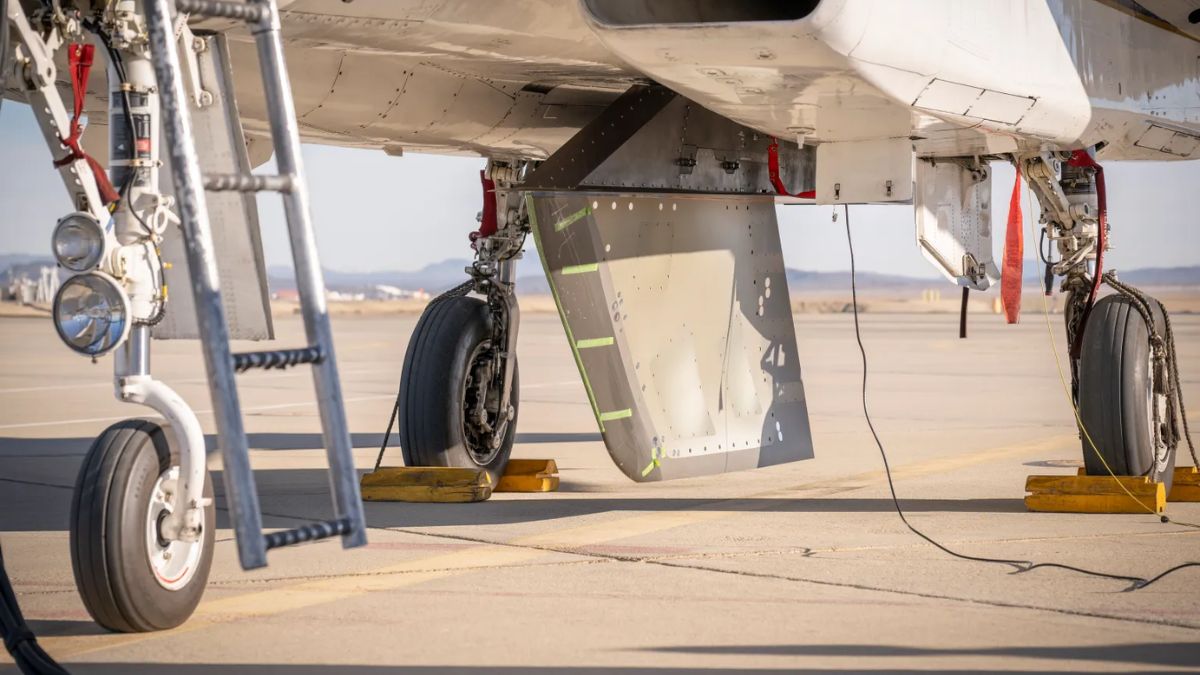
Photo Credit: NASA/Christopher LC Clark
NASA tests laminar-flow wing on F-15B, potentially cutting drag, fuel use 10%
Click Here to Add Gadgets360 As A Trusted Source


Advertisement
NASA scientists have been working on a new wing design at the Armstrong Flight Research Center in California. They tested a 3-foot (about 1 meter) scale model of the CATNLF wing, which was mounted under a NASA-F15B aircraft. During the high-speed taxi test, the plane reached about 144 mph (230 kilometers per hour). So far, the initial results from NASA indicate that this design could reduce drag by 10 percent for commercial airliners.
Laminar-flow wing design trialled
According to NASA, in January 2026, the 3-foot CATNLF model, slung underneath an F-15B research aircraft, achieved approximately 144 mph on the runway. The configuration enables engineers to test the concept in actual airflow conditions without installing a full-scale wing. The aim of the CATNLF device is to keep airflow over the wing's surface laminar-smooth-for as long as possible, thereby delaying the onset of turbulence, which increases drag. Keeping the boundary layer air smooth longer means the design reduces friction on the wing and, correspondingly, cuts fuel burn.
Potential fuel savings
A study conducted by NASA revealed that the installation of the CATNLF in a significant aircraft, the Boeing 777, for example, would help trim fuel consumption by a total of 10 percent per annum. Not surprisingly, a few percent improvement in fuel efficiency translates into significant savings of millions of dollars per aircraft per year for the airlines. NASA claims that the real flight tests will begin shortly. When successful, the technology may be adapted in a wide range of aircraft, perhaps even supersonic aircraft.
Comments
Get your daily dose of tech news, reviews, and insights, in under 80 characters on Gadgets 360 Turbo. Connect with fellow tech lovers on our Forum. Follow us on X, Facebook, WhatsApp, Threads and Google News for instant updates. Catch all the action on our YouTube channel.
Further reading:
NASA, aviation research, laminar flow, aircraft efficiency, fuel savings, Armstrong Flight Research Center, aerospace engineering, F-15B
Related Stories







Advertisement
Follow Us




-
01:42
[Sponsored] Galaxy Watch9 for Everyday Health Insights | Smarter Wellness Choices -
01:15
[Sponsored] Galaxy Tab S10 Lite for Students: Notes, Solve Math and More -
04:17
[Sponsored] LG NANO 4K UHD AI TV NU885: Gemini Search, Dolby Atmos & 5 Years of Updates -
00:57
[Sponsored] Samsung Galaxy Z Fold8 My Fan Cam in Action: Find the Moment, Then Share It -
01:41
[Sponsored] What Do You Need To Know Before Your Next Run? | Samsung Galaxy Watch Ultra2
-
NVIDIA के सीईओ ने पेश किए माइक्रोडक रोबोट, AI से चलते हैं, क्या काम आएंगे
-
iPhone Duo को बीच से खोला, फोल्डेबल डिस्प्ले से हटाया कवर, फिर क्या दिखा?
-
1 जनवरी से फोन में बिना सिम नहीं चलेगा WhatsApp, सिम बाइडिंग हुआ अनिवार्य
-
Amazon Sale में ₹6300 सस्ता खरीदें Vivo V80 5G, 50MP तीन कैमरा वाला फोन
-
Redmi K100 में होगी 16GB रैम, Snapdragon 8 Elite चिप! 27 अक्टूबर को है लॉन्च
Advertisement
Popular on Gadgets
- Samsung Galaxy S26 Ultra
- Motorola Razr Fold
- ChatGPT
- OPPO Find N6
- Mobiles Under Rs. 40,000
- Vivo X300 Ultra
- Asus Zenbook S14
- iQOO 15
- Vivo X300 Pro
- Lenovo Yoga Slim 7i Aura Edition
- iQOO 15R
- Vivo X Fold 5
- Sony PlayStation 5
- HP OmniPad 12
- OnePlus Nord CE 6 Lite
- OnePlus Pad 4
- OPPO F33 Pro 5G
- Cryptocurrency
- HP OmniBook Ultra 14 (2026)
- iPhone 17
- Eureka Forbes AP 355 Room Air Purifier
- Latest Mobile Phones
- Compare Phones
Latest Gadgets
- HMD 2660 Flip Senior Edition
- Lava Aura Curve
- Poco X8s
- Samsung Galaxy F70 5G
- Tecno Spark 50S 5G
- Vivo Y600s Pro
- Vivo Y32 (2026)
- Infinix Smart 20 HD
- Lenovo Yoga 9n 2-in-1
- Lenovo Yoga Pro 9n
- Amazon Alexa Tablet 8
- Amazon Alexa Tablet 11
- Pebble Qore 2
- Amazfit T-Rex Dual Solar
- Toshiba 65-Inch 4K Ultra HD Smart Mini LED QLED TV (65Z670SP)
- Haier M70 Mini LED 65-inch
- Acer Predator Atlas 8
- Asus ROG Ally
- Blue Star 1.5 Ton 5 Star Inverter Split AC (IE518ZNURS)
- Blue Star 2 Ton 3 Star Inverter Window AC (WIE324L)

- About Us
- Sitemaps
- Feedback
- Archives
- Contact Us
- RSS
- Advertise
- Career
- Privacy Policy
- Ethics
- Editorial Policy
- Terms & Conditions
- Complaint Redressal
Download Our Apps
Available in Hindi
© Copyright Red Pixels Ventures Limited 2026. All rights reserved.